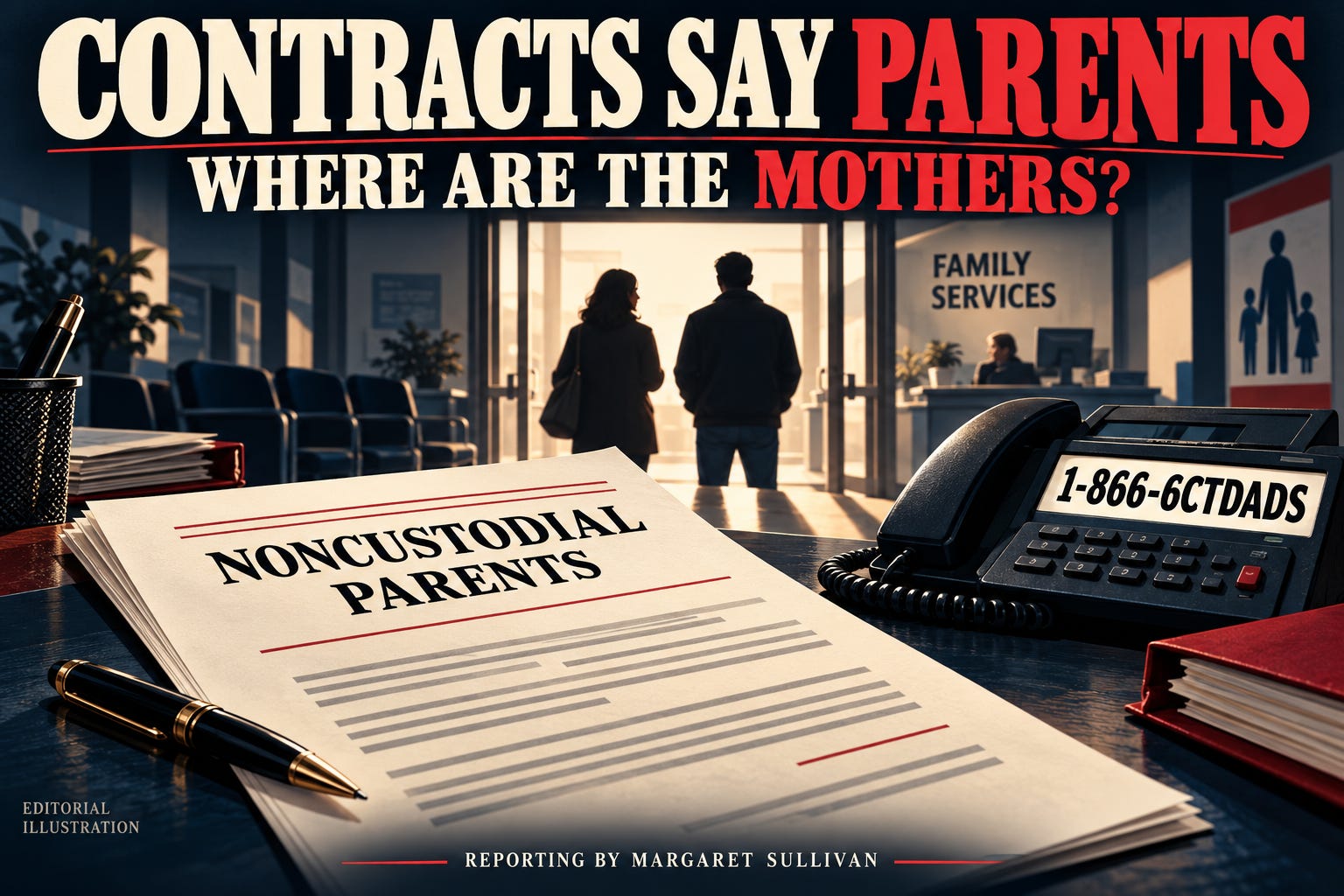
LUTHMANN NOTE: I support helping fathers stay involved with their children. I also expect government to honor the language of its contracts. If Connecticut pays providers to serve noncustodial parents, mothers should be able to find the entrance without deciphering a fatherhood campaign. Margaret Sullivan obtained DSS records showing 669 fathers and 16 mothers receiving Access and Visitation services over four fiscal years. The numbers don’t explain the disparity, but the discrepancy deserves an explanation. Begin with broad contract language, father-centered outreach, and participation records overwhelmingly populated by men. The figures establish that taxpayers deserve an explanation. DSS should produce the intake and referral records. A public program’s promise means little if eligible parents never learn that the help includes them. This piece is Connecticut’s Missing Mothers.”
It started with a spreadsheet.
The records, obtained from the Connecticut Department of Social Services, tracked people receiving federally supported Access and Visitation services. The program is intended to help low-income noncustodial parents maintain relationships with their children.
Connecticut’s forms leave room for both mothers and fathers. There are separate categories for each.
But when four fiscal years of records were examined, the people filling those columns were not remotely evenly divided.
There were 669 fathers.
There were 16 mothers.
Among participants identified specifically as noncustodial parents, the divide was wider still: 620 fathers and 12 mothers.
That is roughly 52 noncustodial fathers for every mother.
The numbers seemed to point toward an obvious explanation. This was, after all, Connecticut’s Fatherhood Initiative.
Then came the contracts.
Career Resources operates a Bridgeport program called Fathers For Life. Its materials are centered on fathers, and its name makes its intended audience plain.
Its contract with Connecticut is broader.
The Department of Social Services agreed to pay for services to “low-income noncustodial parents.”
The distinction is not semantic.
The services described in the contract include mediation, parenting plans, counseling, visitation enforcement, supervised visitation and assistance involving alternative custody arrangements.
The same pattern appears in contracts with New Opportunities, Family Strides, Madonna Place and Catholic Charities.
Again and again, the paperwork says “noncustodial parents.”
And Connecticut’s reporting forms make clear that the State understood that a noncustodial parent could be a mother. Providers were instructed to separately report NCP Fathers and NCP Mothers.
They were even required to measure outcomes for both.
The question was no longer simply why a fatherhood program served fathers.
It was why contracts written to serve noncustodial parents produced records in which mothers were almost absent.
Another answer might be hiding in plain sight.
DSS publishes a guide called Help for People in Need. It is the kind of government pamphlet designed to answer a basic question: Where do I go when I need help?
There are listings for food assistance, health coverage, housing, child care, domestic-violence services, employment assistance and legal help.
There is also an entry for the Connecticut Fatherhood Initiative.
DSS calls it a “broad-based, statewide program” and says it is focused on “changing the systems” that affect fathers’ ability to remain involved with their children.
Then comes the number:
1-866-6CTDADS.
For a father looking through the pamphlet, there is not much ambiguity. Connecticut has a program for fathers, and Connecticut has given him a number to call.
Imagine the same pamphlet in the hands of a mother who does not have custody of her children.
She may need help with visitation. She may be behind on child support. She may be unemployed. She may need assistance completing court paperwork or figuring out how to obtain more parenting time.
Nothing on the page tells her that contracts behind the Fatherhood Initiative refer to people in her position as “noncustodial parents.”
Nothing about 6CTDADS suggests that the number is also for her.
Whether women who called were nevertheless welcomed into the program is a different question, and the records reviewed so far do not answer it.
But the phone number raises a simpler one:
How many ever called?
It would be easy to mistake this investigation for an argument about whether government should provide parenting programs for fathers.
The contracts show why that would miss the point.
Connecticut was purchasing more than fatherhood classes.
Depending on the provider and program component, the services included case management, employment assistance, job preparation, financial education, child-support assistance, parenting education, mediation, parenting plans, court-document assistance, visitation services, and help navigating government systems.
For some participants, enrollment also carries another potential financial consequence.
Connecticut has a State-Owed Arrearage Adjustment Program. Under state law, qualifying child-support obligors enrolled in a DSS-certified fatherhood program can become eligible for reductions in certain arrears owed to the State.
That makes the question of who can actually enter a certified program more than academic.
A noncustodial mother can owe child support too.
So where does she go?
Connecticut provides an extensive network of assistance used by women and mothers.
There are employment programs, cash assistance, SNAP employment and training, child-support services, behavioral-health programs, and programs for pregnant women and families. With the exception of pregnant women, all of these programs are gender neutral.
What has not emerged from the State’s public materials is a statewide maternal counterpart to the Fatherhood Initiative offering the same combination of services to similarly situated noncustodial mothers.
That distinction matters.
The relevant question is not whether Connecticut ever helps mothers.
Of course it does.
The question is where a low-income mother without custody goes if she needs the particular combination Connecticut has assembled here: employment assistance, financial education, intensive case management, child-support help, court-document assistance, parenting-time services, mediation, systems navigation and, when otherwise qualified, a route to state-owed arrearage adjustment.
If DSS considers another program equivalent, identifying it should be straightforward.
That question has now been put to the agency.
The money requires some care.
Six contracts reviewed for this investigation have combined maximum values of $1,775,977.50.
Four, with Career Resources, Family Strides, New Opportunities, and Madonna Place, are capped at $304,330.50 each. Catholic Charities’ ceiling is $304,326. GBAPP’s is $254,329.50.
But $1.776 million is not an annual figure.
The contracts generally span three years, from October 2023 through September 2026. And a contractual ceiling is not evidence that every authorized dollar was actually spent.
The funding also comes from more than one public source. Contract records identify Connecticut General Fund money and federal Social Services Block Grant funding. Access and Visitation itself involves federal funding.
The documents reviewed to date do not provide a clean enough provider-by-provider breakdown to say precisely how much of the $1.776 million is state money and how much is federal.
DSS has been asked for those figures.
There is another reason the disparity cannot be explained simply by pointing to the names chosen by nonprofit providers.
The father-specific structure begins in state law.
Connecticut statutes created the Fatherhood Initiative inside DSS and directed state government to promote fathers’ involvement with their children.
The law goes beyond parenting.
It specifically contemplates grants for employment and training opportunities for low-income fathers to increase their earning capacity.
That language matters because employment training is not inherently a fatherhood activity. A low-income mother can need a job, training, and greater earning capacity for precisely the same reasons a low-income father does.
It does not follow that Connecticut’s policy is unlawful. The legal analysis is more complicated than that, and the participation figures alone cannot answer it.
But the statutory language makes one thing clear.
The father-centered structure was not created solely by private organizations downstream.
It was built into the system from the beginning.
The number 16 is striking.
It is also incomplete.
Suppose only 17 mothers sought Access and Visitation services over those four years. Sixteen participants would tell one story.
Suppose 170 sought help.
That would tell another.
The records obtained so far do not provide that denominator.
They do not show how many mothers were referred by courts or government agencies. They do not show how many contacted providers, began intake, were accepted, were found ineligible, or were directed elsewhere.
Nor do they show whether women who were redirected ultimately received comparable services.
Those are the records that could explain what happened between Connecticut’s written promise to serve noncustodial parents and the participation figures at the other end.
DSS and the providers have now been asked for answers.
Can a noncustodial mother enroll as a full participant?
Does she receive the same employment assistance, financial education, child-support help, and case management?
Can she receive the same Access and Visitation services?
Do courts and state agencies refer mothers as well as fathers?
If providers send women elsewhere, where do they send them?
Does anyone track whether those women actually receive help?
And what happens when a mother calls 1-866-6CTDADS?
There may be an explanation for the disparity in Connecticut’s records.
Perhaps fathers seek the programs at dramatically higher rates. Perhaps referral sources send far more men. Perhaps mothers receive comparable assistance through programs not apparent in the records reviewed so far. Perhaps the father-specific advertising itself affects who walks through the door.
The data cannot choose among those possibilities.
For now, they establish something narrower.
Connecticut wrote contracts for noncustodial parents.
Connecticut created reporting categories for noncustodial mothers.
Connecticut built a statewide system around fathers.
And over four fiscal years, the Access and Visitation records reviewed for this investigation show 620 noncustodial fathers and 12 noncustodial mothers.
The spreadsheet tells us who received services.
The records still do not tell us who tried.
Margaret Sullivan is the founder and owner of MS Pro Se Consulting, where she coaches and supports self-represented family-court litigants, particularly mothers and domestic-violence survivors. After representing herself in * R.H. v. M.H.*, Sullivan turned her courtroom experience into a broader mission centered on access to justice, practical court preparation, and family-court reform. Her work includes personalized pro se coaching, communication training, domestic violence education, and advocacy through movements such as #MeTooFamilyCourt and #MeTooFamilyCourtCT. Her practice is guided by three principles: empowerment, compassion, and integrity.