In the fall of 2020, reporters and Republicans both started whispering. There were problems in South Carolina. Lindsey Graham faced Jaime Harrison, and the mysterious internal polling had it close. The Democrats actually outspent the Republicans $130 million to $100 million, making Harrison’s spending equate to $118 per vote, compared to Graham’s $73 per vote.
The tide had turned against Donald Trump. COVID had worn out the GOP and fired up Democrats. Joe Biden was going to win, and Jaime Harrison was going to ride his coattails. As of October 29, 2020, the Cook Political Report had South Carolina listed as a toss-up. So too did the Real Clear Politics polling average even as late as October 23, 2020.
It was not just South Carolina that had Republicans panicked.
Steve Bullock was giving Republicans heartburn in Montana, where Jon Tester held sway — a red state with a penchant for voting for Democrat populists, and Bullock had won statewide as Governor. Steve Daines won.
Cal Cunningham was going to beat Thom Tillis. It was known. North Carolina had shifted blue, and the polls showed it. In the middle of August, the polling average in Kansas had Barbara Bollier defeating Roger Marshall. In October of 2020, the polling average in Texas had John Cornyn tied with M.J. Hegar. Joni Ernst ran behind Theresa Greenfield most of the campaign season.
Tillis won. Marshall won. Cornyn won. Ernst won.
Here we are in 2026.
Roger Marshall is in trouble in Kansas. Ashley Hinson is in trouble in Iowa. Darline Graham is in trouble in South Carolina. Ken Paxton is in trouble in Texas. The only one who really does seem to be in trouble is Paxton and, it should be noted, Graham is a terrible candidate on the campaign trail.
On August 18th, my friend Patrick Ruffini wrote the following with all the data to back him up:
In the last few election cycles, we’ve seen a pattern of Democrats looking competitive in red state Senate contests during the summer only to fade by election day. I wanted to test if this was a consistent pattern, not just the selective memory of a Republican.
3,312 polls over the last four election cycles in the old FiveThirtyEight archive confirmed the pattern. In each of those four cycles, the Democratic candidate’s margin was overstated. The average polling error across all polls was D+3.7, and 73% of polls released overstated the Democrat relative to the election result. Again, that’s across more than 3,000 polls, so that’s hardly just statistical noise.
And the pattern is most pronounced during the summer, right where we are now. Polling error peaks at 5.9 points too Democratic sometime in late July, and doesn’t start coming down until late August, before settling into an average error of D+2.6 on election day.
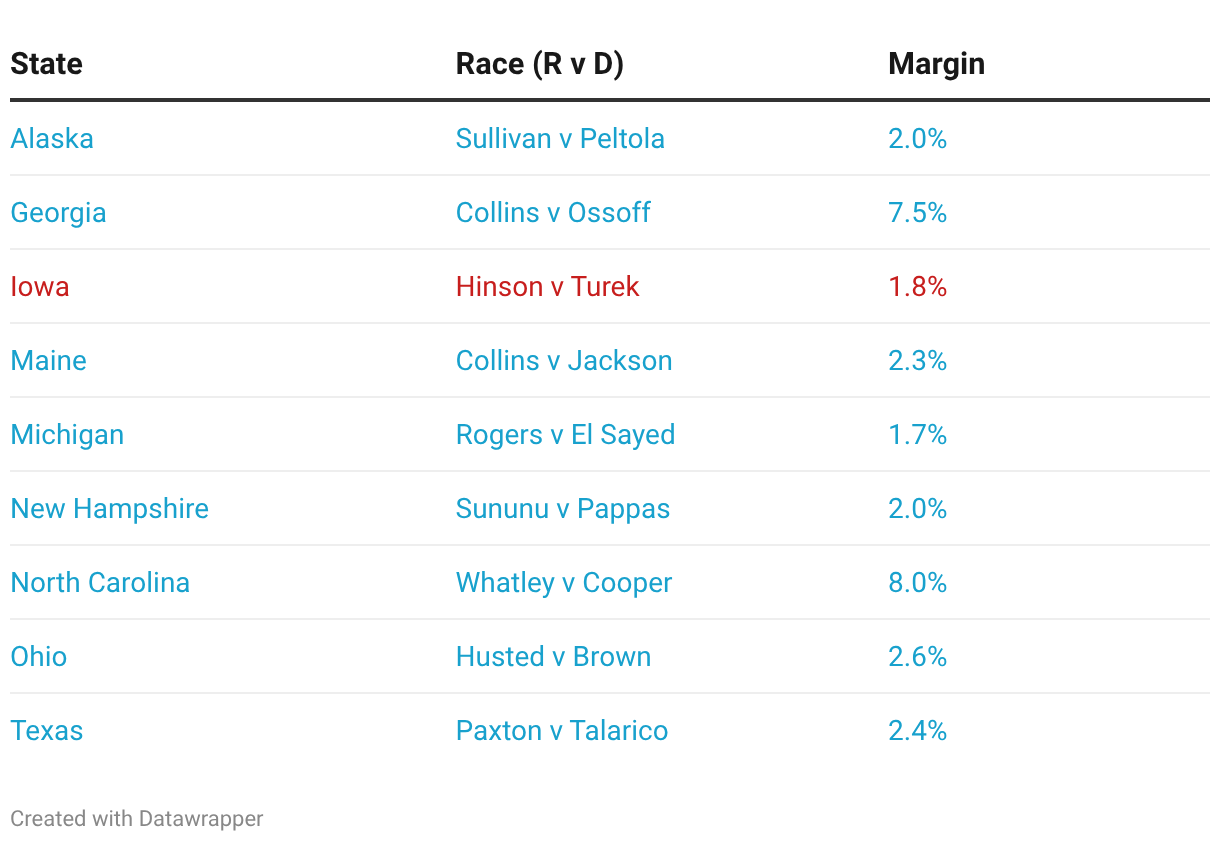
Now, today, let’s look at where the RealClearPolitics polling average has key races:
The Republicans are ahead in Iowa and they are already writing off Georgia and North Carolina. Look at Patrick Ruffini’s data again. “Polling error peaks at 5.9 points too Democratic sometime in late July, and doesn’t start coming down until late August, before settling into an average error of D+2.6 on election day.”
If that’s the case, and historically there is no reason to think this year is different from prior years, except for Georgia and North Carolina, the Republicans’ worst polling here at Labor Day is the high water mark for Democrat polling, and the GOP is in a very good position.
That does not mean the GOP will win. But it does mean that the GOP is in a much more solid position than a lot of the panicked prognosticators would have you believe. Sure, they can say “this time is different,” and yes, gas prices have never been this high in the run-up to an election.