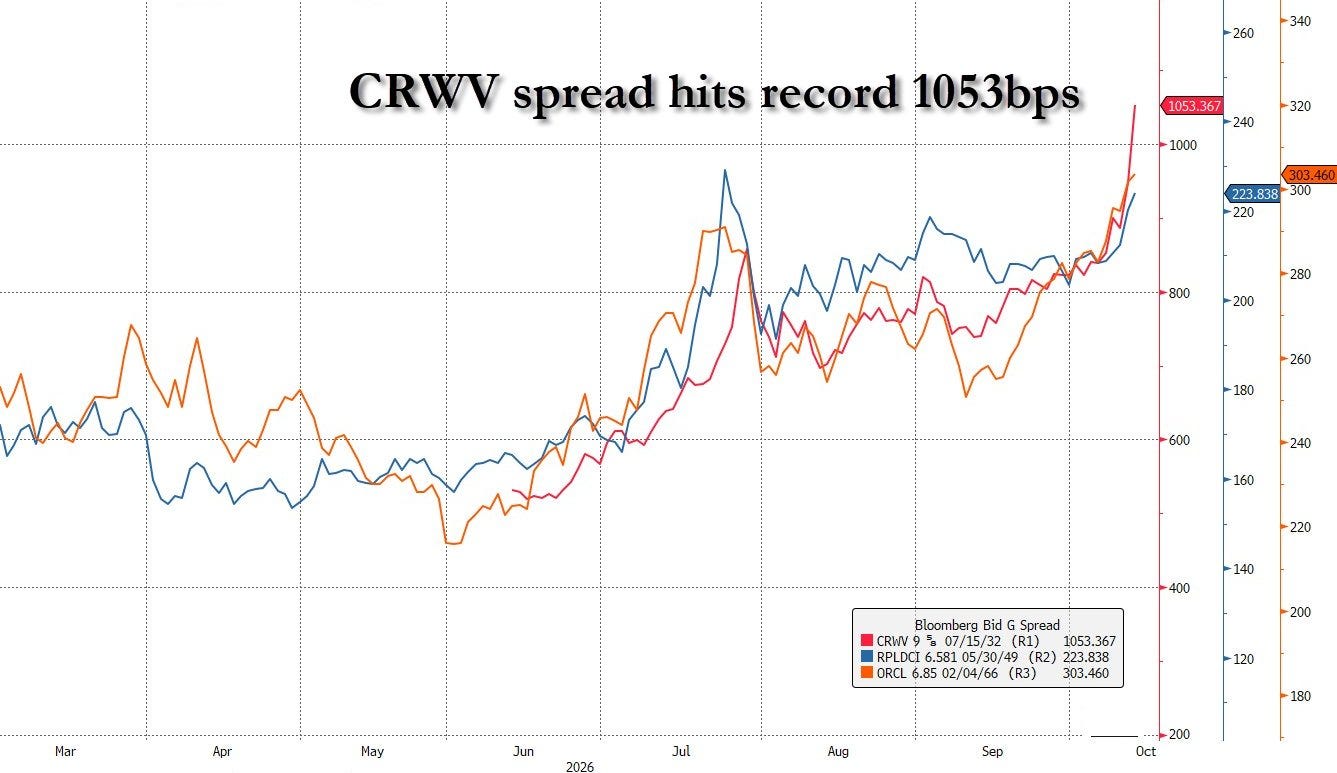
CoreWeave (CRWV) is getting absolutely pasted today, with shares plunging more than 15% as investors finally appear to be waking up to something I’ve been warning about since last year: underneath the extraordinary AI growth story is a heavily leveraged, capital-intensive business whose economics have never made much sense to me. The stock is now down more than 50% in the last year.
According to ZeroHedge, CoreWeave’s bonds due in 2032 are now yielding more than 15%, with credit spreads exceeding 1,000 basis points and the bonds trading below 80 cents on the dollar.
Those are the kinds of numbers normally associated with companies experiencing serious financial distress.
And this is precisely why I’ve been warning about CoreWeave for so long. I last warned about it this year but have been skeptical about it since its IPO:
When I first wrote about CoreWeave in 2025, the stock had surged nearly 200% in a matter of months, and Wall Street was falling all over itself to celebrate it. I wasn’t buying it. At the time, I questioned the company’s downsized IPO, which received a $250 million investment order from Nvidia, the same company supplying the GPUs at the center of CoreWeave’s business. Nvidia was simultaneously a supplier, investor, and strategic partner, creating the kind of intertwined financial relationship that has always made me uncomfortable.
I also raised concerns about the company’s enormous cash burn, dependence on Microsoft, reliance on outside financing, and unusually generous depreciation assumptions for its computing equipment. None of those things necessarily implied wrongdoing, but taken together, they painted a picture of a company whose financial structure seemed considerably more fragile than its stock price suggested.
I wrote at the time that CoreWeave’s rise seemed disconnected not just from fundamentals, but from basic financial market common sense.
Earlier this year, I revisited the company and found the numbers had only become more extraordinary. To the best I could deduce, as of March 31, 2026, CoreWeave reported $25.1 billion in debt principal, another $10.1 billion in operating-lease liabilities, and approximately $40.7 billion in future payments under leases that hadn’t yet commenced. The company had spent $10.3 billion on property and equipment in 2025 and was planning another $31 billion to $35 billion in capital expenditures in 2026 alone.
Despite generating $2.08 billion in first-quarter revenue, CoreWeave still reported a $740 million net loss and $536 million in net interest expense. Now, according to today’s reporting, second-quarter interest expense has climbed to approximately $640 million, while the company recorded another $626 million net loss. Its combined debt and lease obligations reportedly reached $52 billion by the end of June, while consensus forecasts cited by the Financial Times project $71 billion in cumulative negative free cash flow between 2026 and 2028.
These are staggering numbers. I don’t care how many times management says artificial intelligence during an earnings call.
And that’s what makes today’s developments so significant. D.A. Davidson analyst Gil Luria, who previously described CoreWeave as the “subprime tranche” of AI, is now warning that the company’s equity could eventually become worthless if it cannot meet its debt obligations.
According to ZeroHedge, Luria argues that CoreWeave has been borrowing at approximately 9% while generating returns on investment closer to 1%, with even its targeted returns of 4% to 5% potentially falling short of its financing costs.
If you’re borrowing money at 9% to purchase assets generating substantially lower returns, growing revenue doesn’t magically make the economics work. And if creditors begin demanding yields approaching 15%, the problem becomes considerably more serious.
One of the issues I’ve emphasized repeatedly, and which I think remains underappreciated, is depreciation. CoreWeave depreciates its computing equipment over six years, even as Nvidia continues releasing increasingly powerful GPU architectures at a blistering pace. In my 2025 article, I compared that assumption with Nebius, which used a four-year depreciation schedule for comparable equipment.
The distinction between a GPU’s physical lifespan and its economic lifespan is enormously important. Older chips can continue operating for years, but that doesn’t mean customers will keep paying the same rental rates for them as newer, faster, more energy-efficient hardware enters the market. Longer depreciation schedules reduce annual accounting expenses, but they don’t reduce the cash spent buying the equipment or the debt incurred to finance it.
This creates a potentially ugly situation where CoreWeave could still be servicing debt on yesterday’s GPUs while borrowing more money to purchase tomorrow’s. And if rental prices or utilization decline before those assets have generated adequate returns, the entire economic proposition becomes increasingly difficult to justify.
Meanwhile, the company’s founders have reportedly sold approximately $2 billion worth of stock this year, according to S&P Capital IQ figures cited by ZeroHedge. Co-founder Brannin McBee has defended those sales as diversification, which may be perfectly reasonable. But as I’ve written before, when insiders are converting billions in equity into cash while outside investors are being asked to finance an increasingly leveraged expansion, I think it’s worth paying attention. Incentives matter.
McBee also told the Financial Times that CoreWeave could be substantially cash-flow positive if it simply stopped building new infrastructure. That may be true, and there’s a legitimate distinction between an unprofitable business and one consuming cash because it’s aggressively investing in growth. But it also brings us back to the fundamental question I’ve been asking since 2025: what happens when the financing required to keep building becomes prohibitively expensive?
The larger problem is that I think CoreWeave represents something potentially much bigger than one troubled stock. Across the AI ecosystem, investors have increasingly treated capital expenditures as though they were automatically synonymous with future profits. Chip manufacturers invest in infrastructure companies, infrastructure companies borrow money to buy chips, cloud providers sign enormous agreements with AI developers, and AI developers raise money from the same technology companies providing their computing infrastructure.
None of these arrangements is inherently improper, but the circularity should make investors question how much genuinely independent, profitable end-user demand ultimately supports the spending. As I’ve written repeatedly, spending tens of billions of dollars on AI infrastructure doesn’t automatically create tens of billions of dollars in economic value.
To be clear, I’m not declaring CoreWeave bankrupt, and I’m not claiming its stock is guaranteed to go to zero. The company has substantial contracted demand, valuable infrastructure, and powerful strategic relationships. There’s a plausible scenario in which it eventually grows into its enormous financial commitments.
In 2025, I questioned CoreWeave’s IPO, its relationship with Nvidia, its financing arrangements, customer concentration, and accounting assumptions. Earlier this year, I returned to the financial statements and laid out the enormous debt, capital expenditures, interest expenses, and losses that made me increasingly uncomfortable. Now, in October 2026, the bond market appears to be putting a very real price on those concerns.
This doesn’t vindicate every suspicion I’ve raised, and it certainly doesn’t prove the company is headed for bankruptcy. But it is exactly the kind of financial deterioration I was worried could eventually materialize.
And perhaps the most important point is that none of this requires the AI revolution to fail. Artificial intelligence could transform the global economy, Nvidia could continue producing extraordinary hardware, and demand for computing power could remain enormous for decade and CoreWeave shareholders could still lose a fortune.
When I first wrote about CoreWeave in 2025, I said the stock gave me bad vibes. It was an admittedly unscientific description of what happens when you’ve spent years watching speculative manias reward questionable financial economics.
But the concerns behind those instincts were specific: the debt, the cash burn, the depreciation assumptions, the customer concentration, the Nvidia relationship, and the dependence on continuously expanding access to capital. Those were the warning signs then. They’re the warning signs now.
The difference is that today, the bond market appears to be taking them a hell of a lot more seriously. Read more here:
QTR’s Disclaimer: Please read my full legal disclaimer on my About page here.
I also may or may not own names I write about and are watching. Sometimes I’m bullish without owning things, sometimes I’m bearish and own things I’m bearish on. Just assume my positions could be exactly the opposite of what you think they are just in case. If I’m long I could quickly be short and vice versa. I won’t update my positions.
I cannot guarantee the accuracy of any or all facts and figures included in this article though I made an effort to get them right. I have been wrong before and will be wrong again, and encourage you to always double check, do your own research and speak to a licensed financial professional, which I am not.
Contributor posts, guest posts and curated posts have been hand selected by me, but have not been fact checked and are the opinions of their authors. They are either submitted to QTR by their author or reprinted under a Creative Commons license with my best effort to uphold what the license asks, or with the permission of the author.
Since 2026, I have been making an attempt to no longer actively trade as much as I once did ( read my story here). In an attempt to lead a healthier lifestyle, I’ve also excluded myself from most fantasy sports, sports betting, online and in-person casinos and prediction markets.
My goal is for my investing/saving to be done by recurring contributions mostly to sector ETFs and a few select equities, trusted third parties who oversee my accounts, and advisors. Such advisors or funds, through individual equities, options, index funds, mutual funds, ETFs, or other securities, may have positions in, exposure to, or holdings of names mentioned herein that I know nothing about. Basically, it is possible I could own, have exposure to, or not own anything, at any point.
You are on your own. Do not make decisions based on my blog. I exist on the fringe. Again, I get shit wrong a lot, both in the market and in life, but am trying my best. If you see numbers and calculations of any sort, assume they are wrong and double check them. I failed Algebra in 8th grade and topped off my high school math accolades by getting a D- in remedial Calculus my senior year, before becoming an English major in college so I could bullshit my way through things easier. Hence, I am a writer. I write these posts after a couple beers sometimes. Many times I edit after my posts are published because I’m impatient and lazy, so if you see a typo, check back in a half hour. Thanks, you’ve been a great crowd and don’t forget to tip your servers.