The Lost Cause narrative has led generations of white Americans astray in their understanding of the Civil War and the Confederacy. Among its most insidious threads is the one that recognizes and honors the South’s “loyal slaves.”
It’s been depicted on numerous Confederate monuments, most notably on the Confederate monument in Arlington National Cemetery, which was removed in December 2023.
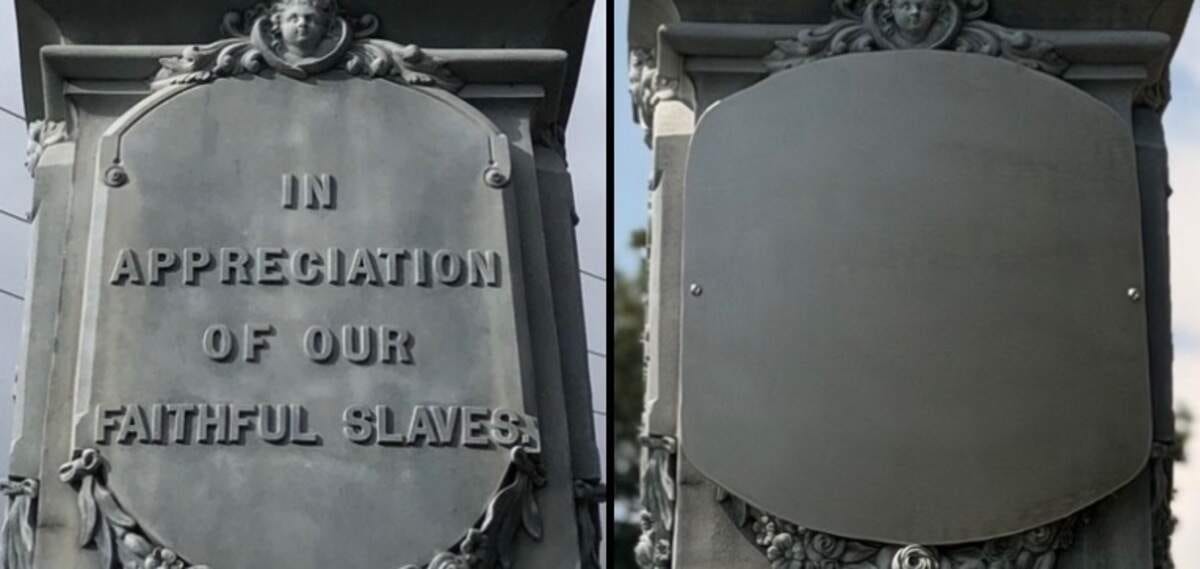
The Confederate statue in Tyrrell County, North Carolina, dedicated in August 1902 included the following reference: “In Appreciation Of Our Faithful Slaves.” It took its place as part of a public historical narrative that helped to justify the return to white control of local and state government following the Wilmington Race Massacre of 1898 and the disfranchisement of Black residents in 1900.
Tyrrell County’s Confederate statue celebrated African Americans, who willingly deferred to white authority during the antebellum years and through the four years of the Confederacy. Freedom for 4 million African Americans, according to the Lost Cause, was forced rather than embraced.
Today, a federal lawsuit regarding this statue was officially resolved following a final settlement, resulting in a steel plate being placed over the controversial inscription praising slavery. The judge in this case accepted a joint stipulation of dismissal. This officially ended the legal battle brought by Black residents.
Instead of fighting state restrictions to remove the entire statue, plaintiffs from “Concerned Citizens of Tyrrell County**”** argued that displaying a pro-slavery message violated 14th Amendment equal protection rights.
Their case was bolstered by research that appeared in an article titled “The Racialized Impacts of Confederate Symbols in Public Spaces: The Case of Courthouses,” which was published in the Journal of Race, Ethnicity, and Politics.
Authors Emily Wagner and Lucy Britt concluded:
Findings reveal that a Confederate monument made Black and Latino Southerners feel less safe and welcome at the courthouse and led Black Southerners to perceive the court system as less fair toward people like them. In contrast, Confederate monuments had no overall effect on white Southerners’ perceptions of courthouses or the judicial system. These results underscore the role of contentious symbols in reinforcing inequalities in public spaces.
Of course, this is not an ideal solution. The statue should be removed given its racist intent. There can be no dispute about that.
That said, I do hope the plaintiffs in this case can take heart from their victory. As I have said many times before, I can only imagine what it feels like to walk in front of a statue, maintained with my own tax dollars, that honors people of my own race for their willingness to remain enslaved.
No one should have to endure such a humiliation and insidious lie.