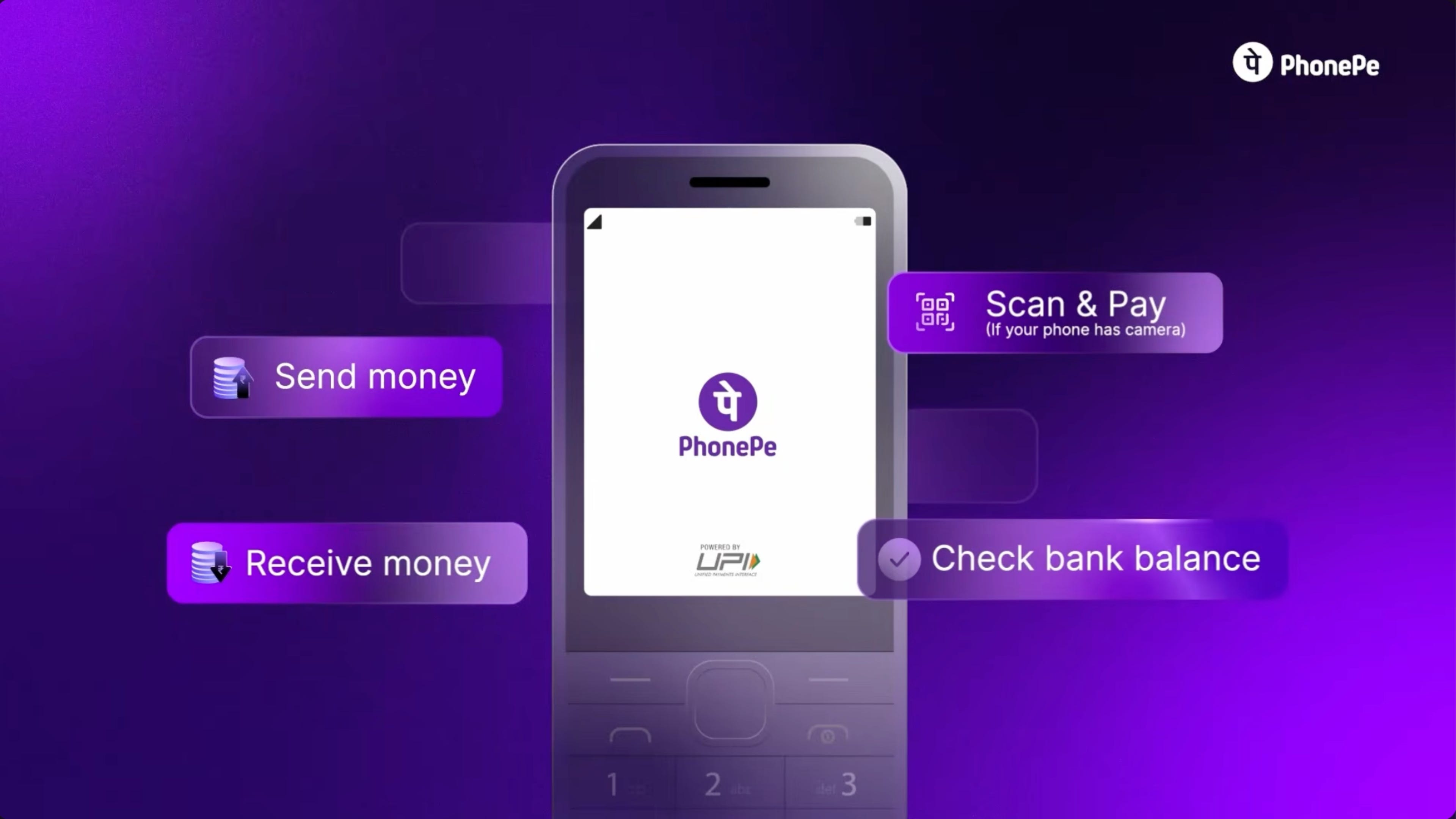
Opening thoughts. A few days ago, payments platform PhonePe announced the PhonePe UPI 123Pay. This is the arrival of UPI payments as an option for feature phone users in India. PhonePe estimates there are about 200 million feature phone users in India, I believe the number is much higher. For this, they’ve tied up with phone makers Nokia, HMD, Lava International and iTel Mobile to have the PhonePe app preloaded on the feature phones they seek. Don’t think of an app and the need for a 4G or Wi-Fi connection. This will work completely on the SMS architecture (even unstable 2G isn’t a hurdle).
Once this is set up, users can send money via UPI, receive money via UPI, scan and pay (if the feature phone has a camera), and check their bank account balance. The first time a user opens the PhonePe app, registration begins with the SIM card for the mobile number linked to the bank account. This happens via SMS. At the second stage, a user must select their bank from a list on the screen, and the accounts linked with that number will be listed—the user selects one they wish to use. PhonePe says that if the bank isn’t listed for some reason, there is the option to select ‘other bank’ and pull in the specific details by using the IFSC code mentioned on the chequebook or passbook.
“Bringing UPI to feature phones through PhonePe UPI 123Pay extends the benefits of digital payments beyond smartphones to every corner of the country. To us, this is what building for India actually means: meeting people where they are to drive a truly universal wave of financial inclusion that will onboard the next 300 million users into the digital financial fold,” says Sameer Nigam, Founder and CEO, PhonePe.
It is good to see PhonePe stepping up for users who would likely not return much in terms of transaction margins or monetisation. This does serve the smaller town and rural user base who may possess a Jan Dhan bank account but really lack the knowledge to register for a UPI app using debit card details. As of August 2026, India’s UPI transaction volume for the month stood at 24.51 billion transactions valued at ₹29.82 Lakh Crore. PhonePe’s share of the transaction volume is around 45.89% (that’s 10.86 billion transactions) and it holds 48.33% of the transaction value share (that is around ₹14.44 lakh crore).
The Reserve Bank of India (RBI) credit card data for July is now out, and it gives a fair idea about the broader trajectory. This becomes yet another month in which a million new credit cards have been added. (1.26 million; in addition to 1.13 million in June), with the base now at 12.29 million active credit cards. This marks a 9.9% year-on-year growth, from 11.16 crore active cards in July 2025.
As is often the case, there are two sides to this coin too. The volumes of transactions surged 24.5% year-on-year to 60.53 crore in July 2026 (a lot of the credit goes to RuPay credit cards for more frequent transactions, including at merchants that accepts cards on UPI). However, total expenditure grew by only 7.4%, causing the average transaction value to decline by 13.7%. Is this a case of consumers pivoting from high-value discretionary spending, taking cue from broader economic or geopolitical signals?
Make of it what you will. The RBI data captures a variety of e-commerce and online spends, which they total to a value of ₹1,32,445 crore (₹1.32 lakh crore) across 31.15 crore transactions. At the same time, point of sale (PoS) payments accounted for ₹75,740 crore (₹0.76 lakh crore) across 29.37 crore transactions.
The cue for banks, and policy makers to worry about, is that though there’s a surge in total transaction volumes, trends have structurally lowered the average bill size per transaction.
Secondly, there has been a perceptible momentum for ‘devaluation’ of rewards users earn on every credit card payment, as banks have begun to course correct (one would always love 10% or so rewards and milestones, but it’s not viable for banks to give these returns in perpetuity). This has also led to some consumers reducing their discretionary, high-ticket spending on credit cards. The removal of transactions such as jewellery and gold purchases by many card issues, has reduced spends that were anyway otherwise avoidable.
Our extended coverage on the fintech intersection…
📖: Bringing Gemini AI to a world of money: Google Pay’s Sharath Bulusu
📖: Beyond cashbacks, a collective rewiring of India’s credit card ecosystem
📖: Longer financing tenures underline India’s smartphone purchases
📖: Thoughts on Samsung Wallet, credit cards, and Nuuk’s new Halo
📖: India is shaping inclusive fintech AI for the world: Mastercard’s Nitendra Rajput
Yet, this can often be a vicious cycle. Do banks prefer to have a million new credit card signups every month, even as average ticket spends reduce? If the reasons for the average transaction value declining are economic, there will be inevitable defaults. That will mean banks will be forced to tighten credit lines, slow down aggressive underwriting for issuance, and focusing strictly on high-quality borrowers to avoid those defaults ballooning.
Maybe one of the reasons is HDFC Bank, SBI Cards, ICICI Bank, and Axis Bank, continuing to dominate over 70% of the credit card market share. While not a direct reason, this sort of dominance does mean each follows the other in terms of broader decision making. One bank slashes rewards earnings on their cards, others too follow. And almost overnight, a good rewarding credit card suddenly doesn’t look that interesting anymore. And poof, avoidable spends disappear from the radar.
Versatility with tech, if you do consider that aspect when spending the cash, is a good base to build with. What if that wireless keyboard you’re buying now can work not just with your Windows PC or iMac, but how about with an iPad or Android tablet too? When Indian tech company Amkette shared their new Optimus 2 wireless keyboard for analysis, its is exactly this broad utility that immediately caught my attention. The name, Optimus 2, and the scope of relevance. Looks good too, dressed in black or blue colours (a darker shade of blue might have looked a smidgen more premium, but I’m nitpicking).
I will straightaway get this going with an Apple iPad mini, and an equally impressive Xiaomi Pad 8, with particular focus on relevance as a child’s versatile computing device for online classroom and everything else that kids these days like to do on their iPads. There are two crucial ways in which Amkette has got this absolutely right. First, the quad device connectivity (three are on Bluetooth, and one on 2.4GHz wireless) with quick control keys on the keyboard itself to switch between them. Secondly, the integrated device dock for tablet and even smartphones, simply works to make this a convenient proposition to even carry around.
I did wish for the device dock to have a bit more flexibility in terms of angling the iPad when working on it—but it is good visibility nonetheless. However, do not attempt to use this on your lap with a tablet docked, because chances of gravity winning, are quite high. That said, the fact that the Optimus 2 is a full-sized keyboard means that a smaller tablet such as the iPad mini can actually leave some space to dock a phone there as well. Just observational things. Amkette has given this long battery life, and in my testing, I haven’t been able to drain this completely as yet—and this will charge via a USB-C port.
Amkette says these are low profile keys, but for someone who is coming from Apple’s Mac keyboards, this still feels like a tad too much key travel. Takes some getting used to, if your existing keyboard is similarly more incisive with key depth. Not the conventional layout either, particularly with the device selection keys above the number pad and slightly differently placed media function keys. This will take a bit of relearning for muscle memory.
The Amkette Optimus 2 wireless keyboard, priced around ₹1,099 depending on deals and offers, really leaves no complaints. It set out to be that one keyboard for more than one device you may own, and has delivered on that promise with some level of perfection. Whilst not costing typical Logitech keyboard sort of prices either. You really cannot go wrong with this versatility and simplicity. Must note, Amkette’s on a bit of a roll these days. First, the Mozen series premium wireless chargers, and then the X series mice marking instances of what the Indian tech company intends to do.
That’s all folks. Stay tuned for next week’s Neural Dispatch and Wired Wisdom. And do subscribe, for there’s tons coming your way. Do send your bouquets and brickbats.