Ben and Alex see a 4–5% rate of real GDP growth—a doubling of productivity—from “AI” over the next fifteen years as the current thing grows exponentially before (probably? perhaps?) turning into a logistic headed for its asymptote.
They write:
Ben Moll & Alex Imas: Will AI Soon Lead to Double-Digit [Annual Economic] Growth? <
[https://aleximas.substack.com/p/will-ai-soon-lead-to-double-digit]>: Double-digit growth in the next 10-15 years would require machines to do most of the economy’s work by 2035, people to keep spending on whatever gets automated, buyers and investors who absorb the new output, AI that never destroys value or slows its own deployment, and an R&D loop for which there is no evidence thus far. Each of these assumptions may fail in the real world. Whatever the exact number, a much more likely outcome is a large increase in the level of GDP spread over a decade or two, which is what (say) 4-5% growth is. If you remain unconvinced and still believe in double-digit growth, we are still looking for counterparties for[our bet]…
Only a third of the economy consists of paid-for knowledge work. There is a “relational sector” of services where human involvement is the value that creates a demand-side floor. The non-automatable sector will be larger than that. Amdahl’s Law—the with Leontief production or utility the speedup is limited to the size of the sector to be sped up—lurks in the background: growth is limited by what is essential and yet hard to improve. Explosive transformation will be hindered by real-world frictions: slow diffusion, physical constraints, relational demand, and political resistance. Add in messy jobs and limits on physical inputs, and hopes of 10% per year growth are more seem unattainable.
Plus “Singularity”-talk requires AI to fully replace researchers and overcome falling research productivity. There is no evidence it can do either:
<https://aleximas.substack.com/p/will-ai-soon-lead-to-double-digit> <https://aleximas.substack.com>
Sep 09, 2026
The following post represents the personal views of the author(s) and does not reflect or represent the positions of their employers.
This piece outlines the economics behind oft-discussed predictions that AI will soon deliver double-digit GDP growth in advanced economies. Anthropic CEO Dario Amodei says that AI could push growth to something like 10-15 percent per year. Leopold Aschenbrenner’s essay “Situational Awareness” states that the decade ahead “could see economic growth rates of 30%/year and beyond.” And in a widely shared 𝕏tweet, Anthropic researcher Sholto Douglas advises “pricing in economic doublings into your mental models of the 2030s,” with Elon Musk 𝕏endorsing the tweet. That is a growth rate of 100 percent per year. These are not isolated examples: predictions of double-digit growth are common among AI insiders, as Tom Cunningham’s compendium of AI growth forecasts for 2025-2035 shows.
We are extremely bullish on AI and think the capabilities explosion predicted by technologists is already happening and will only continue. But an explosion in capabilities is unlikely to translate into double-digit growth because of the (sometimes counterintuitive) economic forces that generate GDP growth in the first place. To paraphrase Milton Friedman’s dictum about monetary policy, AI will affect GDP growth with “long and variable lags.” We will not argue about what the economy might look like in 2080 or 2100. Our claim is about the timeline: in the next 10-15 years, growth rates upwards of 10% are extremely unlikely and a much more reasonable baseline is, say, 4-5% (which would already be massive). Even Anthropic’s own economic model only reaches double-digit growth in its “extreme” scenario; its “modest” and “substantial” scenarios stay well within the single digits. The uncertainty around these numbers is enormous and we are not making a forecast; instead our aim is simply to outline the assumptions that need to *all hold *in order for double-digit yearly growth to happen and to explain why we think they won’t. We have put money on this: see this bet that US per capita real GDP growth will stay below 15% in every year through 2033.
This piece proceeds in four steps:
Before starting, we remind the reader of some basic growth rate arithmetic. We argue that it is often much more useful to first think in
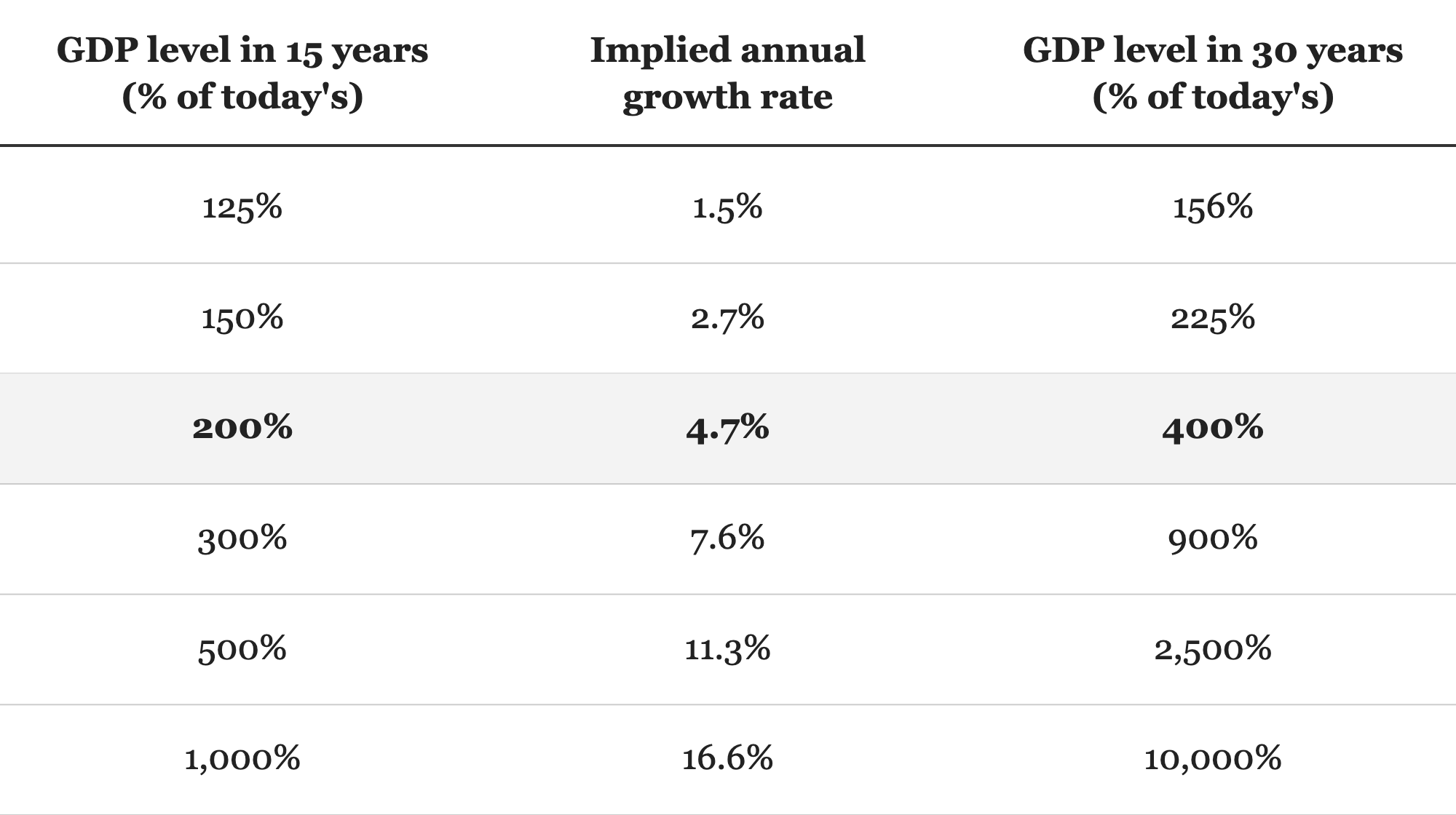
levelsrather than growth rates. That is, to ask yourself “how much richer will we be, say, 15 years from now?” and then back out the implied growth rate rather than directly jumping to predictions about growth rates. This simple exercise can often prevent drawing overly fast conclusions from seemingly small growth rates. For example, if you think that we will be 200% (i.e. twice) as rich 15 years from now that implies an annual growth rate of 4.7%. That is, a growth rate in the 4-5 percent range would already be massive.With this in mind, it is important to be clear that,
theoretically, it is entirely possible that AI will cause GDP growth to explode to double digits within a short time frame or that the economy will, say, double every single year some time in the 2030s. That is, there isabsolutely nothingin standard growth theory that constrains growth rates to be in the single digits. In fact, as we show below, it is easy to write down a standard textbook growth model of the type we routinely teach our undergrads (a souped-up Solow model), plug in some seemingly innocuous parameter values, and get an AI-driven short-term growth explosion. The basic logic is that, by replacing labor with capital, automation alleviates / eliminates diminishing returns and removes labor as a bottleneck on growth. Other (and fancier!) modeling approaches yield the same prediction based on the same logic.But just because something is possible
in theorydoesn’t mean it will actually happenin practice. The reason is that theories that predict explosive growth make a number of implicit assumptions that are unlikely to be satisfied in the real world. We group them into five categories:Assumption 1: Fast, economy-wide automation
Assumption 2: Continued high spending on what gets automated (no messy jobs, no relational goods, no scarce physical inputs, no goods of any kind which are both demanded by consumers but whose production process is not fully automated)
Assumption 3: There is someone to buy the output and firms invest to produce it
Assumption 4: No AI-driven cyber incidents destroying economic value
Assumption 5: Explosive technology growth because AI automates R&D
We discuss why each of these assumptions may be violated in reality despite a capabilities explosion, and explain why AI is different from dropping a million new workers into the economy. In addition, various measurement issues mean that GDP may not fully pick up the welfare gains due to AI.
We conclude by discussing possible reasons why people may have unrealistic growth rate expectations. Our main explanation is that it may be hard to “see the forest for the trees” and people may extrapolate from their immediate environment to the rest of the economy. Other reasons may include motivated reasoning, or that they are seduced by the elegant mathematics of growth theory.
Before turning to AI, we start with some basic growth rate arithmetic. Our point is that it is often much more useful to first think in levels rather than growth rates, and only then to back out the implied growth rate, rather than jumping directly to predictions about growth rates. That is, a good question to ask yourself is: how much richer do you think we will be, say, 15 years from now? By what percentage do you think the level of GDP will have increased by then? Once you have settled on a number, convert it back into a yearly growth rate. The following table does this conversion:
Asked this way, we bet that most people would come up with much lower growth rates than if they had been asked about growth rates directly. For example, us being twice (200%) as rich in 15 years as we are today seems like a lot. But it implies an annual growth rate of “only” 4.7%. Put differently, a growth rate in the 4-5 percent range would already be massive. Add to this that the jump from the current ~2% growth to a higher growth rate won’t happen overnight but instead gradually, and you get even higher implied growth rates for the same level effect: if growth is still low in the first years, later growth has to be all the faster to reach the same level of GDP by 2041. On the other extreme, a growth rate of 16.6% would mean that we would be 1,000% (10x) as rich 15 years from now.
It is also interesting to extrapolate these numbers another 15 years into the future, to 30 years from now, as in the last column of the table. Here you can see that high growth rates lead to some extremely wild numbers. For example, 16.6% annual growth would mean that we will be 10,000% (so a factor of 100) as rich as today. This is the arithmetic to keep in mind whenever someone predicts double-digit growth rates: such predictions are not modest claims about the economy doing a bit better, they are claims about a hundredfold gain within a generation.
Before arguing that double-digit growth is unlikely in the next 10-15 years, we want to be clear that there is nothing wrong with this idea in principle. There is absolutely nothing in standard growth theory that constrains growth rates to be in the single digits. To make this point concrete, we first show that a very standard textbook growth model, of the type we routinely teach our undergrads, delivers an AI-driven growth explosion. We then briefly discuss fancier models and other mechanisms that deliver the same or even wilder predictions. The basic logic is always the same: by replacing labor with capital, automation alleviates or even eliminates diminishing returns and removes labor as a bottleneck on growth. A recent episode of the Dwarkesh podcast states the logic intuitively: “... right now we’re bottlenecked by the fact that there’s people, and you can’t double people every single year. But in a world where you can also double the labor force every single year, how fast can the economy grow? I think it could double every single year. At the very least it would be tens of percent every single year.”
The model combines two standard building blocks, explained in detail in the technical supplement to this blog post. The first building block is a task-based production function in the tradition of Zeira (1998) and Acemoglu and Restrepo (2018): producing output requires completing a list of tasks, every task can be done by workers, and a fraction α of tasks can also be done by machines. Automation means that α increases over time. The second building block is the standard Solow model: a constant fraction of output is saved and invested in machines. In reduced form, the model boils down to two familiar equations:
where Z = Z(A,α) and A is the level of technology which grows at a constant rate. The key property is that the capital share of this Cobb-Douglas production function equals the share of automatable tasks α. That is, automation raises the exponent on capital.
The mechanics are then simple. As long as some tasks can only be done by workers (α below 1), capital accumulation runs into diminishing returns: the human tasks are the bottleneck, growth from accumulation alone peters out, and long-run growth is pinned down by technology growth. This is the standard Solow logic. But automation weakens this brake. When every task can be done by machines (α equal to 1), diminishing returns vanish entirely: output becomes linear in capital and the economy turns into the “AK model” from the endogenous growth literature. Machines produce output and output is used to build more machines, so the economy keeps growing without labor being a bottleneck. Technology growth on top of this makes the growth rate itself grow over time.
To show what this means quantitatively, we calibrate the model in the most standard way possible (2% initial growth, a saving rate of 20%, an initial α of one third, i.e. the usual capital share) and assume that the share of automatable tasks rises from one third today to 100% by 2045. The figure below shows the result. Growth accelerates from 2% to about 12.5% by 2035 and keeps rising thereafter; by 2045 GDP is roughly 8 times its 2025 level (panel a, blue line). If, in addition, the saving rate responds to the soaring return on machines (green lines), growth reaches 15% already by 2034 and 20% by 2045. In short: a textbook model with seemingly innocuous parameter values delivers exactly the growth explosion the optimists describe. (The transition is much less benign for workers: the wage temporarily declines and grows much more slowly than GDP, and the labor share goes to zero. See the technical supplement.)
Figure: It is easy to obtain AI-driven explosive growth in theory. In our souped-up Solow model ( see supplement), the economy transitions to full automation: α rises from 1/3 to 1 over 2025–2045. Panel (a): GDP (ratio scale) with and without automation; the labels on the dots report GDP relative to the no-automation trend. Panel (b): the GDP growth rate, with values at each decade. Blue: baseline fixed saving rate; green: endogenous saving rate. The shaded band is the 2025–2045 automation phase; the dashed vertical line in panel (b) marks the baseline’s switch to the cost-parity regime in 2041.
Our Solow model is deliberately minimal, but many richer models deliver the same or even wilder predictions. The canonical treatment is Aghion, Jones and Jones (2019), who analyze automation in both goods production and R&D and characterize the conditions for “singularities.” Trammell and Korinek survey the whole literature and we already mentioned Cunningham’s compendium. Other academic examples include Korinek and Suh (2024), who work out AGI transition scenarios in which growth accelerates sharply, and Restrepo (2025), who studies an AGI economy in which compute replaces labor as the accumulable factor, output becomes linear in compute, and the labor share converges to zero.
The most important addition relative to our Solow model is that AI also automates R&D, so that technology growth itself accelerates. In standard (semi-endogenous) growth theory, new ideas are produced by human researchers,
so idea production is bottlenecked by the size of the research workforce: you cannot double the number of researchers every year. If AI automates R&D, then researchers are also replaced by machines and idea production instead tracks the capital stock,
Note that this is exactly the same logic that turned our Solow model into an AK model, now applied to the knowled…