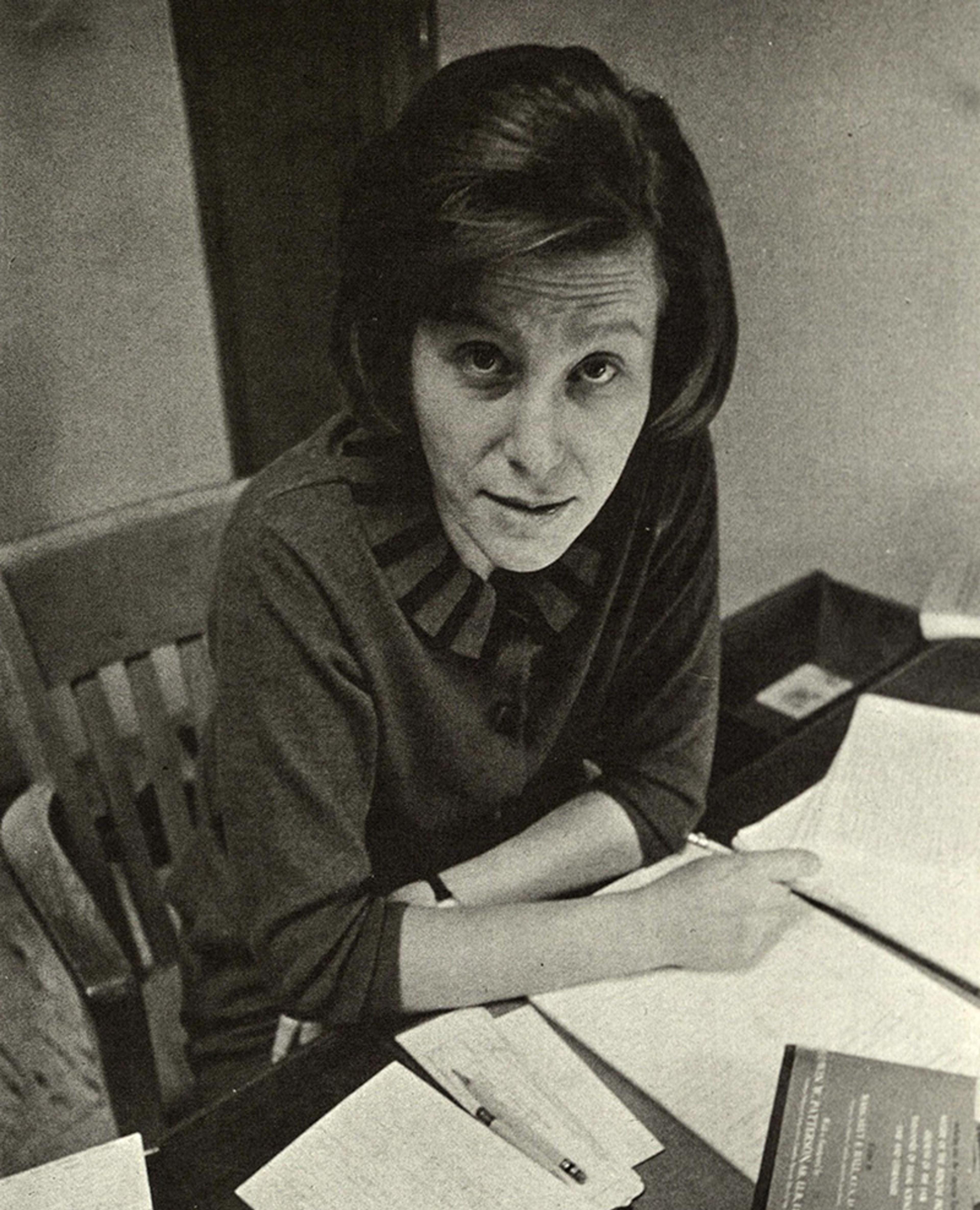
As I understand it, Sextus Empiricus sorted thinkers into three groups:
“Dogmatists” claim to have found the truth.
“Skeptics” claim the truth can’t be found.
Pyrrhonists “continue to search”.
Assigning her to the last category is, I think, a very nice way to characterize Judith Shklar.
Confronted with anyone who claimed to know what was going on, her first instinct was always to dismantle their claims, usually with black humor and references to all the horrible things that people claiming to follow that particular doctrine of thought had done to other people, either because of that doctrine, because it made them a little money or gained them a little advantage, or for no comprehensible reason at all. Hence one does not aim at justice or a Just City. Recent history, she believed as strongly as she could, had demonstrated very powerfully and yet again that “to speak of justice has become hazardous” to your clarity of thought but, more important, to the people around you. Hence the proper aim was to attempt the diminishing of injustice, while recognizing that it is and always will be pervasive. True liberals who want to be effective in the world should worry not about promoting virtues but “worry more about vices”, with “the deliberate infliction of physical, and secondarily emotional, pain upon a weaker person or group by stronger ones” as a truly great and central evil.
And, in short: that the task is Sisyphean does not mean that we should not keep attempting it:
<https://jamesmiller411396.substack.com/p/a-thinker-for-our-times> <https://jamesmiller411396.substack.com>
- Note: This is a revised version of a text that originally appeared as a book review-essay (with footnotes) in the journal *Political Theory
*I have chosen to revise and reprint it now (without the footnotes) because of the renewed recent interest in Shklar’s work; because my understanding of her achievement sharply contradicts that offered recently by my friend Samuel Moyn in his important study of *Liberalism Against Itself: Cold War Intellectuals and the Making of Our Times; and finally because the piece grew out of my own firsthand, if brief, acquaintance with that rarest of creatures, in my experience — a learned scholar who was also a great-souled philosopher.
The two of us by chance spent two weeks together in March 1987 as scholars in residence at the Villa Serbelloni in Bellagio, Italy.
At the time, I had closely read and admired several of her books; I had studied political theory with two of her former students, George Armstrong Kelly and Mark Hulliung; and I had also seen Shklar a couple of times at public events, where she had taken apart the ostensible arguments of a distinguished scholar with brisk precision. Stinging in her criticism and keen to stir up debate, she was an unrelenting gadfly of sublime intelligence.
Because what I regard as my first mature work, Rousseau: Dreamer of Democracy (1984) had been inspired in large part by the combined pleasure and disagreement I experienced while reading Shklar’s 1979 study of Rousseau’s social theory, Men and Citizens,* I was mortified to learn that I would be spending two weeks with her at Bellagio. If she had read my book, I feared that she would certainly have noticed all of its defects.*
To my surprise, Shklar was magnanimous: she had closely read, and received, my book as I had intended it -- as an earnest response to her keen appreciation of Rousseau as a uniquely provocative and paradoxical thinker (in that regard, someone very much like herself).
From the start of our time together, she was generous in her companionship, ardent in discussing ideas, but also reticent whenever I asked her about herself: she didn’t think her personal experiences merited much attention. (It was only years later, in response to an invitation from the American Council of Learned Societies, that she produced a short autobiography.)
*At Bellagio, we went on several long walks together. She spoke of how profoundly we both had been touched by the work of Rousseau — it was, she promised me, an intellectual and moral adventure that both of us would never get over. (She was right.) At the same time, I kept pressing her for more information about her life and, among other things, how the idiosyncratic convictions she had expressed in her 1984 magnum opus, *Ordinary Vices, squared with her own political conduct.
In the years that followed, we met annually to catch up, either in her small study room in Widener Library, surrounded by one of the richest collections of books in the world, or at a cafe for coffee in Harvard Square. At our last meeting, in 1990, she was serving her term as the first woman to be elected President of the American Political Association. It was moving to see how proud she was of finally achieving the public recognition of her peers.
The work of Judith N. Shklar began, and ended, in paradox: she was a political theorist—but one who remained forever uncertain about what positive results, if any, theorizing about politics might produce.
In 1957, in her first book, *After Utopia, *a prodigiously learned survey of modern European social thought from Helvetius to Simone de Beauvoir (a project begun when she was just twenty-two years old), Shklar exposed her readers to a barrage of typically unequivocal opinions: “It is next to impossible to believe strongly that the power of human reason expressing itself in political action is capable of achieving its ends.”’ The results of political action in our own century must give us pause: “To speak of justice has become hazardous. The inhibitions bred by our historical experience and by analytical honesty are overpowering.” Yet, without at least a “grain of baseless optimism,” we cannot imagine “an end beyond what is known to exist”— the basis of any strong theory of politics.
A decade later, her convictions remained unchanged. The disappearance of the kind of “classical imagery and values” once expressed by philosophers from Plato to Rousseau had left “political theory without any clear orientation and so with a sense of uneasiness.” A great tradition was dead: “No one was writing anything comparable to *Leviathan,” *Shklar later recalled, “and no-one ever would. Only political chatter and the vestiges of ideology were around. No *Social Contract, *no Rousseau, no political theory!”
Not long before her sudden and unexpected death in 1992, Shklar admitted the obvious. The publication in 1971 of *A Theory of Justice *by her Harvard colleague John Rawls had changed everything. As a matter of plain empirical fact--and empirical facts mattered to her a great deal--she had been mistaken about the postwar prospects for constructive political thought: the lively academic interest in the work of Rawls and, later, Charles Taylor, proved it.
Still, as Nancy Rosenblum justly remarks in an essay in *Liberalism without Illusions: Essays on Liberal Theory and the Political Vision of Judith N. Shklar, *an invaluable posthumous festschrift edited by Bernard Yack, “Shklar consistently declined to engage in the business of systematic normative theory, where notions of social justice and responsibility are given solid ground.”
Try as she might—and she did seem to try, especially in her late essays on American political science—Shklar could never surmount her skeptical queasiness about even the most modestly liberal of political hopes.
Thus, readers of *The Faces of Injustice, *published near the end of Shklar’s life, are flatly told that “there is no just way to overcome many of the realms of injustice.” And again: “injustice lurks in the pursuit of justice for all.” Even in 1988—when these lines were first delivered at Yale as the Storrs Lectures on Jurisprudence—to speak of justice was, for Shklar, evidently still “hazardous.”
Shklar was a moral psychologist of brutal candor and an intellectual historian of great rigor: many of her essays bear comparing, in their elegance of style and acuity of insight, to the best short works of Isaiah Berlin. Her range of reading and growing mastery of narrative style recall another unusual thinker, whom she knew and in certain respects admired, Hannah Arendt; but she never composed an edifying political just-so story to match that recounted by Arendt in *On Revolution *(a book that Shklar told me that she detested).
She cherished her friendship with Michael Walzer, another gifted writer of great erudition and intelligence, but never hid her profound antipathy toward his emphasis on “shared intuitions and sensibilities” as the communal ground of political judgment: “To confuse a common culture with a harmony of political interests amounts to little but a sleight of hand. What cultures share as a rule is language, which makes it possible for us to express, among other things, our hatred and contempt for each other.”
Was Shklar essentially a misanthrope? Can one consistently pursue a strictly negative way of thinking about politics? Or rather, as Walzer gently suggests in his festschrift essay “On Negative Politics,” must her *via negativa *produce the ultimate paradox, a tacit affirmation, mirabile dictu, of nothing other than “an American version of social democracy”?
Reviewing Shklar’s work for the *Times Literary Supplement, *Mark Lilla, a former student, remarked that her “vision of political life was deeply, perhaps too deeply, marked by the catastrophes of modem history.” I find Lilla’s gloss on Shklar here and elsewhere strange: it is not clear how an accurate awareness of catastrophic possibilities could shape anyone’s vision of political life “too deeply.” Still, Lilla is surely correct to stress the impact of her biography on her paradoxical sensibility.
Shklar was born to a life of comfort and learning, the child of an enlightened and prosperous Jewish family that called Riga home. Her mother was a pediatrician. In 1928, the year that Shklar was born, Riga was the capital of Latvia, a newly formed nation that had declared its independence after World War I from both Russia and Germany, two imperial states that enviously eyed its strategic location at the Eastern edge of the Baltic Sea.
“I am a bookworm,” she begins her brief and vivid memoir, “A Life of Learning,” first published as an Occasional Paper by the American Council of Learned Societies in 1989. “Since the age of eleven I have read and read, and enjoyed almost every moment of it.”
Shklar’s eager entry into the Republic of Letters happened in 1939, the same year, not coincidentally, that World War II broke out— and Latvia found itself, once again, a target of conquest.
Airlifted out of Riga by a politically perspicacious uncle shortly before Russia invaded Latvia, the family stayed for some months in Sweden before escaping, via the Trans-Siberian railroad, to Japan. There, a timely payment of cash secured a visa to Canada. Leaving Japan not long before the bombing of Pearl Harbor, the Shklar family took a boat to Seattle, where American authorities promptly put them behind bars in a detention center for illegal Oriental immigrants.
In his essay for the *Times Literary Supplement, *Mark Lilla implies that these trials and tribulations had marked Shklar with an unfortunately grim political vision: “She practiced what Leo Strauss in another context called the ‘reductio ad Hitlerum,’ and of this she was master.”
In my own conversations with her, Hitler never came up. And Shklar’s own verdict on her childhood and early youth was characteristically mordant: “If I were asked what effect these adventures had on my character, I would say that they left me with an abiding taste for black humor.”
They also left her with a permanently damaged sense of belonging—although this was an aspect of her experience she was in fact quite reluctant to discuss. It nevertheless linked her to older emigre scholars, such as Hannah Arendt, whose experience of exile she described in these terms: “Their homesickness, aggravated by worry about friends who did not get out, was overwhelming. It is something that has to be experienced to be understood.”
Even in later years, comfortably settled in her office deep in the heart of Harvard’s Widener Library, the bookworm preferred to keep her distance: “I have participated happily enough in what goes on around me,” she confessed in her memoir, “but with no wish to be deeply involved.”
During World War II, the Shklar family settled in Montreal. Judith attended McGill, where she met her husband (a doctor, like her mother) and discovered her calling in a course on the history of political thought taught by Frederick Watkins, an American scholar who also introduced her to Jean-Jacques Rousseau, the first crucial interlocutor in the life of her mind: “To read Rousseau is to acquire a political imagination,” she remarked years later—and Rousseau’s was just the kind of wildly utopian political imagination that was bound to challenge and provoke her own well-earned skepticism about the good will of those who rule.
Entering the graduate program in political science at Harvard in I951, she was quickly adopted by Carl Joachim Friedrich, an old-fashioned German-trained specialist in the philosophy of Kant and Hegel, who taught her “how to behave, how to be professional, how to give and prepare lectures, how to deal with colleagues and how to act in public.” Despite Shklar’s professed commitment to the values of a democratic citizen, she never shed the Prussian manner—imperious, blunt, intolerant of perceived ignorance--that she had learned in part from Friedrich.
Still, in private, she was surprisingly self-effacing. She thought of herself, not without reason, as the recipient of great good fortune. Friedrich chose her as his successor, an extraordinary honor to bestow on a young woman, and one regarded with uncomprehending jealousy by most of her colleagues, the genteel and clubby kind of men who always dressed in oxford gray Brooks Brothers suits.
“She was a perfect blend of polar opposites,” Stanley Hoffman, perhaps her oldest Harvard friend, recalled: “She combined an ebullient fondness for intellectual combat with a passionate desire to avoid conflict in human relations, as was shown by her initiating a pseudo half-time permanent lectureship when my colleagues were still too full of male prejudice to grant her the tenured professorship she so obviously deserved.”
Shklar neither ignored this indignity nor chose to dwell on it. In *American Citizenship *(1991), she does not mince words about the injustice of excluding women from the franchise and the workplace. But, as she confessed in her memoir, she could never be a “real feminist,” since “the idea of joining a movement and submitting to a collective belief system strikes me as a betrayal of intellectual values.” (To the best of my knowledge, the only political organization she expressed any loyalty toward was Amnesty International, contributing not just money but also her literary talent, writing uncredited pieces for its newsletter in the 1980s.)
A self-avowed liberal and—as one might predict—a staunch anticommunist throughout her life, Shklar began her intellectual odyssey with an admiration, bordering on envy, for a brand of “radicalism” she associated with the visionaries of the French Enlightenment, and Rousseau above all, thinkers who were buoyed by the belief “that man can do with himself and with his society whatever he wishes.” She never ceased reading the philosophes, browsing through their works in quest of opportunities for textual commentary and emblematic praise, for example, of the ironic liberalism that Jean D’ Alembert thought flowed from skepticism: “As long as no one knows, everyone has a right to enjoy the most ‘extreme liberty’ of expressing his own opinions.”
Unlike Isaiah Berlin, whose turn of m…