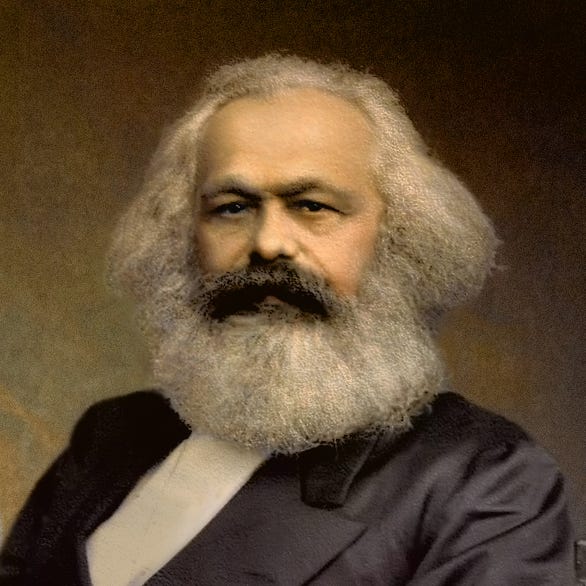
Summarizing (with a few compressions and thus errors) from Tristram Hunt’s biography of Friedrich Engels.
Thus here we have Larry MacDonald on portfolio strategy secrets of the original Marxists:
<https://larrymacdon.substack.com/p/how-karl-marx-achieved-financial-1c4> <https://larrymacdon.substack.com>
Karl Marx and Friedrich Engels were the authors of The Communist Manifesto, the widely read and influential 1848 treatise that was instrumental in laying the foundation for the communist movement as we know it today. Less well known is that the two fathers of communism also traded stocks on the London Stock Exchange.
Marx operated more like a day trader, darting in and out of stocks. Engels held a diversified portfolio of solid companies and invested for the long term.
Marx’s dabbling in the market began in 1864, when an admirer bequeathed £820 to him. This was a considerable sum back then, more than he had earned from his occupation as a writer. A good portion was spent on home renovations, pets for the kids and a family vacation. The money left over went into stock speculation.
As Marx writes in a June 25, 1864 letter to his uncle, Lion Philips:
“I have, which will surprise you not a little, been speculating … in English stocks, which are springing up like mushrooms this year …and are forced up to quite an unreasonable level and then, for the most part, collapse. In this way, I have made over £400….
In the letter, Marx adds that he is going to do more trading:
“…now that the complexity of the political situation affords greater scope, I shall begin all over again. It’s a type of operation that makes demands on one’s time, [but] it’s worthwhile running some risk in order to relieve the enemy of his money.”
There is no record of how he fared in this further attempt to relieve “the enemy” of his capital. If we go by the perennial tendency of traders to proclaim their winnings but rarely their losses, we might guess that the capitalists were the ones who relieved Marx of his funds.
On the other hand, Engels was quite a financially savvy fellow. He was involved in running the family textile business in Manchester, England, and had a seat on the stock exchange. Engels retired from business in 1870 at the age of 49, his portfolio worth £1.2 million.
When he died 25 years later, it was up to £2.2 million. His positions included shares in a railway (London and Northern Railway Co.), gas utility (South Metropolitan Gas Co.), infrastructure project (Channel Tunnel Corp.) and a mutual fund holding government bonds (Foreign and Colonial Government Trust Co).
During retirement, Engels’ portfolio produced sufficient income to cover his living costs and provide Marx with an annual stipend of £380. This effectively rendered both men members of the rentier class, a group not usually viewed with a great deal of fondness by communists.
Engels had a rationale. He argued that his investments weren’t participating in the exploitation of workers because the “stock exchange simply adjusts the distribution of the surplus value already stolen from the workers.”
Marx, of course, saw his market plunges as a way to attack the accursed capitalists. He was going to bring the full force of his intellect to bear on making adroit stock picks that would take away their ill-gotten riches.
Engels and Marx were devoted readers of the Economist magazine and other business publications. This fuelled in-depth economic discussions between the two. For example, Engels writes in an 1852 letter to Marx:
“The minor panic in the money market appears to be over ...railway shares are again rising merrily, money is easier, speculation is still pretty evenly distributed …. Anyway I don’t believe that the crisis will this time be preceded by a regular rage for speculation … crucial ill-tidings from overstocked markets must surely come soon. Massive shipments continue to leave for China and India, ... and here and there native dealers are going bankrupt. I don’t believe that prosperity will continue beyond October or November…”
The level of analytical and financial detail is quite impressive. The pair were said to be interested in monitoring business conditions to see if a depression was coming – as they were sure the next economic contraction was going to be the trigger for the proletariat to rise up and revolt. They no doubt wanted to be prepared for that momentous event.
The revolution never did come to pass in their lifetimes. But with the stocks they were holding, it’s not an implausible conjecture that their diligent macroeconomic research was also of benefit to their stock picks and portfolio management.
Sources:
Marx & Engels Archive (https://www.marxists.org/archive/marx/index.htm)
<https://larrymacdon.substack.com/p/how-karl-marx-achieved-financial-1c4> <>
A £400 speculative profit then was the same multiple of typical wages as about $500,000 would be today. Marx was, for his time, playing at a scale far above that of most day traders.
Tristram Hunt’s 2009 Engels biography has various titles:
The Frock-Coated Communist: The Revolutionary Life of Friedrich EngelsThe Frock-Coated Communist: The Life & Times of the Original Champagne SocialistMarx’s General: The Revolutionary Life of Friedrich Engels.
as his publishers, Meropolitan Books and Allen Lane, tried to find a title and subtitle that would induce people to buy books.
I think Larry has some of his numbers somewhat off. As I calculate it, using <http://measuringworth.com/>, Engels’s withdrawal of capital from Ermen & Engels at his retirement in 1869 had then, counting his severance capital withdrawal and other assets, the approximate purchasing power of $3.3 million today, and was the same multiple of the wage level as $21 million would be today. At his death in 1895 Engels’s estate was some $5.7 million in terms of today’s purchasing power, and fully $21 million considered as a multiple of the typical wage.
And I really should review Tristam Hunt’s Engels biography, should I not?
##enlarging-the-bounds-of-human-empire
##crosspost
#larry-macdonald-how-karl-marx-achieved-financial-independence
#larry-macdonald
#how-karl-marx-achieved-financial-independence
#friedrich-engels
#karl-marx
#tristram-hunt
#frock-coated-communist
#marxs-general
#economic-history
#rentier-capitalism
#stock-speculation
#ermen-and-engels
#manchester-cotton
#wealth-and-inequality
#communist-manifesto
#history-of-capitalism