My friend Greg Clark takes aim at me in the foreword of his new book To Have & Have Not:
A recent Substack essay by Brad DeLong, titled,
Big Trouble in Little Human Genetic Difference-Worshipper Land,illustrates nicely the hostility and contempt felt by the academy for anyone who would suggest an important role for direct genetic determination of social outcomes:“[A]ttempts to carve out a large, causal, manipulable “main effect” of genes on complex social outcomes keep reducing, on closer inspection, to approximately zero” (DeLong, 2026).
Thus an article in the
Proceedings of the National Academy of Sciences, which contains the essence of the argument of the book, has been attacked by such prominent behavioral geneticists as Marcus Feldman and Kevin Lala as “scientific racism” (Lala and Feldman, 2024), and “racist pseudoscience” (Lala, Brown, Twyman and Feldman, 2025). Similarly a presentation of the core arguments of the book atGlasgow Universityin 2021 was indefinitely “postponed” by the Dean in response to a letter signed by 110 Glasgow University Faculty condemning the work as pseudo-science and eugenics. A majority of the reviewers at Princeton fell in solidly with the received wisdom on the unimportance of genetics, without seriously engaging with the copious empirical evidence presented that cultural and social causation could not explain the patterns of inheritance observed in England. Chicago University Press considered the manuscript, but ultimately reported that they could not find reviewers willing to review it!…
But attempts to carve out a large, causal, manipulable “main effect” of genes on complex social outcomes do keep reducing, on closer inspection, to approximately zero! I understand that Greg does not like that conclusion. But it is one I have reached, and I have heard Greg (and many others) make their best pitch, and fail to throw anything I can regard as possibly over the plate!
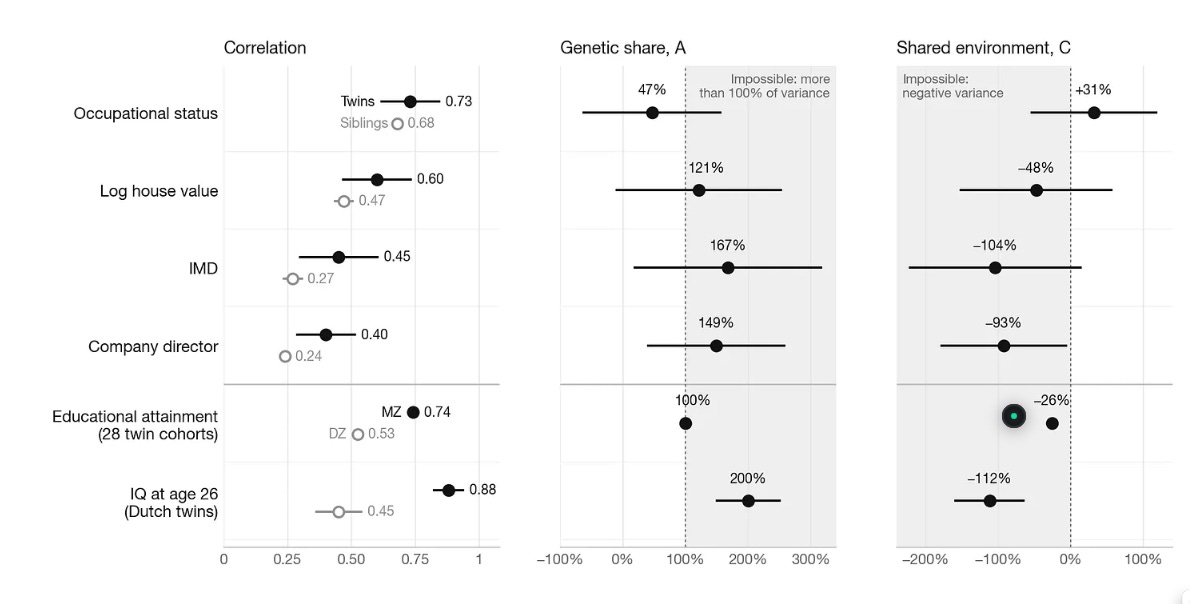
More important, it is what Sasha Gusev thinks. In his estimation, Greg’s genes-only model of intergenerational human status immobility “for three of the four traits… produces an estimate of [genetic] heritability that is greater than 100% and a negative estimate of the shared environment variance…. These estimates are clearly absurd…”
Sasha:
<https://theinfinitesimal.substack.com/p/vibe-heritability><https://theinfinitesimal.substack.com>
The economic historian Gregory Clark has written a book on status persistence, which was the focus of a recent online symposium. Clark has assembled a massive dataset of multigenerational status measurements in England. The project has a particularly British whimsy to it, with much of the data coming from the Guild of One-Name Studies, a largely online society of genealogical hobbyists. After analyzing lineages from >400,000 English people, Clark draws a startling conclusion that “genetics underpins social status in England from 1600–2026” — in other words, people are in the upper class and stay in the upper class because of their genes. Clark goes on to argue that “the vast resources poured into increasing rates of social mobility in modern society through public education, income supports, and social services have achieved nothing in terms of increased mobility”. This is a bold claim, so before going much further, it is worth taking a look at Clark’s data. Here are the parent-child correlations in social status traits, reproduced from an analysis of the data by Benning et al.:
Clearly the conventional estimate of social mobility — how similar in status are you to your parents — changed substantially. So how does Clark come to the opposite conclusion? Clark argues that the decrease in familial correlation is a mirage, driven by increases in measurement error. Instead, he proposes to quantify the rate of decay in the familial correlation across increasingly distant relatives, from which he infers large and unchanging latent parameters. These parameters, he argues, imply that status is highly heritable and highly genetically correlated between spouses, thus persisting across generations entirely through genetic pathways.
𝕏I and others have previously criticized Clark’s paper for conflating status persistence (through a variety of mechanisms), which his data can observe, with genetic causality that his data cannot identify. I also 𝕏noted that Clark’s actual parameter estimates are nonsensical. These issues are echoed in some of the symposium articles in novel ways, which I will highlight here. I’ll also comment on the broader discussion in and around the symposium, which I think serves as a microcosm of the nature-nurture discourse.
Nikolai Eftedal (himself the author of a fascinating recent study of intergenerational persistence) contributed a short article, cheekily (by my reading) presented as an effort to “provide defenses against two criticisms [Clark] could face”. Eftedal points out that Clark’s model relies on a highly heritable, latent status phenotype that has extreme properties (“arguably so extreme as to be implausible”) and that his model makes impossible predictions about twins. Specifically, Clark’s model hinges on a very high level of genetic assortative mating, which would necessarily imply that monozygotic and dizygotic twins should exhibit only modestly different levels of phenotypic correlation. In Eftedal’s words: “for most relevant traits and outcomes, this is wrong”.
It may seem counterintuitive that a highly heritable phenotype would produce similar correlations between MZ and DZ twins, but it is a direct consequence of the genetic similarity induced by assortative mating. When parents are genetically correlated, DZ twins become more genetically correlated too while MZ twins remain identical, thus bringing the two classes of phenotypic correlations closer together. Classical twin studies, which assume random mating, will in turn estimate a large contribution of the shared environment and a low heritability for status traits (they generally do not). Here’s what that looks like for a highly heritable trait under random mating versus Clark’s spousal genetic correlation (m=0.57):
Under Clark’s model, a trait with heritability of 90% would actually appear statistically to have a heritability of 39% in twins. Eftedal attempts to throw Clark a lifeline by suggesting that large non-additive/interaction effects — which make MZ twins more similar but dissipate rapidly across generations — could reconcile the estimates from twin and family data. In his reply, Clark re-analyzes his dataset to identify sets of twins and siblings and estimate their phenotypic correlations. Among these twins and siblings, he concludes that “there is little sign … of significant non-additive effects”. In other words, he tosses the lifeline right back.
It seems that Clark may have missed the point of the exercise. Under assortative mating, it is not sufficient to eyeball the twin similarities, you need to estimate heritability after accounting for assortment. With a bit of algebra (see Appendix), we can derive a simple relationship between the correlations in Clark’s twins/siblings and underlying heritabilities while also accounting for the genetic correlation between mates estimated by Clark. Having done so, we can walk down the table of twin correlations from Clark and re-estimate the heritability his model would produce:
For three of the four traits, Clark’s parameter produces an estimate of heritability that is greater than 100% and a negative estimate of the shared environment variance. These are observed correlations, which Clark argues are swamped by measurement error, so the out of bounds heritability estimates should actually be even more out of bounds. To be fair, the twin estimates from Clark’s data come with a lot of uncertainty, but we can also apply the same calculation to high quality modern twin studies (cited by Clark in other parts of the text). For educational attainment (Silventoinen et al.) as a representative status trait, the same latent assortment would be consistent with a heritability of 100% and a highly significant (and impossible) shared environment variance of -26%. For IQ (Boomsma et al.), the resulting heritability would be 200% and the shared environment -112%. These estimates are clearly absurd, both in Clark’s data and in modern data, and Clark rejects attempts to reconcile them.
I’m focusing on this example because I think it’s easy to understand and typifies the discussions between Clark and his critics. Clark makes a bold claim (long-run patterns of intergenerational transmission are explained by a purely genetic model). Flaws are identified in the claim (the spousal genetic correlation needed for the model would produce impossible estimates in twins). Clark carries out a new analysis with new data (evaluating MZ/DZ correlations for non-additivity), adding a new epicycle to the model. This analysis is itself flawed in a new way (the MZ/DZ comparisons did not account for assortative mating), revealing a new problem. And on it goes.
The symposium features several such epicycles. John Benning re-analyzes the data and finds that Clark is inappropriately re-using samples to calculate his correlations (“pseudo-replication”) and that proper bootstrapping produces extremely uncertain estimates especially for distant relatives. Clark responds that he does not make use of the estimated sampling error, so it doesn’t matter. In reality, his regressions are weighted by exactly that sampling error and he makes multiple claims about the precision and statistical significance of his estimators which rely on that sampling error; not to mention repeated qualitative arguments about non-zero status persistence in distant relatives. Jan Stuhler points to the extensive literature on within-family birth order effects, which has demonstrated clear environmental influences on social status. Clark argues back that within-family estimates (not exactly a fringe statistical procedure) should not be trusted in general, then justifies this with a simulation in which spurious birth-order effects appear only in between-family regressions — precisely the issue that within-family analyses address. And on it goes.
What about Clark’s advocates? Charles Murray (a political scientist) and Noah Carl (a disgraced sociologist) contributed to the symposium, lavishing praise on the book while studiously avoiding any of the statistical issues. Both argue that Clark’s findings align with findings from twin studies, when just a little bit of algebra shows that they are fundamentally incompatible. Alex Tabarrok at the Marginal Revolution blog echoes this theme: Clark has “pushed the debate far into new territory”. Ironically, Tabarrok highlights an observation from distant relatives that is precisely one of the low certainty, pseudo-replication estimates critiqued by Benning. The broad takeaway is: we know in our hearts that Clark is on to something, so don’t think too hard about the numbers, just enjoy the vibe.
This is a common reaction to Clark’s work — that he’s identifying something new and important even if his numbers don’t really add up — but extraordinary claims require a high evidentiary standard, not a gut feeling. Imagine your friend invented a new bodyweight scale after spending years collecting data to calibrate it, and swears that everyone has been weighing themselves incorrectly. You put your toddler on the scale, the little machine does its calculation, and it tells you that your toddler weighs 500 pounds. “See!” your friend says eagerly, “your little one is critically obese, without my invention you’d never have known”. Puzzled, you pick up your toddler and step on the scale together; the scale runs its calculation again, and now it reads 300 pounds for the two of you. “It’s just broken,” you conclude, “I obviously do not weigh negative 200 pounds”. Your friend becomes defensive: “Look, let’s not get into the weeds. 300 pounds, 500 pounds, that’s not the point. My invention has revealed that your toddler is much heavier than you thought. I am pushing the debate into new territory!”.
But your friend hasn’t actually revealed anything; maybe the first measurement was wrong, maybe the second, or maybe (probably) both — the invention simply doesn’t work. Likewise, we know that essentially all traits are driven by some combination of genes, environment, and the interaction of the two. Clark fits a purely genetic model to his data and it doesn’t work. We’ve seen this before. All we can conclude is that pure genetic transmission doesn’t fit the data, a finding that should already have been obvious.
Following Clark’s terminology, given a genetic correlation between mates of m, the expected genetic sharing between their offspring siblings is:
Then given an additive genetic variance (aka heritability) of A, and a shared environmental variance of C, the resulting phenotypic correlation for different twin classes is:
In Clark’s data, twin zygosity was unknown, but given a pool of twins of which p proportion are MZs, their expected phenotypic correlation is:
Finally, we can relate the two quantities to heritability (A) as:
and solve for heritability as:
as a sanity check, we can see that under random mating m=0 and all twins being monozygotic (p=1), the above reduces to the standard ACE twin model estimate where A=2(rmz-rdz). In the main calculations I have assumed, as Clark does, that half the twins are MZs (p=1/2) and I have used Clark’s pooled estimate of m=0.57.
<https://theinfinitesimal.substack.com/p/vibe-heritability> <https://theinfinitesimal.substack.com>
- Brad DeLong here*: I don’t think I really have much value added here.
I would note that the post he is quoting from is the latest version of a lecture part that I have been occasionally giving in my courses since long before Greg began working on intergenerational status inequality. At the moment it (sometimes) shows up in the “Inequality & Domination” module of my Econ 135: Global Economic History: <https://braddelong.substack.com/p/big-trouble-in-little-human-genetic>.
And what I wrote is, as best as I can tell, a statement of fact. It is how I read the current state of the literature. And, more important, it is how Sasha Gusev and others much more qualified to judge than I am read it:
**Cherno…