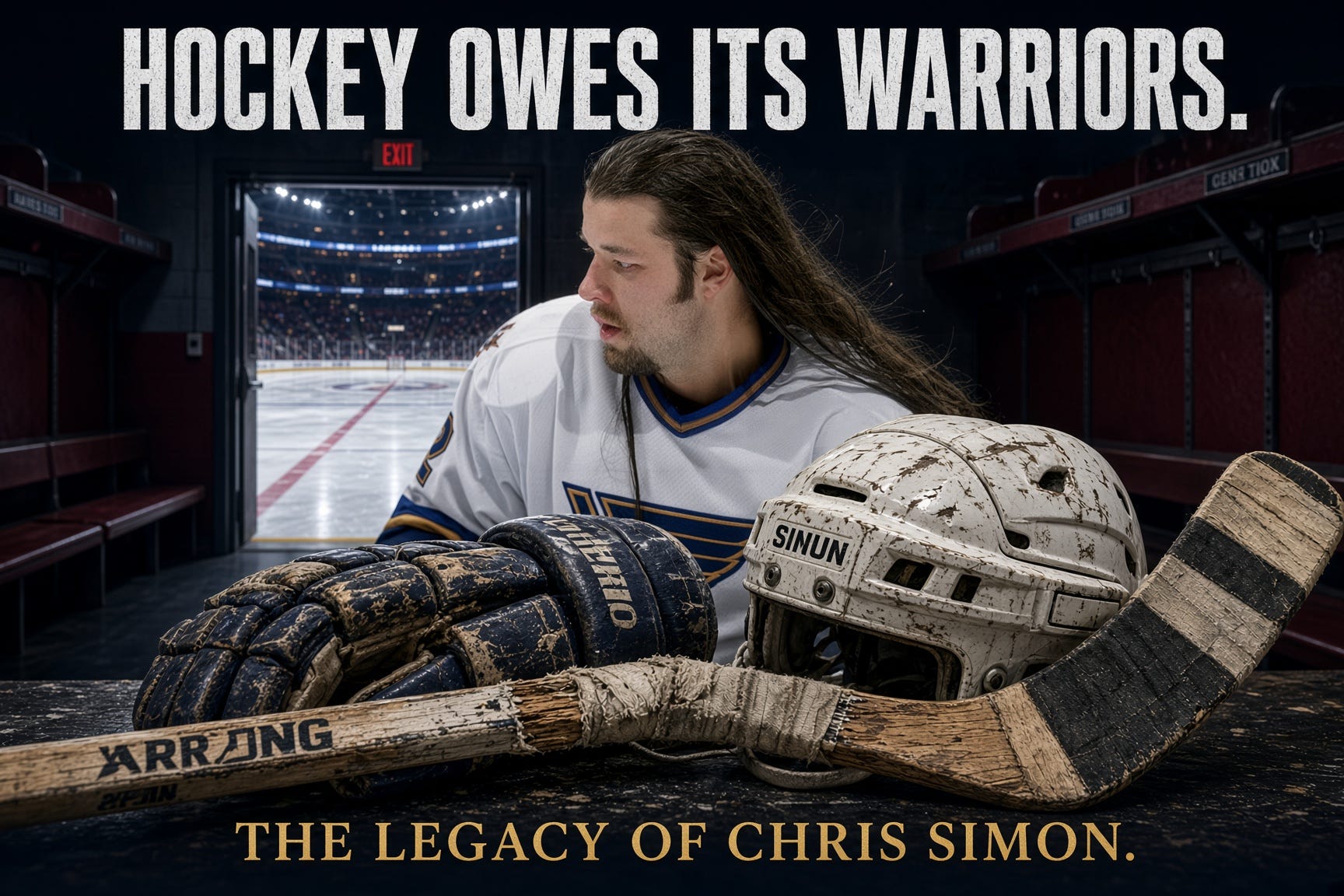
LUTHMANN NOTE: I’m tired of watching professional sports turn broken players into tribute videos. The NHL knows how to sell a rivalry, a fight, and a championship reunion. It should bring that same determination to financing care when a former player’s memory starts failing, and his family needs help. Sully’s Warrior Legacy Fund gives the league something concrete to answer. Put hockey revenue behind lifetime treatment and financial support, with public accounting of where the money goes. Simon’s CTE diagnosis does not settle every question surrounding his death. It does not make another round of sentimental applause any more adequate. Gratitude should survive the final buzzer. This piece is “CTE and Chris Simon,” first available on NY News Press.
Before the NHL fully separated skill from intimidation, Chris Simon embodied both. He could fight the league’s most feared heavyweights, score meaningful goals, and remain a trusted presence on teams built to contend for championships. That rare combination made him more than an enforcer: it made him a legitimate hockey player whose toughness carried strategic value.
Simon won the Stanley Cup with the Colorado Avalanche in 1996, when the franchise captured its first championship. That team featured gifted players such as Joe Sakic and Peter Forsberg. In Washington, skilled players such as Adam Oates and Joe Juneau also benefited from Simon’s physical presence. Simon and other warriors confronted the era’s violence directly, helping create the space and security in which stars could play with confidence.
The same dynamic existed throughout his time in Washington. Simon’s reputation, strength, and willingness to answer challenges made opponents think twice before taking liberties with teammates. He could protect a star, create room along the boards, win difficult battles, and shift the emotional balance of a game. His physical presence was not separate from his hockey value; it amplified it. At the same time, his offensive ability meant teams could not treat him as merely an enforcer.
That distinction mattered in the championship-caliber environments of the Colorado Avalanche in the 1990s and the Washington Capitals during their 1998 run to the Stanley Cup Final. Simon brought the intimidation of an enforcer, the scoring touch of a legitimate contributor, and the playoff relevance of a player coaches could trust when games became more intense. In an era defined by size, skill, speed, and confrontation, he was a rare hockey unicorn.
Simon’s death by suicide at 52 also forces an uncomfortable question about the cost of that toughness. Long-term exposure to repeated head impacts has been associated with chronic traumatic encephalopathy, a degenerative brain disease that currently can be confirmed only after death. In Simon’s case, that examination has been completed: his family announced on April 14, 2025, that Boston University neuropathologist Dr. Ann McKee had diagnosed stage 3 CTE. McKee said the disease likely contributed to his memory problems, depression, and apathy. The announcement also emphasized that suicide has multiple contributing factors and that a postmortem CTE diagnosis does not establish the cause of a suicide. The diagnosis nevertheless belongs in any honest account of a player whose job required him to absorb and deliver extraordinary violence.
The NHL still has players who bring courage, physicality, and a willingness to intervene. Mathieu Olivier, Nicolas Deslauriers, Arber Xhekaj, Marcus Foligno, and Mark Kastelic represent different versions of the contemporary warrior. Several contribute well beyond fighting, yet their presence underscores an uncomfortable truth: physical players still perform a policing function in a sport that has never entirely eliminated predatory hits, retaliation, or intimidation. Their role should not be romanticized, but neither should it be dismissed as obsolete or worthless.
The NHL has a responsibility to acknowledge that contradiction. It cannot celebrate players who police the game while treating the long-term consequences as someone else’s problem. The league should revisit its inadequate 2018 concussion settlement with former players and negotiate a meaningful, transparent program for medical care, neurological monitoring, mental-health treatment, disability support, and family assistance. That settlement provided payments and medical benefits without an admission of liability by the NHL. Former hockey players deserve better than silence, legal maneuvering, and a settlement that fails to match the risks the league accepted for generations.
The league should also consider a permanent Warrior Legacy Fund financed by the NHL, its franchises, broadcasters, sponsors, and a small share of league-wide hockey revenue. The fund could provide lifetime medical coverage, neurological screening, mental-health care, housing assistance, and guaranteed financial support for former enforcers and other players whose careers required them to absorb extraordinary punishment. It could also establish contributions for current warriors from the beginning of their careers, ensuring that those who protect today’s stars are not left financially vulnerable when their bodies and minds can no longer perform that work.
Such a program would not erase the damage or place a price on a lost quality of life. But it would recognize that the prosperity of the sport and the fortunes of its gifted players were partly built on sacrifices made by players like Simon. The warriors of old deserve long-term security, and the warriors of today deserve a guarantee that their courage will not become their families’ financial burden.
Simon’s distinction was that he could occupy the enforcer’s role without being confined by it. He could fight like a heavyweight, score like a legitimate contributor, and function as a meaningful part of a championship-caliber team. His toughness supported his hockey ability, and his hockey ability made his toughness more consequential.
His legacy should therefore inspire more than nostalgia. It should honor the current players who still police the game while demanding that the league protect them. Chris Simon deserves to be remembered as a courageous teammate, a legitimate scoring contributor, a feared fighter, and a rare combination of skill and toughness in old-school hockey. He was also a Stanley Cup champion whose presence helped gifted players such as Joe Sakic and Peter Forsberg play freely in Colorado’s 1996 championship season, just as players such as Adam Oates and Joe Juneau benefited from the protection and sacrifice of physical teammates in Washington.
His legacy is a reminder that the players who made the sport safer for others must not be abandoned when the damage becomes visible. The NHL should repay the warriors of old and guarantee long-term financial security for the warriors of today.