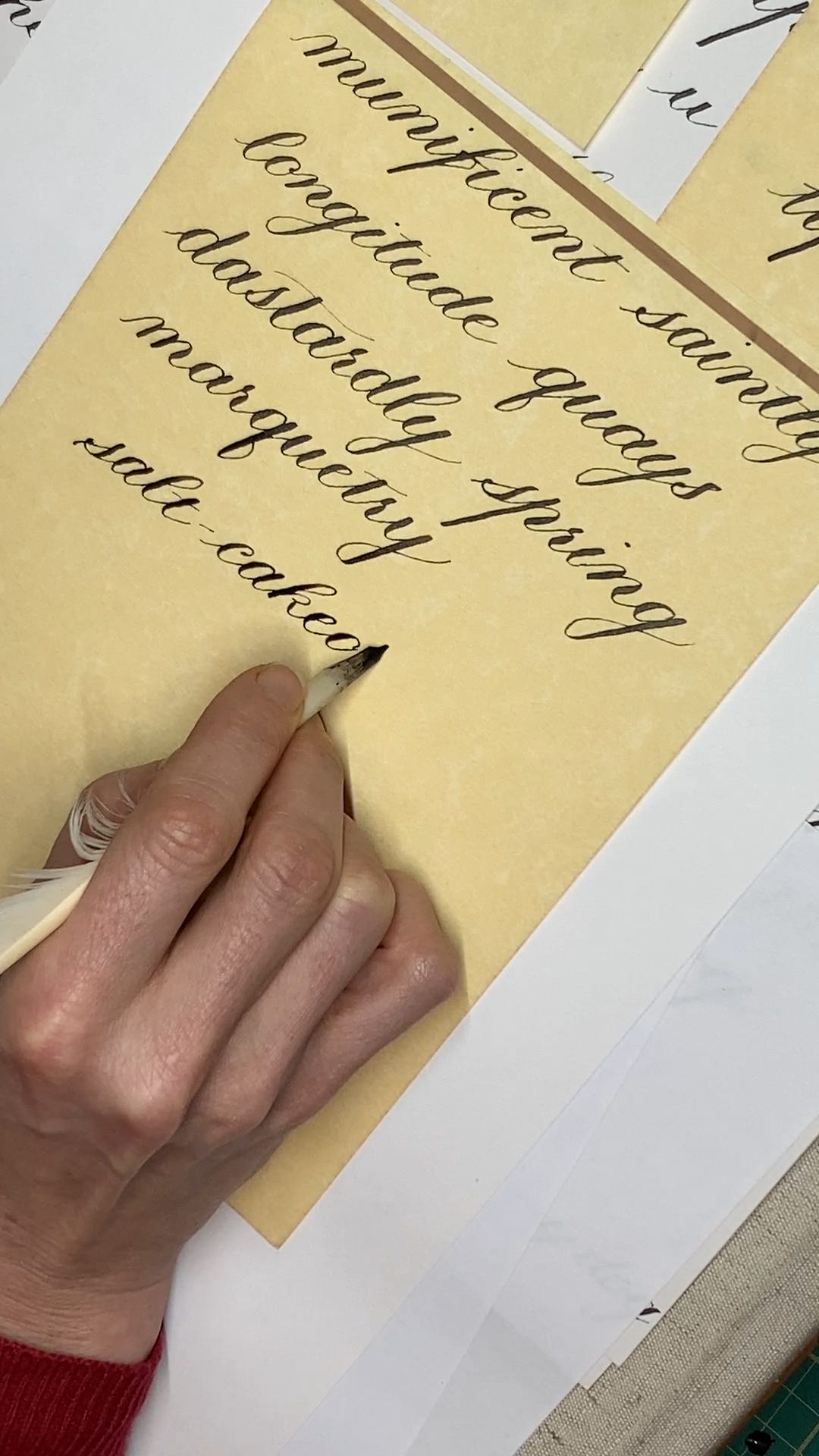
Understanding cursive doesn't make you smarter, but reading in cursive might. Wait, which is it? Thinking about the history of cursive and the American education system gives us a good look at how misinformation and reframing of History often put our kids’ education at risk.
Cursive, or handwriting as it’s often called, became Central to American Education in the late 19th century. By the 20th century, most American children learned to write longhand. If you look back at writing from people trained in American public schools in the twenties and thirties, Many have almost the same look. Why? Cursive was used as a tool to ensure conformity. Many American workers trained in the early 20th century needed to conform; they worked in factories or offices. This society needed lots of people who could think within the box, so training them to write exactly like their peers would ideally create a community of people who thought similarly.
In the 1980s, computerization of factories decreased the number of physical workers needed in those spaces. We went from an age of mechanization to an age of automation; as a result, some educators believed creative thinking would be essential for the workforce of the future. Many of these educators also hoped to create a system of privatized education where some people would profit off the education of others. The Reagan era was the first major time the government began vilifying public education. Why? Many in the Reagan Administration understood there was money to be made off of the education sector.
The seeds of dissatisfaction about American Education bloomed into the ugly Bush-era program No Child Left Behind. This program attempted to transform American Education in order to compete with our ideological enemies, China. Having been in the classroom around that time, I found it largely reduced educators' ability to meet students where they were. Between the 1920s and the early 21st century, the American populace had changed quite drastically. Unlike the segregated communities educators taught in at the beginning of the 20th century, 21st-century Americans live in more diverse communities. Anyone who has spent even a few minutes in an actual classroom understands that diversity brings both the pleasure of many different voices and the need for teachers flexible enough to meet students' real needs. Teaching to a test only works when everybody can succeed on that test with the same type of instruction. Sadly for the American populace, no one in the Bush Administration seemed to understand how American Education actually worked, and as a result, it was disastrous for American students.
One change to the American education system was that children were no longer taught cursive. In the years after No Child Left Behind, most children were falling behind both in their own classrooms and on the international Stage. The Common Core was put in place in hopes that teachers could regain some of the successes they had before No Child Left Behind. They were offered more flexibility; while the tests were important, they no longer required exactly the same curriculum, so kids could at least access the same types of information. As part of this move, more and more states started legislating for cursive. Why many kids seem to lose spatial awareness and small motor skills. Scholars postulated that cursive might not have been just a tool for bringing every learner to an equal, conformist ideal, but also for supporting spatial awareness and small motor skills. Now 25 states require cursive to be taught to American students.
However, there is actually no clear documentation that cursive improves other learning goals. Much of the legislation to bring it back into American Education was a backlash against No Child Left Behind, not based on strong peer-reviewed data.
Even worse, cursive isn’t ancient. Our own writing system draws from what we would call block print. The ancient Romans didn’t use cursive as we think of it. Instead, they had a faster script that didn’t completely modify any of the letters. In the Renaissance, an Italian scholar, Niccolò Niccoli, standardized a slanted, faster writing system, which is the source of our contemporary word italic.
The Enlightenment gentleman gave us our own cursive. English writing Masters created systems like copperplate and roundhand. Their association with erudite, learned men made them essential ways to communicate deep ideas, like, say, the Declaration of Independence. Unlike the earliest fast forms of writing, these systems were essentially a reform of the letters. A literate person could understand both the printed word and two different written ones. In essence, our nation was founded at a time when a thinker needed to read three different forms of any word.
While I will never forgive George Bush for almost anything he did, including No Child Left Behind, there was a historical precedent to the idea that simplifying script might make learning easier. In the Cultural Revolution in China, the communist government simplified many characters. Today, many mainland Chinese readers cannot fluently read the historical characters used by Mandarin speakers in Taiwan. Being able to read and write the fanciest version of your native language does not necessarily make you a better thinker.
So what is the answer for educators about cursive? Sadly, there is no singular answer. When I still worked in education, people regularly asked me about Finland, which had such a wonderful education system. Finland is also one of the most homogeneous Societies in the world, and it’s considerably smaller than the United States. History only tells us one way solutions worked or didn’t work. Given that the present is always different than the past, those Solutions will not work for us. Cursive became a litmus test for how people felt about George Bush, so it returned to American Education not because it is necessarily good for children. In my time in education, I saw children have less ability to think critically and much less ability to use small motor skills. I also think that for many Learners, mastering cursive helps them understand different forms of communication because they can write their own language in two different scripts, as well as read letters from the past. In our largely monolingual society, this affords those Learners some semblance of the heterogeneous thinking multilingual people have.
Notice, though, I did not say this necessarily means cursive is the solution to our children’s problems. Education is not simplistic. There is not one single problem, and so there is not one single solution. I’m using cursive as the example here because many of us have both some understanding of it and often strong feelings about whether it should be taught. But this kind of complicated problem is what we face in American Education every day, and frankly, it is what we also face in American politics. Some leader decides this is the one solution; they push it through based on a very simplified concept of the problem, the solution, and history. As American thinkers, we need to work harder to understand that almost every problem is more complicated; therefore, every solution will have to be multi-fold. History is harder to understand than they have told us, but it does not give us a singular roadmap.