LUTHMANN NOTE: I’m suing Danesh Noshirvan, independent of this “lottery ticket lawsuit,” and I make no secret of my view: this is ambulance chasing with an algorithm. The people he accuses become defendants, while his own publications keep the fight alive. Fort Myers Federal Court Judge Kyle C. Dudek’s orders require something tougher than audience applause. Proof. I welcome that scrutiny. I also reject the notion that only the parties have a stake. A doctor’s practice, an employer, or a family can become tomorrow’s target. Protecting private people from false accusations serves the public. Federal courts should recognize the machinery in front of them and insist that influence never substitutes for evidence. This piece is “Danesh’s Lawsuit Meets Reality,” first available on FL Gulf News.
FORT MYERS, Fla. — Danesh Noshirvan, the SCOTUS-doxxing Mega-Influencer with a body-court, is taking his federal court lawsuit to a jury with a problem his social-media following cannot solve. He still has to prove it.
U.S. District Judge Kyle C. Dudek’s October 20 orders expose weaknesses in Noshirvan’s claims while leaving him to answer for dozens of his own accusations against Jennifer Couture, Dr. Ralph Garramone, and Garramone Plastic Surgery.
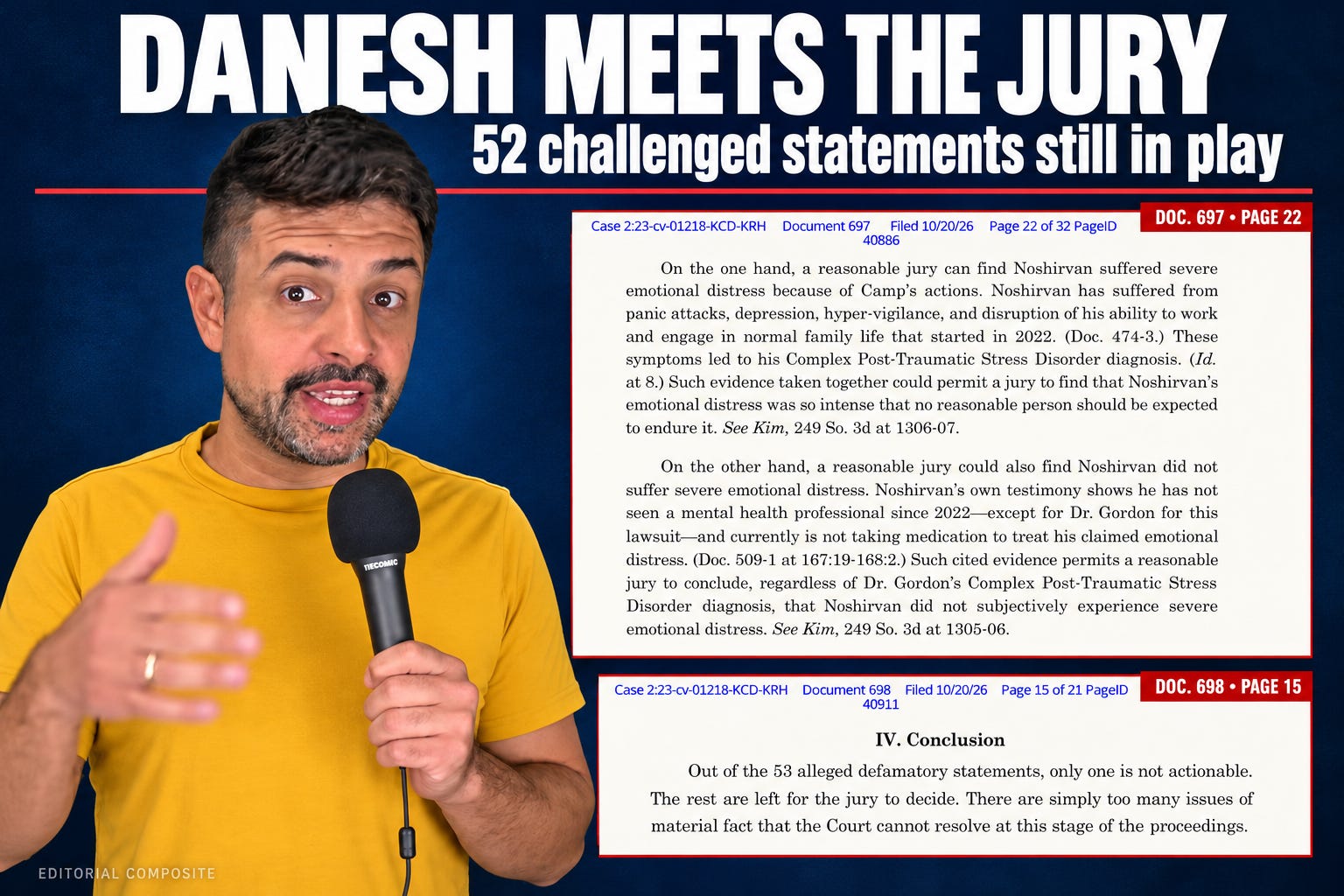
Noshirvan’s motion for partial summary judgment failed outright. His conspiracy claim concerning former attorney Robson Powers failed against all defendants. His effort to dispose of the defamation counterclaims succeeded on one of 53 challenged statements.
The remaining fight goes to trial, where the audience will be sworn Southwest Florida jurors rather than his left-of-center followers who can applaud, donate, and scroll past inconvenient evidence.
Read together, the orders reveal a case considerably more dangerous for Noshirvan than his familiar posture as the injured digital gadfly suggests. He has a contested damages story. His opponents have surviving claims, identified expenses, and a physician’s practice whose reputation became an online target.
The Garramone counterpunch could prove more consequential than the lawsuit Noshirvan filed.
Danesh claims millions of dollars worth of medical injury. However, the recent court orders eviscerated those claims. The most revealing passage appears on page 22 of Dudek’s order on Noshirvan’s claims. The judge wrote that Noshirvan’s testimony showed he had not seen a mental-health professional since 2022, apart from Dr. Gordon for this lawsuit, and was not taking medication to treat his claimed emotional distress. That is an awkward record for someone asking a jury to find suffering so severe that no reasonable person should be expected to endure it.
Dudek expressly said that evidence could permit jurors to reject severe emotional distress despite Gordon’s Complex PTSD diagnosis. A litigation expert’s conclusion does not settle what the plaintiff actually experienced, what caused it, or how much compensation follows. There is a substantial difference between presenting a diagnosis and persuading jurors that the underlying facts support the damages pitch.
The same page identifies evidence supporting Noshirvan: panic attacks, depression, hypervigilance, and disruption of work and family life. Dudek also found that the threats described in the record could meet Florida’s outrageous-conduct standard. Those findings explain why the distress claims survived. They also define the trial: the jury must weigh that account against the treatment history, credibility, causation, and the rest of the evidence.
Noshirvan is no shrinking violet. The publications reproduced in the companion order show a man repeatedly calling his opponents child stalkers, invoking imprisonment, and attacking a surgeon’s professional reputation.
Continued broadcasting does not diagnose anyone’s mental health. It does give the defense a concrete public record to examine alongside his account of disrupted work and life. Jurors can consider what that record proves without pretending that either an aggressive persona or an expert’s label answers every question.
The failed Powers conspiracy claim supplies another warning about the distance between accusation and proof. Dudek found that the cited evidence predated the relevant attorney-client relationship or did not concern Powers. It could not reasonably establish that the defendants agreed to interfere with a relationship that did not yet exist. An impressive stack of exhibits cannot repair a missing link.
The counterclaim order is particularly uncomfortable for Noshirvan and his lawyer, Nicholas Chiappetta of Lake Worth, Florida. Fifty-two challenged statements remain within the case’s six defamation counts.
Judge Dudek removed Statement 32 from the original 53 and otherwise denied Noshirvan’s motion. His concluding instruction leaves the rest for the jury.
Along the way, Judge Dudek dismantled several proposed escape routes. “Noshirvan, again, cherry-picks words rather than looking to the whole context of his publications,” he wrote. The posts presented themselves as news, complete with “BREAKING!,” promises of proof, and datelines. Yet an article accusing Garramone of perjury did not supply the supposedly perjurious testimony. A publisher cannot manufacture the appearance of documented reporting and expect every damaging assertion to dissolve into harmless opinion when challenged.
The judge also distinguished paying Camp from paying him to stalk, threaten, or harass a family. The first fact does not automatically establish the second accusation. And when Noshirvan described hometown flyers as accusing him of being a local pedophile or child murderer, Dudek observed that the flyers instead used “predator” and “swinger”. Those remained serious accusations, but their sting differed from the story Noshirvan published.
Chiappetta’s side also argued that the retraction notice failed because opposing counsel served him instead of his client. Dudek called that argument “frivolous.” The attorney-client agency relationship answered the objection; the judge additionally noted the ethical problem with demanding that opposing counsel bypass a represented party’s lawyer. That criticism belongs beside the failed privilege arguments. Broadcasting allegations to followers did not give Noshirvan the litigation immunity he claimed.
To my eye, this is ambulance chasing upgraded for the algorithm. Noshirvan keeps delivering accusations about the people he is suing, while his lawyer advances a demand that those same people compensate his claimed injuries.
Judge Dudek’s rulings put both halves of that arrangement before a jury. The influencer’s own publications are now evidence in claims against him.
Dr. Garramone and his practice describe themselves as bystanders dragged into the original parking-lot controversy. Their counterclaim alleges that Noshirvan turned on them because they did not “immediately fire” Couture. It seeks damages for reputational injury, lost patients, and other financial harm. These counterclaims address later publications; the practice and doctor expressly excluded Noshirvan’s January 2022 through December 2024 conduct from those claims.
Judge Dudek found sufficient counterclaim damages evidence for trial even without relying on disputed reputational harm. He identified security personnel, an enhanced security system, and Couture’s mental-health treatment. He also found at least five statements specifically naming Garramone Plastic Surgery. The practice cannot simply be edited out of the story when its name helped carry the accusations.
The later conduct remains contested. Dudek found evidence from which jurors could attribute Camp’s actions to the practice, and evidence from which they could find he pursued a personal vendetta beyond legitimate reputation work. Couture and Garramone also failed to obtain summary judgment on their counterclaims because falsity remains disputed. The doctor’s and practice’s absence from the parking-lot confrontation does not decide every subsequent allegation. Their opportunity now is to establish what Noshirvan’s publications got wrong and connect those statements to actual harm.
One passage deserves a sharper challenge. Rejecting Noshirvan’s attempt to classify the counter-plaintiffs as limited public figures, Judge Dudek wrote: “No reasonable person would expect for anyone beyond the immediate parties to be impacted by the lawsuit’s resolution.” He characterized the case as parties throwing mud at each other. Dudek finished that description on the next page: “Nothing more.”
The legal result favors Couture, Garramone, and the practice: they need not prove actual malice. That protection is important. Going viral should not automatically conscript a private citizen into public-figure status.
But Judge Dudek’s broader description understates what this litigation exposes. Preserving private-party protections and recognizing a case’s public significance are entirely compatible positions.
Cancel culture reaches beyond the person in the original video. Employers, professional practices, families, and customers can all become pressure points. The machinery turns especially ugly when an influencer repeatedly publishes criminal accusations about his targets while seeking money from them in court. The public has an interest in whether the judicial process meaningfully distinguishes demonstrable injury from a profitable victim narrative, and legitimate criticism from actionable defamation.
Let that distinction blur, and the incentive is obvious. Every aspiring TikToker or YouTuber can imagine an outrage campaign followed by a federal lottery ticket against someone with assets. Courts need not assume such a motive in every case. They do need to insist on proof, police frivolous arguments, and recognize the consequences when litigation becomes another source of content and leverage.
Judge Dudek reads like an institutionalist, and these orders show a judge doing the hard work of separating legal defects from factual disputes. That makes his cramped description of the public stakes particularly unfortunate. The federal judiciary earns public confidence by demonstrating that social media mega-influence buys no evidentiary shortcuts and that private people retain meaningfully enforceable rights when a mob finds them.
The trial will decide liability. The institutional lesson is already visible: a following cannot substitute for proof of injury, and a lawsuit does not immunize the plaintiff’s own publications.
Noshirvan and Chiappetta now face a jury that can examine both the claimed victim and the damage his accusers say he inflicted. The rest of us have every reason to watch.