Epistemic status: unusually irritable post.
Is it acceptable to have mainstream philosophical views? Is it acceptable to *apply *those mainstream positions to important questions—especially when you are voluntarily giving away $10,000? A great chorus of people on the internet has risen up and answered this question: NO, FUCK YOU! The anti-tradeoff uniparty has spoken. Tradeoff acknowledgment detected, opinion rejected.
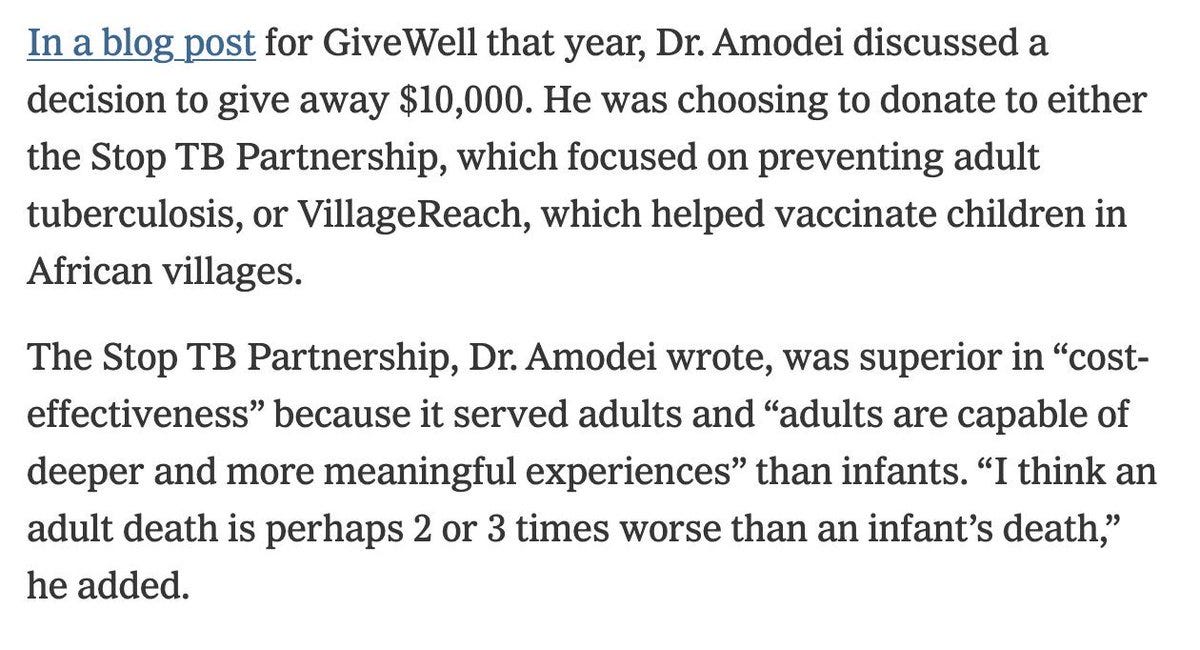
Back when Dario Amodei was a grad student at Princeton, he was deciding how to give away $10,000 that he’d made one year. His plan was to give away a significant chunk of his income over the course of his lifetime. Dario wanted to do the very most good he could with his money. In a GiveWell post, he laid out his reasoning (this ended up not making an ultimate difference, because he later concluded that Village Outreach was more effective, which is the charity that helps infants):
GiveWell makes explicit cost effectiveness estimates (based in part on those of the
) for both organizations:[Disease Control Priorities report], and[~$545 per infant death averted for Village Reach]. These are roughly comparable, but don’t take into account the fact that Stop TB mainly treats adults, while VR mainly treats infants and children. I feel that adults are capable of deeper and more meaningful experiences than are infants, and also deeper connections with other people, so an adult death seems worse to me than an infant death (though both are of course bad). Trying to quantify exactly[~$150-750 per death averted for Stop TB]howmuch worse is very subjective and can also seem calculating (“how many babies wouldyoukill to save an adult?”), but on a practical level one is forced to make difficult decisions with limited funds, and in my case I’d say that I think an adult death is perhaps 2 or 3 times worse than an infant’s death. Thus, adjusted for my personal values, I’d say that Stop TB is ~2-3 times more cost-effective than VR, though I understand that others may validly disagree with this subjective assessment.
Now, I have some disagreements with Dario. For one, I find the view that infant death is less bad than adult death to be implausible. Saving an infants life adds more years of happy life. In addition, I’m not a subjectivist, so I don’t agree with Dario’s claim that it’s a “subjective assessment.”
But these are ordinary philosophical disagreements. Overall, I think it is very admirable that Dario gave away a big portion of his yearly income after carefully thinking about how to do the most good. When you’re making important decisions, you should think about them carefully. It is better to think carefully and be wrong about some issues than not to think at all and go based on vibes.
Other people, in contrast, reacted with shock and horror that he would be so cold and calculating. For example, here was the response of Guardian journalist Moira Donegan:
Now, perhaps I’m just cognitively defective, but I would think that if making high-stakes decisions, one should consider tradeoffs. If you are deciding between two charities, you should give to the one that does more good. In order to figure out which one does more good, you should think about how much good each one does.
Sometimes, that involves comparing the value of saving different lives. It is better to save a 25-year-old than a 98-year-old Grandmother who will die anyways in two weeks (𝕏contra some of Dario’s critics). Now, there is a mainstream view in philosophy according to which saving people who are 20, say, is better than saving infants. I disagree with this view, but it’s the kind of thing that one should think about if they’re deciding between saving adults and infants.
I assume that the “subjective and qualitative thinking” that Moira Donegan has in mind does not involve doing Dario’s reasoning but with different numbers. Instead, it involves going with vibes—donating wherever feels best to you. Donegan’s pinned Tweet is:
It would be very surprising if Donegan did a careful cost-benefit analysis and concluded that this was the best way of bettering human lives. Instead, I assume what happened is that she gave to a cause that she felt good about, without carefully thinking about how to do the most good. This is the kind of “subjective and qualitative thinking” she has in mind.
Here’s how I see this: imagine that there were many people drowning in ponds. Every person in society can either save a bunch of children, but that might not work at all, or can save a few adults. Doing either is expensive. Dario, a grad student of modest income, after doing some quick mental arithmetic, decides to save the few adults.
Then, a Guardian journalist standing by the pond and ignoring the screams of both the children and the adults claims that Dario is cognitively defective for making this choice and begins sanctimoniously lecturing people about how even bothering to think carefully about the question requires lacking “pro-social impulses.” She decides to give to a random charity funding abortions, without thinking at all about whether it does the most good.
It is *absolutely outrageous *for those who spend no time thinking about how they do the most good with their charitable giving to lecture those who think about it carefully. It is enraging that people pat themselves on the back for not thinking at all before making hugely consequential decisions where other people’s lives are on the line—and then have the gall to lecture those who do think carefully about this question.
If Dario had simply pocketed the money and spent it on a nice car, nobody would have been mad. It’s only because be bothered trying to do some good that anyone is outraged.
Moving on to marginally more serious criticisms, this one from , whose blog I’ve sometimes enjoyed.
But obviously the public isn’t aghast because of the specific number. If Dario had instead said that it was 1.3 times better to save an infant, people would have been similarly aghast. Instead, the thing people are outraged about is that he’s trying to think explicitly and legibly about tradeoffs. He is willing to think about whether some other things are worse than the death of an infant.
But this is what we should do. There are tradeoffs in the real world, whether or not we bury our heads in the sand and pretend they don’t exist. Children are dying. So are adults. We cannot save everyone, so we have to think hard about who to save. Every moment, we are in triage.
The other point: the position that Dario is defending is a popular and mainstream position in philosophy. It might even be the plurality position among philosophers. It’s supported by the fact that on most views of personal identity, identity is a degreed property that fades over time—so if there is someone that is only minimally connected to their future self, their interests in living count less. Now, I disagree with this view! But if you act based on mainstream philosophical positions, while it’s okay to argue against them, it’s unreasonable to act like even considering them is beyond the pale.
Again, just think about the big picture here: a grad student (hardly a millionaire) decided to give away 10,000 dollars and thought carefully about how to do the most good. In making his decision, he endorsed a mainstream philosophical view. The reaction of the internet—most of whom haven’t given away 10,000 dollars in their life, much less with any eye towards effectiveness—was self-righteous revulsion and disgust.
You’re allowed to spend however much money you want on yourself. You’re allowed to give to whatever charity you feel like. But what you’re not allowed to do is think about how to do the most good with your charitable donation. What a crazy world we live in.
Has a wronger statement ever been made? Dario’s statement was explicitly very hedged and qualified. He explicitly said that it was a difficult question where reasonable minds can differ. In contrast, his critics have—almost without exception—treated this as the most trivial problem in the world, without even bothering to consider counterarguments. I do not understand how a person could see this dispute and treat *Dario *as the one self-righteously declaring the question to be easy.
Did Orlowski think for two seconds before Tweeting this obvious bullshit? He is either lying or basically ignorant. It would be a remarkable surprise if EAs thought that infants aren’t deserving of help when every single GiveWell top charity helps infants. Contrast that with Andrew Orlowski who, best I can find, has only ever mentioned charities that save the lives of infants to smear the people who give to them. My guess is that Dario did more for poor African infants that year than Orlowski will do in his life.
EAs have dedicated billions of words to saying that infants don’t deserve help? What the hell is he talking about? We’ve dedicated billions of dollars to the idea that they do! Not only is this not “the only thing [we] can all agree on,” it’s not something that any EA I know thinks.
Is there anything more irritating than smug know-nothing journalists who have done nothing—so far as I could find—to improve the welfare of infants sounding off on the EAs who have given billions of dollars to the most effective charities benefitting infants? This would be rather like saying that the only thing that Jeffrey Dahmer and Ted Bundy can agree on is opposition to murder or the only thing that Orlowski, Black, and Donegan can agree on is opposition to smug-self-righteous drive-by pointing and sputtering.
The good news is that woke is back babyyyyyyyyyy.
Note that the logic here is not utilitarian, as the time-relative account of interests is, in fact, in moderate tension with utilitarianism. Nor is it a commitment of EA—I’m an EA, I don’t agree with the time-relative account of interests. It is, however, a core feature of EA that we think about ethical questions that bear on the value of different charitable endeavors rather than burying our heads in the sand and snidely sneering.
Naturally, I responded to Khlaaf:
I learned, however, that It’s Not Her Job To Educate Me:
This is a funny request when there are books that defend the view that Dario was defending written by some of the most eminent philosophers in the world. The fact that you and your leftists friends decide to sneer at a view in unison does not mean that blanket opposition to it is the opinion of those with An Education. It’s particularly galling to treat the anti-intellectual view that we shouldn’t even think about a totally mainstream philosophical position as the view that anyone who has “read a book” would have.
So Dr Heidy Khlaaf, genuinely read a book:
HE WAS DONATING TO LIVESAVING CHARITIES!
HE WAS CHOOSING BETWEEN CHARITIES THAT HELPED AFRICAN INFANTS AND ONES THAT HELPED AFRICAN ADULTS. And he gave to the ones that helped the infants. None of the people in question were “‘developed’ white men.” I realize it is more convenient, when disagreeing with people, to hallucinate that they are saying things completely different from what they are in fact saying, but come on—there is no law that says you have to call people racist for what they say, without knowing the context.
If an LLM engaged in hallucinations this extreme, this fact would be treated as exhibit 2,583 illustrating that LLMs are just Stochastic parrots. Fortunately, an LLM these days wouldn’t make such a mistake; these kinds of mistakes are reserved for leftists bringing out all the smear tactics they can muster against a person who deliberated and then decided to spend a big chunk of his money saving African infants—something that virtually none of his critics have ever done. Like Richard (read his excellent article on the topic here), I find it hard to express how messed up I find this whole situation without swearing.
It is a sad fact that Dario is getting heaps of scorn from people who don’t give much to charity because, as a graduate student, he both donated a lot of money and thought hard about where it might do the most good. Had he foregone either of these—spending the money on a car, given it to a charity determined by Ouija board, or even lit it on fire—nobody would have been outraged. You’re allowed to do good so long as you don’t think too hard about it.