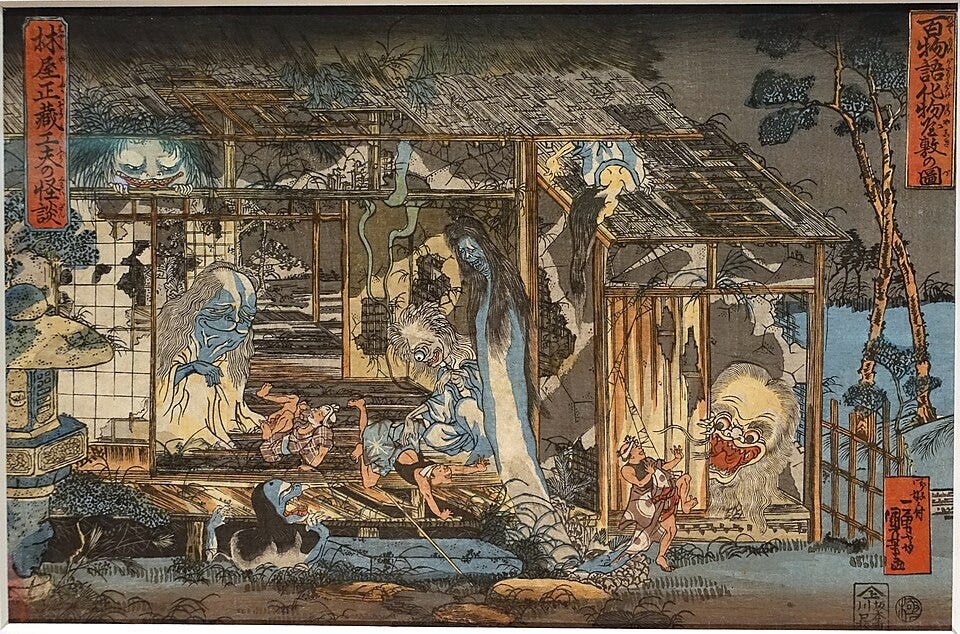
What was the first thing you noticed? You might not remember. Our eyes work faster than our minds. We usually take in plenty of visual information, skipping past what we think is useless, until our intellect catches up. But your eyes were taking in things like the colors and form. Our eyes orient before our minds catch up. The first thing you think you noticed was probably the first thing you could make sense of. But in this instant-coping strategy, we often miss a useful step—getting lost.
While prehistoric people needed to assess danger quickly, today, our minds could use slowing down. Pushing yourself to look, then look again, is extremely helpful. In this print, the artist included plenty of spooky ghosts and some scared people. As I wrote the other day, many of these Japanese prints were meant to be collectibles that owners could pull out and view repeatedly. Therefore, people wanted lots of details to keep their attention. So, try the exercise the original owners did. Look today. Set a timer for 5 minutes. Write down everything you’ve noticed. Do the exercise again tomorrow with a clean sheet of paper. Compare your list. Did anything new appear on the second day?
We live in an instantaneous society. Images are meant to be forgotten. But historically, art was meant to be enjoyed. You were meant to create a relationship with an artwork. In most eras, even the wealthy had a finite number of visual images in their life. Collectively shared images existed in worship spaces. At home, people probably passed down religious imagery. Secular, even enjoyable, images would be rare.
Think about our lives now. How many images did you look at today? On social media? On your drive? In the grocery store? If you use social media, you likely see (and forward) some of the more than 3.2 billion images and 720,000 hours of video shared daily. Amid the proliferation of imagery, we usually don’t form a unique relationship with any one image. We’ve given up special for plenty.
Teaching yourself to look slowly helps you build deeper relationships with fewer images, but it also helps you learn how to pick, from the flood of digital imagery, which ones to care about.