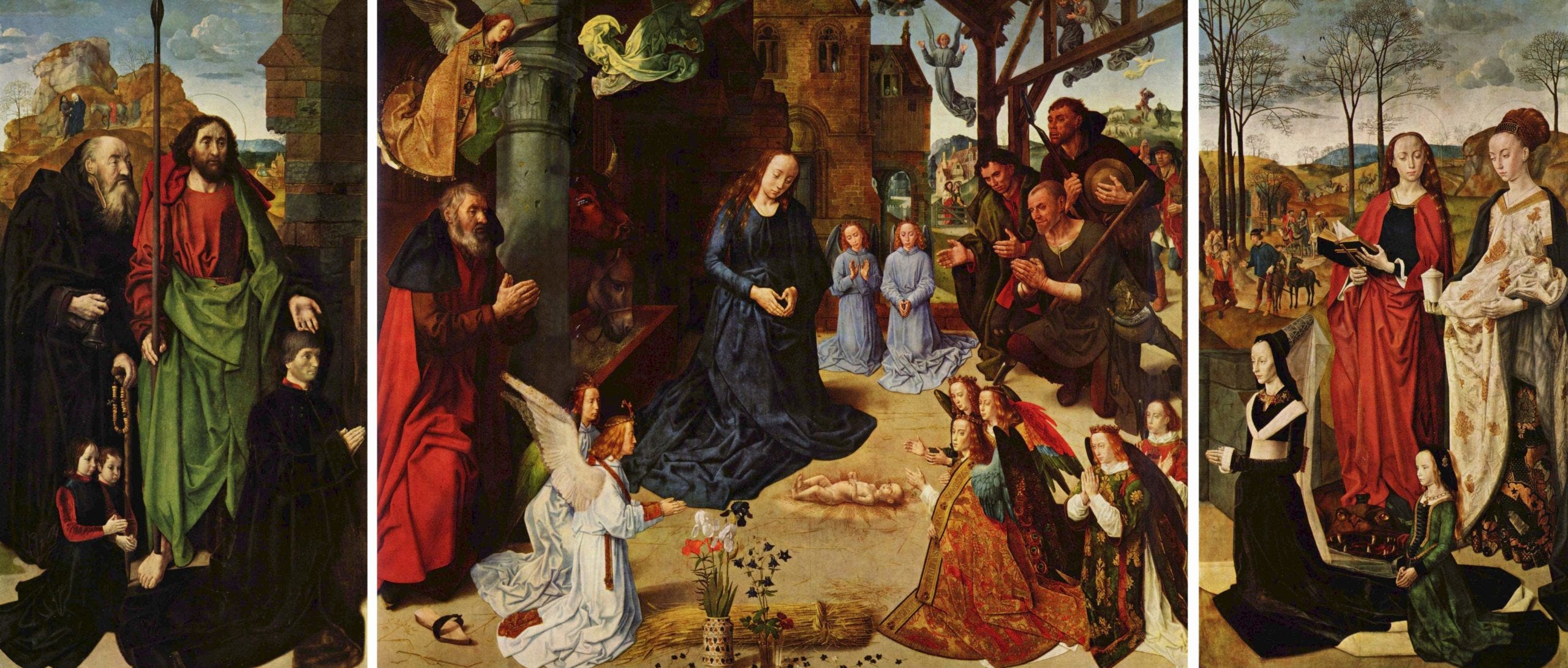
On May 28, 1483, sixteen porters lugged this large altarpiece into a chapel in Florence's oldest hospital. It took ages to arrive from Ghent, first by sea into the Mediterranean and then up the Arno River. The wait was worth it. The art world would never be the same after the Portinari Altarpiece was opened. Explore this artwork.
Notice how some people are airbrushed, and others are unsparingly honest. Compare the realism, crooked noses and all, of the shepherds with the fine faces of the angels. The stark contrast highlighted how different divinity was, as in the divine glow of the infant Jesus or the splendor of the Saint’s vestments.
But the Renaissance viewer’s excitement would be in exploring how each artist composed the familiar scene. They’d expect to see shepherds, Mary, Jesus, Joseph, the Ox, and the Ass. They’d likely spend time just finding each element.
They’d understand how to read these works — to actively look for each vignette. Most altarpieces have a central panel, the work’s subject. The side panels often include additional elements of the religious story or elements that support the importance of the central work. In this case, on the far top right, you see the Annunciation to the Shepherd, with the same three men speaking with an angel.
Along with the narrative elements, this work includes symbolic elements that were particularly popular in the Northern Renaissance. There is a multitude of symbolic elements: an empty shoe implying the sacred space of the manger cannot be sullied by dirty shoes, the sheaf of wheat for the host, the columbines for the seven sorrows of the Virgin, the violets strewn on the ground for humility, the glass vessel as a symbol of the Virgin as the vessel of Jesus, the vines on the apothecary jar as a symbol of the blood of Christ. This short list hardly touches all of the symbolic elements in this work.
Read more about this work: