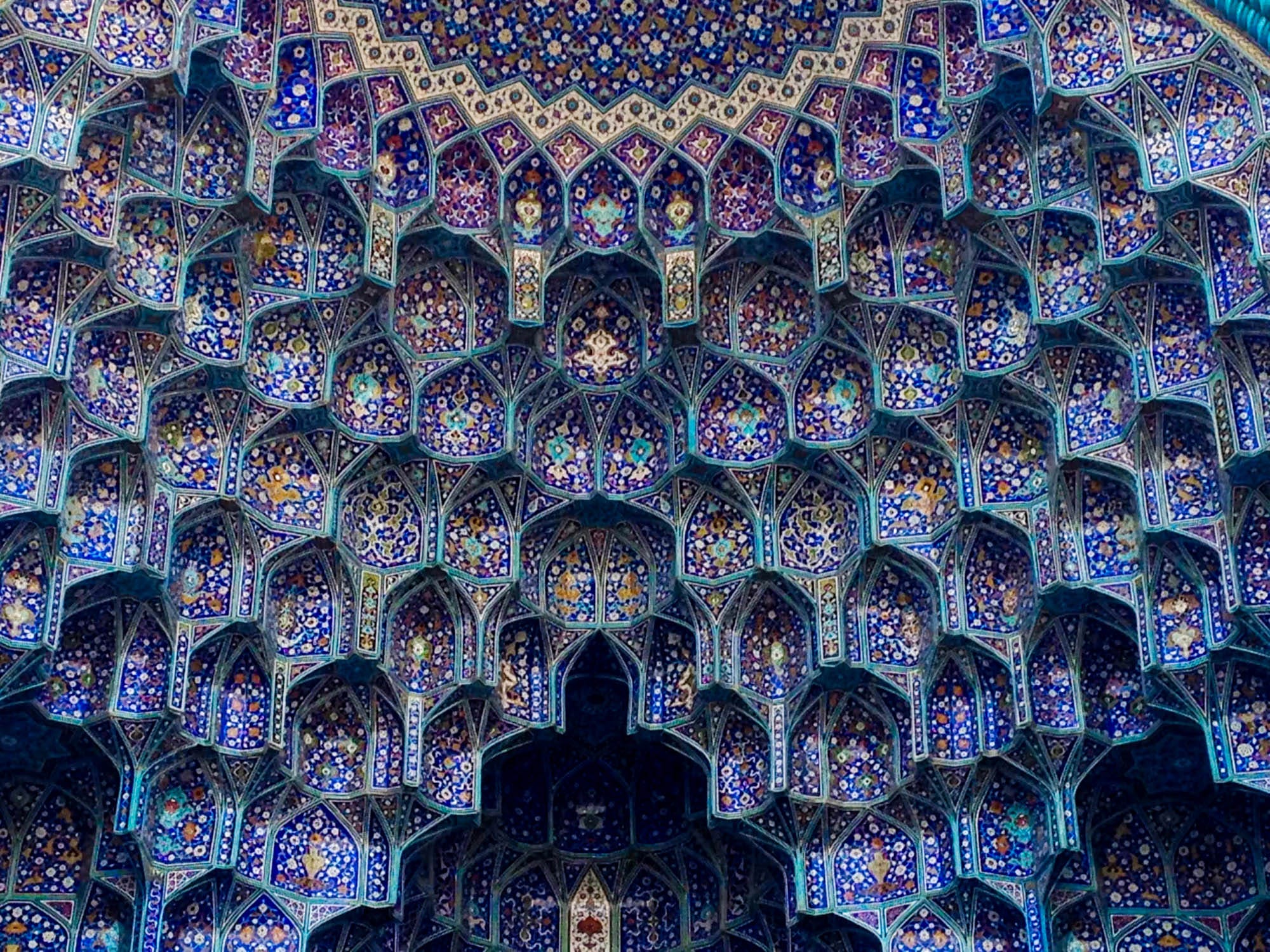
One of my relatives loved National Geographic. Piles of them sat in their house, and flipping through a feature on the city of Isfahan was life-changing. Blue had already been my favorite color. But to see the ways in which blue was modulated that deep, as your being, balanced by pops of lighter blue and then accented by white and yellow, the physical space looked transformational. I have no idea what the article said; the words didn't draw me in.
Color communicates with us in ways no word ever can. By this point in this very short article, you might have already moved past what I’m discussing and focused on the point underlying this essay. Our connection to color is almost primordial. Globally, blue is regularly among the most favorite colors. No matter what environment you live in, blue is universal thanks to the sky. Is this why people seem to gravitate to the color blue?
The connection to the sky may be why blue was so often associated with faith, like the sky-blue robes of the Virgin Mary. In the West, this association might be why blue was so commonly featured in Modern art. Kandinsky often featured blue in his compositions, saying, “The deeper the blue becomes, the more strongly it calls man towards the infinite, awakening in him a desire for the pure and, finally, for the supernatural…”
Now you might think, but so many cultures didn’t have a word for blue like the ancient Greeks. While Homer called the Adriatic the wine-dark sea, it wasn't because they didn’t conceptualize blue. It’s simply that their linguistic expression of color was different than ours. Having seen the Adriatic on choppy, stormy nights, blue as a word doesn't capture the kinds of terrors those sailors might have imagined looking down into the water. Language cannot fully articulate what we feel.
The ethereal power of blue drove people to buy exorbitantly costly pigments like lapis lazuli, but it also drove innovation. In ancient times, Egyptians figured out how to synthesize blue. Commercial blue paint tubes made the Impressionists' landscapes possible.
Imported blue pigments made Hokusai’s wave a delight (his earlier works didn’t quite sing). But then those blue-forward prints inspired Van Gogh. The delights of blue generated more delightful blue artworks.
But what strikes me from that early moment on the floor with a National Geographic is the way that blue creates the mood, however joyful, solemn, or meditative. It feels like there is a blue for every moment. What’s your favorite blue artwork?