This is part of my FREE series, 75 Days of Media Literacy.
I spend hours exploring communication in photojournalism. How is each image constructed? How does the artist use their voice to share the moment? In photojournalism, the artist is also a journalist. They report to the viewer what really happened. This kind of photography is incredibly different from portraiture, where you create a portrait for money, often of a sitter.
Weddings help explain the difference between reportage and seated portraits. You have formal portraits done for your wedding. That image should center you and your spouse. The candid pictures at the party often tell the actual story of what happened. Many of those images might show you as the main character, with everyone around you supporting you. When you see wedding images, the main character, though, is often the couple together. Often, the couple is unstable, so one person clearly comes off as the main character; given that the point of the event is for two main characters to come together, the photograph reveals a truth the couple might not have wanted shared. This is what I think every time I see a video of a husband destroying a cake. He couldn't handle sharing the spotlight.
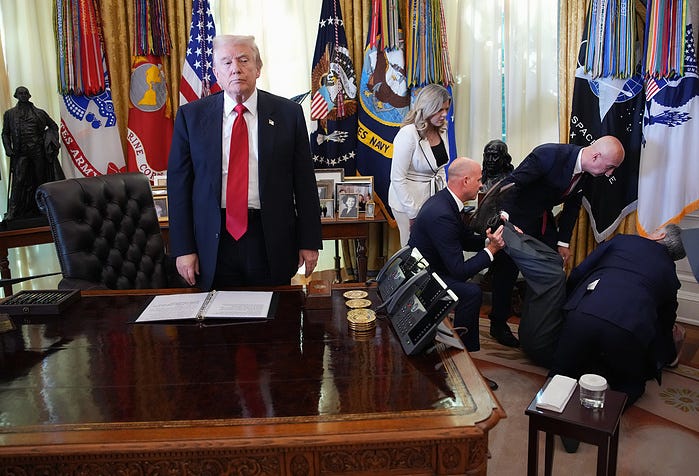
Photojournalism functions like candid images of weddings, helping you understand what’s happening in the photograph. Look for the main character: is your eye drawn to the person who should be the main character? For example, if there’s a picture of Donald Trump amongst other people, what is the visual tension between the two? Is the main character giving the emotional expression you would expect in the event? Andrew Harnik was on site when somebody fainted in the Oval Office. Trump stood completely unaffected while everyone else went to the aid of the afflicted. Dr. Oz was at the fainted man’s side; I hope he made a full recovery.
Creating complicated visuals that balance the perceived main character with something else is a classic tool of artists. It’s the visual equivalent of “point counterpoint”. As a viewer, you are meant to judge based on relative intensity. Here is the Virgin Mary, but my eye is drawn to these figures on the left. Why isn't the Virgin the center and the point? Sometimes the answer to these compositional questions lies in an object's function. If you are purchasing an artwork for your home to use for devotion day after day, you don’t want a simple composition that will bore you after a few viewings.
Sometimes the answer is in the story itself. Many nativity scenes will show the Infant Jesus with the ox and the ass, the two beings who, at his birth, immediately understood he was the Son of God. But the story of the nativity comes in multiples: first the animals, then the shepherds, then the Magi, so combining all those elements in a visual that is still balanced and appealing means creating a composition with enough interest in the secondary and tertiary stories to keep you looking.
Animals and art are good examples of why figuring out the main character can be hard. In European painting, a dog often symbolizes fidelity in a marriage. But given the ubiquity of dogs and homes, it was also a tool of levity. Since this is a moment before the moving image, the visual artist is saying there are two main characters here; connect to the one you choose. Today, we would toggle between two cameras showing the two main characters of the scene.
Social media has also transformed who the main character is because we can crop large images to center figures that were originally meant to be a foil. One of my favorite details in the Ghent Altarpiece is the angel in the choir who isn't paying attention. In the Renaissance, it became fairly common to add one angel or one saint who acted in a human way, goofing off or making a face. This tool helped cement the artist's prowess at capturing real life, but it was also an Easter egg for viewers. But now, for those of us who see these images almost exclusively online, we can cut out the details we find interesting and transform who the main character is. The figure that was originally a visual foil to the action becomes centered in our contemporary visualization of that artwork.