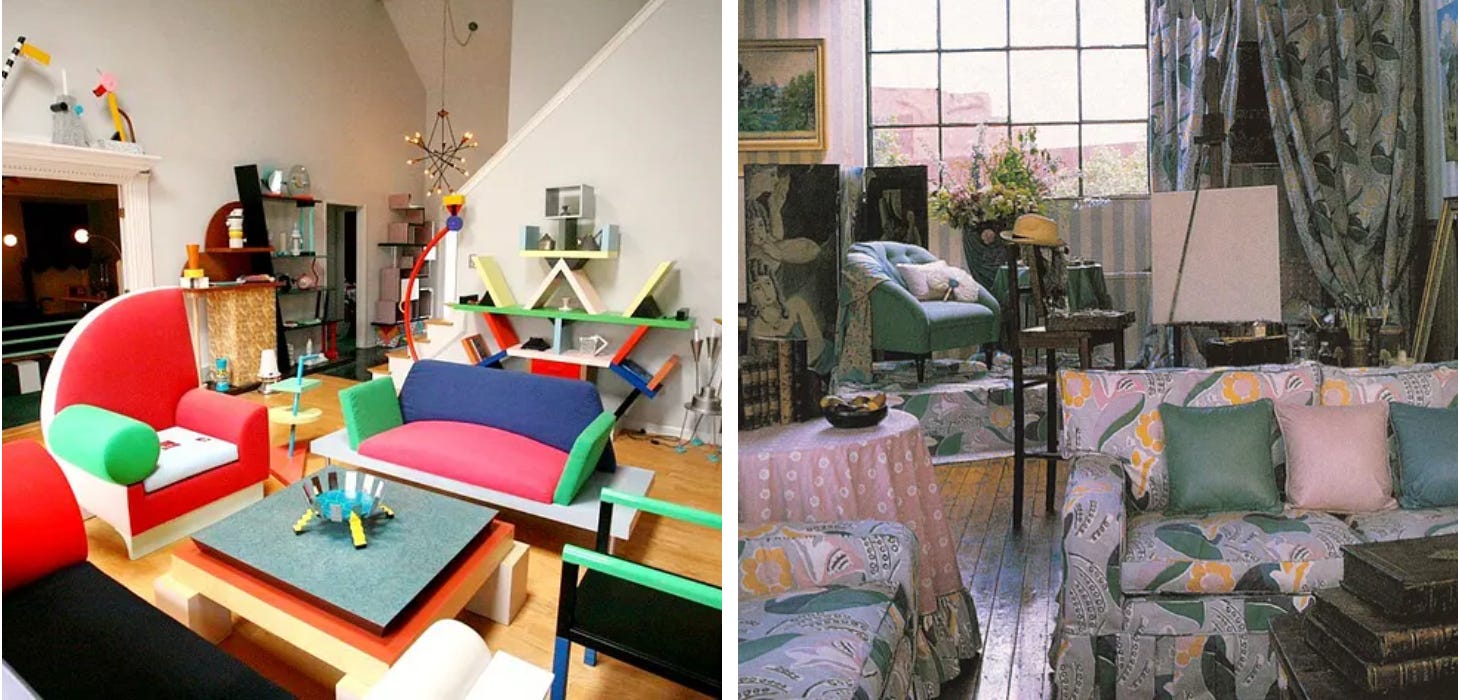
Think of your youth. Now, try to put the aesthetics of your childhood into words. For me, I remember a lot of bright colors with pops of black and white. But another person who thinks back to their 1980s childhood might remember lots of mauve and floral.
The Memphis Milano design firm, which pioneered the bright-colored style, became enormously influential in the 1980s. Laura Ashley and Miami Vice pushed the pink trend, though in drastically different ways. If you’re learning design history, you might study Memphis Milano, a high-end style that typifies the most groundbreaking elements of the 1980s. You’d believe this was the only 1980s if you hadn’t ever survived mauve-and-teal interiors after mauve-and-teal interiors.
Art historians attempt to make sense of art over history. Their work draws together themes, as art is a historical document. They might notice that many artists are focusing on pop culture and call it pop art. These periods help people learn the basics of art history. That said, they need to simplify and share the story. Movements are often approximations to help you make sense of a group of artists. History is often distilled to facilitate knowledge scaffolding. But remember, good stories are always an interpretation. So art movements tell one story, leaving out many others.
Human error is also baked into these discussions of movements. People determine canonical movements, shaping future art history within the spaces of their galleries and exhibitions. These power brokers didn’t have foresight or a time machine; they had money and aura. Learning the movements can help you make sense not just of the art of the time but also of what these power brokers valued. Take movements, just as you take the idea of decades, as framing tools that give context. But remember, some people will be outside these movements.
In other words, don’t just take art history at face value. Question who is included and who has been forgotten. Ask why people chose to be outliers. Think about whether you prefer the outliers or the popular styles. Making sense of history isn't passive, unless you want its meaning to pass you by.