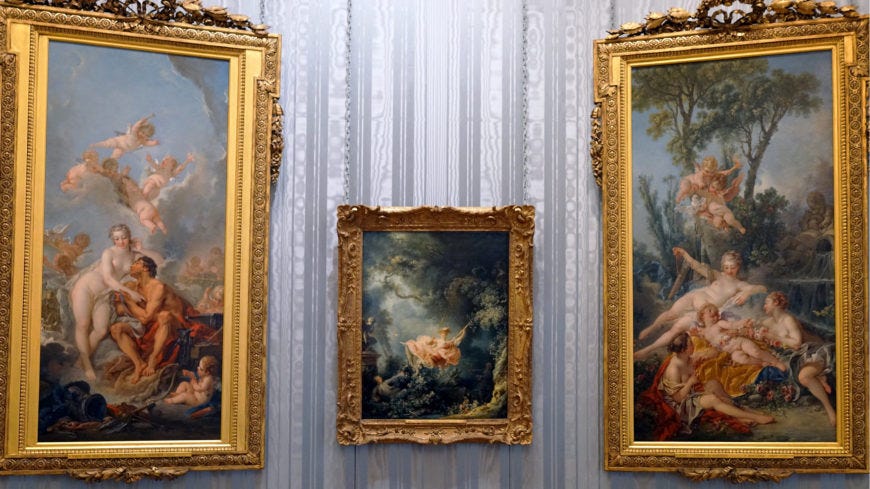
How did the original person experience an artwork? Was it hung up high? At waist level? Was it meant to be seen alone or looked at with many people? An artwork's size often helps you estimate its original audience.
If an artwork is about shoulder width or smaller, it’s often meant to be viewed alone.
The famous Rococo work *The Swing *is often shown in reproductions without its frame. Digitally, it’s hard to assess its scale. In person, the work is fairly small, approximately 31.8 in × 25.2 in. Science fair posters are usually bigger.
This salacious artwork shows a man looking up a woman’s dress, as another man pulls the swing. But the work shows a gentleman in his small study, where he could spend a moment quietly reflecting on the pleasures he’d had and the ones he planned. The elite say that play and games are essential to their lives. The French court lived on gossip and intrigue, much of which occurred while they played games. Foolish in many ways was serious business. Cultivated people had diversions and could let loose—and their cachet at court depended on it.
But images like The Swing weren't viewed in polite company; instead, gentlemen likely kept them in a study. In our time, the comparison might be our phones. Think of the transgression you’d feel if someone you didn’t know (or your mom) went through your camera roll. We might extend this comparison to your social feeds. Algorithmic social media has made the feeds speak much more closely to our needs.
In comparison, altarpieces were made for congregations. The scale helped ensure all worshippers had a tool to help them focus their prayer. But donors also loved the scale—as it helped everyone see their largess. Take Hugo van der Goes’ Portinari Altarpiece.
Tommaso Portinari was an ambitious Italian who worked for the powerful Medici Bank in Ghent. Born into a prosperous Florentine family, he sought fashionable items to collect in his free time. Hugo Van Der Goes was a busy artist who created the fashionable Northern paintings Ghent society loved with minute, realistic details. Basically, Portinari wanted to buy from the best to show he was the best.
**Read more about these works: **