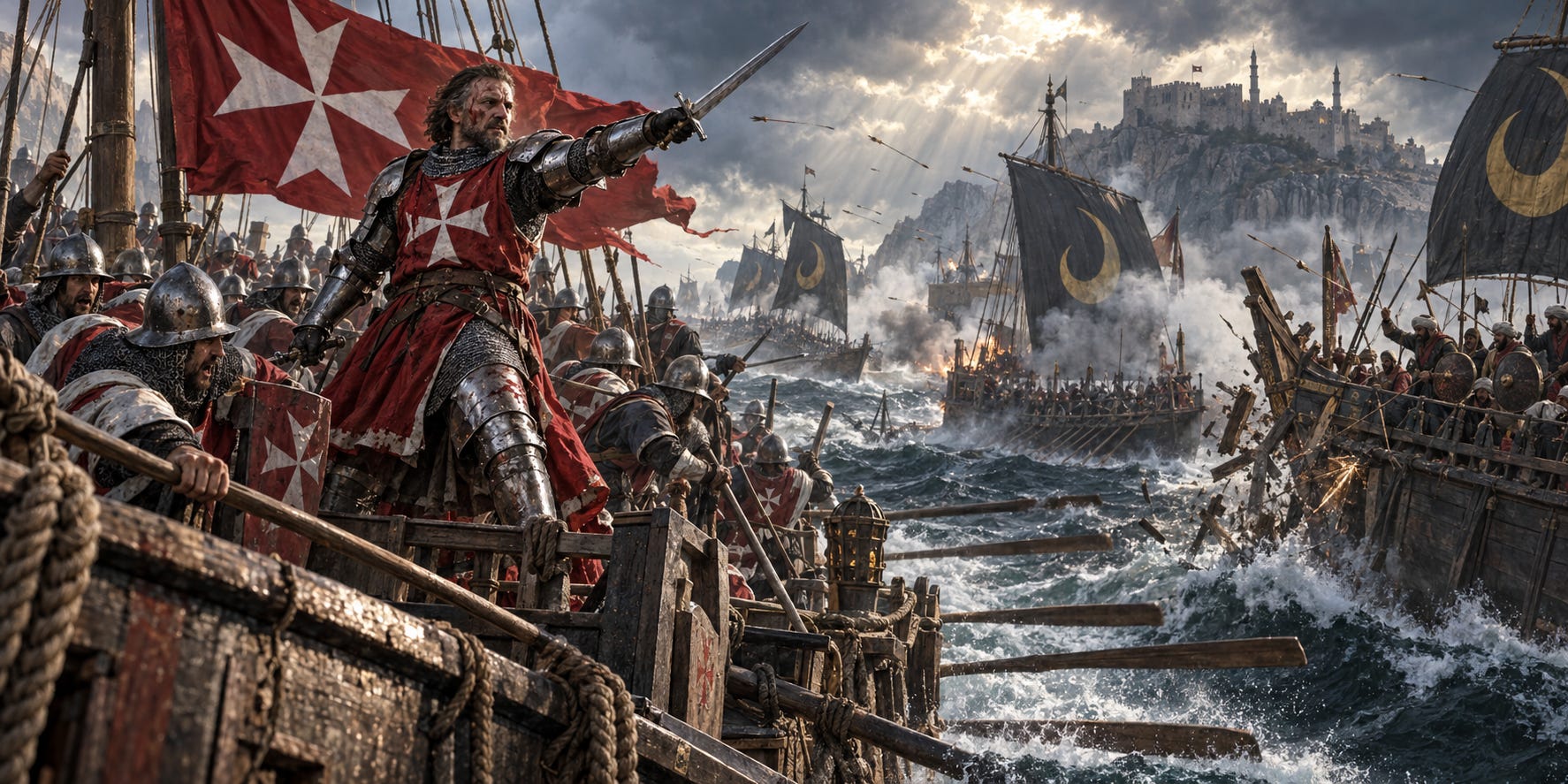
Today in history, September 18, 1444, the vastly outnumbered Knights of St. John of the Hospital defeated the greatest existential threat they had faced since making the tiny island of Rhodes their headquarters in 1310.
This, too, is another tale of superhuman valor—brought on by the Knights’ conviction that death was preferable to dishonor.
It begins a few years earlier in Egypt, following the rise of Mamluk Sultan Sayf al-Din Jaqmaq. Beginning life as a Circassian sold to Egypt by his brother, as an adult he was “known for his devout religiosity.” During his reign, and for the offense of being Christian, “many Copts were burned and killed, while others were nailed to wooden planks and paraded on the backs of camels on the streets of Cairo.”
In 1440, two years after becoming sultan, Jaqmaq sent a large fleet consisting of eighteen fully armed and equipped galleys against Rhodes. The master of the order, Anton, acted fast and had eight galleys, as well as four cargo ships with high decks, fitted out and filled with his warriors.
Once the Muslim fleet was sighted on September 25, 1440, the Order’s marshal, Louis of St. Sebastien “advanced boldly” to the sound of gunfire and martial music “and offered them battle.” Meanwhile, the hardened inhabitants of Rhodes, emulating the knights, took up arms and lined the coasts “resolute to oppose the infidels, if they should offer to make a descent.”
Hoping to avoid such an intrepid reception—the Knights of Rhodes’ reputation had long instilled terror among the denizens of Islam—the unnerved Muslims ran their vessels close to shore, lying alongside each other with their sterns turned seaward. They held the brethren off with a barrage of cannon fire—only to be “answered in the same manner.”
Once darkness descended, the Egyptian fleet absconded, seemingly toward Turkey. In reality, they were headed for and planning on devastating Lango, a small island garrisoned by the Knights. The marshal, however, “whose experience supplied the place of spies, guessing at their design,” put out to sea at the same time, “so that the Saracens, when they came up [to Lango], were strangely surprised to find him in their front, drawn up in the order of battle, and offering to fight them a second time.”
Not wishing to reengage the sea knights (as they were widely known) the admiral ordered a retreat to a nearby Turkish island. Although the Ottomans and Mamluks were longtime rivals, the Turkish inhabitants of the island, due to “the religion which they professed in common with the Saracens, ran to their succor against the Christians,” and the two Muslim peoples fortified the island.
On the admiral ship, Marshal Louis summoned a war council to decide what to do next. Many of the officers offered strong arguments to return to Rhodes: the Muslims far outnumbered them; the island had sandy shallows, which were dangerous for their large cargo vessels; and besides, the knights could already claim the victory, having driven the Egyptians from the Order’s domains.
The marshal, however, was of the old cast; he “did not know what danger was,” and informed them that “the knights of St. John never counted their enemies, and that he would sooner choose to meet with a grave in the sea, than lie under the reproach of seeing the barbarians so near him, without daring to attack them.”
Without any further ado, he transferred his men-at-arms from the carracks to his fleets and sailed straight for the island’s coast. Both sides opened cannon fire on one another; a wild battle ensued, “and the Saracens, supported by the Turks, exerted themselves to the utmost, in order to hinder the Christians from approaching their gallies.” When night finally parted the combatants, seven hundred Muslims and fifty Christians were dead.
Having made his point, and as a sea storm was brewing, the marshal, “covered over with the blood of his enemies, and wounded in five several places,” finally set sail for Rhodes. The sullen Mamluks set sail back to Egypt though, and by “way of revenge,” they first made a stop in Cyprus and torched another of the Order’s great commanderies, and this, concluded Vertot the annalist, “was all the advantage the sultan had from an armament and expedition which had put him to a considerable expense.”
But Sultan “Sword of Islam” Jaqmaq never forgot nor forgave these humiliations and began building a vast fleet in 1442, specifically to annihilate Rhodes. On August 10, 1444, the hitherto largest armada ever to attack Rhodes—85 ships and 18,000 men—appeared, blockaded, and laid siege to its capital, which was defended by a few hundred knights.
Continue reading below.
If you value unflinching, historically grounded analysis that mainstream outlets soften or ignore, consider upgrading. Paid subscribers get:
**Several new, full-length articles every week.**Carefully researched pieces you won’t find elsewhere.
Full access to the complete premium archiveArchive of in-depth writing, research, and commentary — all in one place.
Entry into the subscriber chatA private space for serious readers and thoughtful discussion.