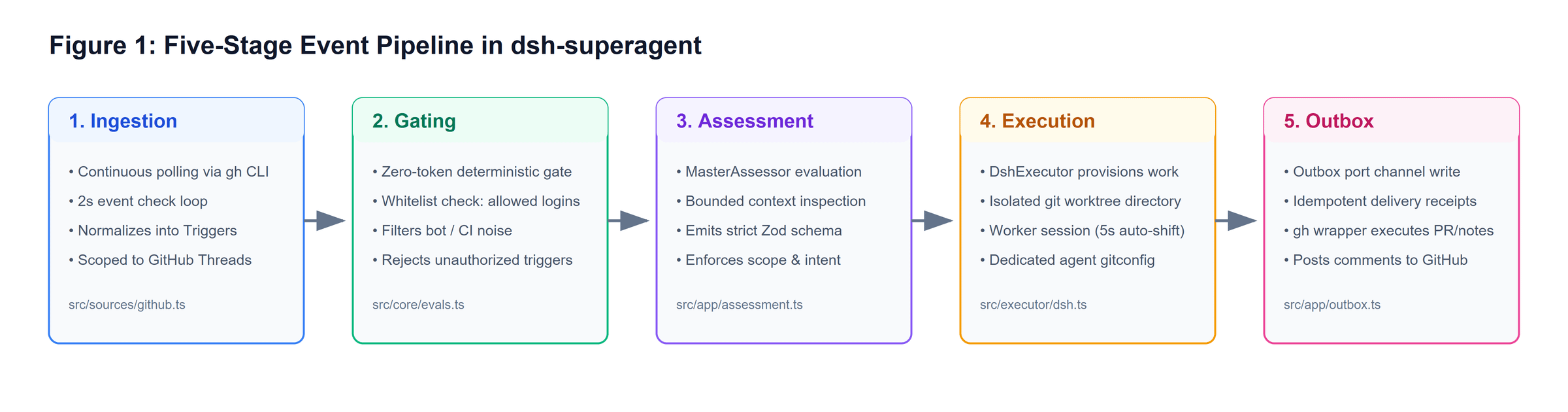
DeepSeek published the experimental prototype for its autonomous repository agent system to demonstrate a non-interactive, event-driven architecture for software engineering tasks. While commercial coding assistants prioritize synchronous terminal chat, the prototype establishes an alternative pattern: an event-driven daemon that processes Git repositories as continuous event streams, allocates dedicated operating system worktrees for each task, and applies deterministic admission gates before executing any model inference.
This technical review analyzes the TypeScript implementation of dsh-superagent
, evaluates its concurrency controls across multi-developer teams, and details how its core invariants were extracted into an open-source orchestration skill compatible across modern coding harnesses (including Anthropic Claude Code, OpenAI Codex, Cline, and Antigravity). We examine how replacing multi-tenant ticketing databases with structured task contracts enables a single operator to drive complex, long-horizon workflows without context exhaustion or branch collisions. Paid subscribers can access the companion open-source GitHub repository and complete skill implementation in the paid section below.
**Section 1: The Five-Stage Event Pipeline in dsh-superagent**establishes why deterministic admission gates must decouple event ingestion from language model inference.Section 2: Multi-Developer Concurrency and GitHub Event Ingestionevaluates how thread-scoped polling, CLI shims, and immutable mandates prevent concurrent write contamination across teams.Section 3: The Two-Tier Decoupled Agent Topologydetails why orchestrator sessions must never execute shell commands or wait synchronously on worker turns.Section 4: Abstracting the Workflow: From Enterprise Ticketing to Single-Operator Orchestrationexplains why individual operators do not need database-backed tickets but require structured task contracts for context window preservation.Section 5: Dynamic Decomposition for Unknown Long-Horizon Workloadsintroduces the 3-axis decomposition matrix and the Rule of Three concurrency ceiling for parallel subagents.Section 6: Implementation of the super-orchestrator Skillpresents the production skill runbook, subagent archetypes, and verification tooling.Section 7: Cross-Platform Execution Across Heterogeneous Agent Harnessesdetails operational adapters and configuration runbooks for Claude Code, OpenAI Codex, Cline, VS Code Copilot, OpenCode, Meta Muse, xAI Grok Bot, Pi Agent, and Antigravity.Section 8: Case Study: Building and Hardening an Autonomous Agentic AI SOC Systemdemonstrates how the skill was applied within Google Antigravity to implement an open-source SOC, detailing agent typology, canary injection defenses, and synthetic test suites.Section 9: Key Takeawayssummarizes architectural imperatives for resilient agentic software engineering.