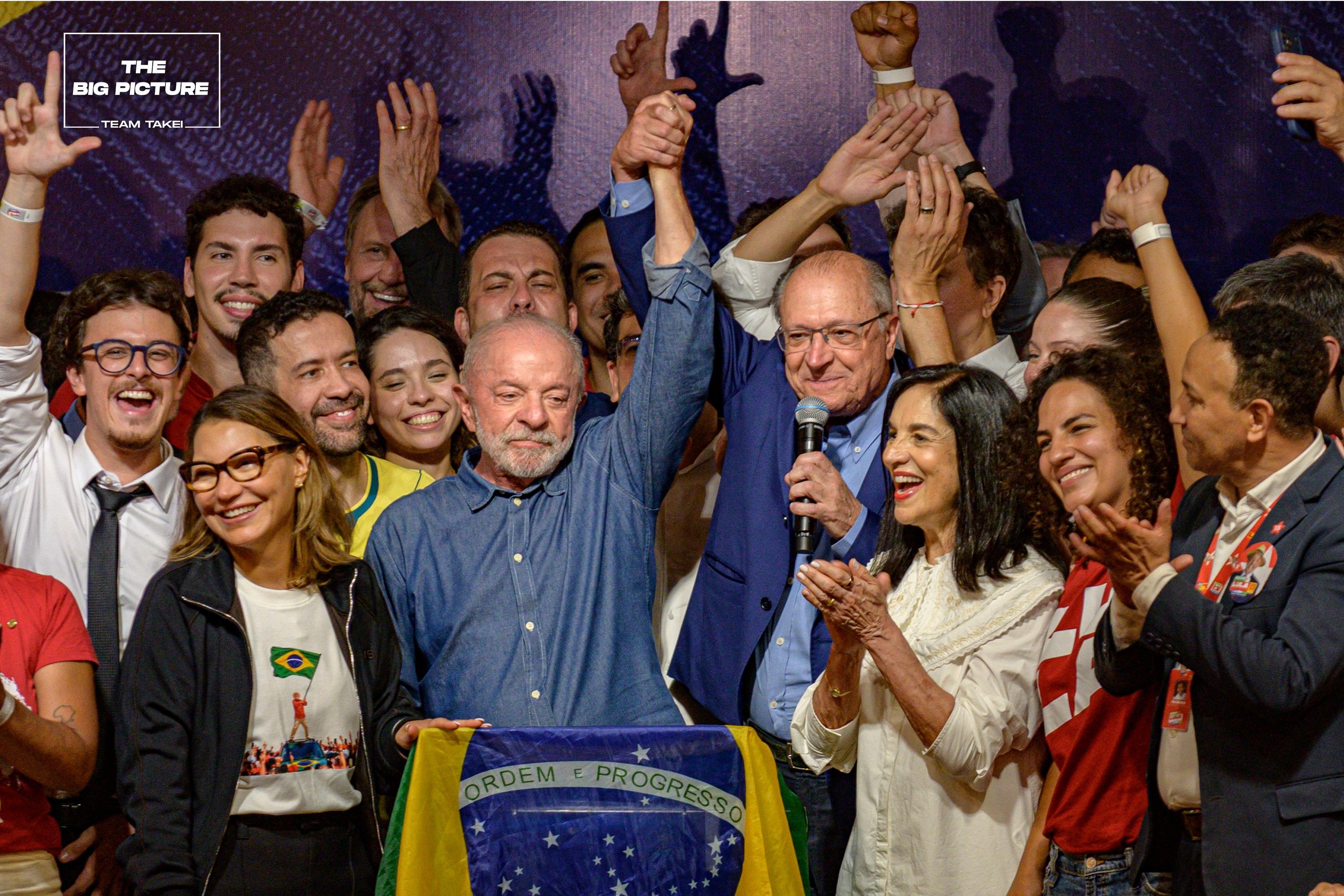
On Sunday, voters in two countries delivered defeats to movements that have spent years eroding their democracies. In Brazil, President Luiz Inácio Lula da Silva overcame a first-round deficit to defeat Sen. Flávio Bolsonaro, son of the former president now serving a 27-year sentence for plotting a coup. In Serbia, a student-led movement that grew out of protests over a deadly railway station collapse won the country’s parliamentary election, and longtime strongman Aleksandar Vučić conceded.
The two results came six months after Hungarian voters ended Viktor Orbán’s 16 years in power, handing a constitutional supermajority to his challenger, Péter Magyar. In all three countries, the pro-democracy side faced similar obstacles: a captured media, institutional advantages built up over years and, in the case of Brazil and Hungary, open support for their opponents from the Trump regime.
As I write this, exit polls from the election in Israel put the race with no clear winner between Netanyahu’s bloc and the opposition—but with the Arab block holding crucial political leverage to form a government.
Democracy is on the march, and would-be autocrats are losing power. But ahead lie significant tests, including our own test on Nov. 3 in the United States. The fights and the successes speak to both the dangers posed by right-wing, anti-democratic parties and leaders and the resilience of pro-democracy forces.
Flávio Bolsonaro ran in the shadow of his father’s crimes. In September 2025, a panel of Brazil’s Supreme Court convicted Jair Bolsonaro of attempting a coup to remain in office after losing the 2022 election and sentenced him to 27 years and three months in prison.
The case reached further than a power grab. In November 2024, federal police arrested four army special operations officers and a federal police officer accused of plotting to assassinate Lula, his running mate Geraldo Alckmin and Justice Alexandre de Moraes. Investigators said the plan was meant to keep Lula from taking office.
The Trump regime sought to tip the scales in Bolsonaro’s favor, but it backfired badly, as it had in other elections where Trump intervened. In 2025, Trump linked a 50 percent tariff on Brazilian goods to Jair Bolsonaro’s prosecution. After the U.S. Supreme Court struck down those tariffs in February, the regime imposed new 25 percent tariffs on some Brazilian goods. Flávio Bolsonaro met Trump at the White House in May and pledged that, if elected, he would bring Brazil into Trump’s “Shield of the Americas.”
The strategy appeared to be working for the Oct. 4 first round of voting. Bolsonaro finished first with roughly 47 percent of the vote to Lula’s 45 percent. Lula had hoped to win outright and called the result “unexpected.” He later admitted that it was “the least organized campaign I’ve taken part in since 1989.”
Over the next three weeks, Lula rebuilt the campaign. He reached out to young voters, mobilized millions of Brazilians in the streets in defense of democracy, warned of a second Bolsonaro government and argued that a Flavio Bolsonaro presidency would subordinate Brazil to the United States. Federal Deputy André Janones built a pro-Lula WhatsApp channel, Exército do Lula (Lula’s Army), which grew from about 50,000 followers to nearly 2 million in two days and passed 10 million before the runoff. WhatsApp, owned by Meta, had long been a Bolsonarista stronghold.
Trump handed Lula an opening when he hailed Flávio Bolsonaro’s first-round showing as a “very, very big victory.” As Adriana Carranca argued in an op-ed in Time, that let Lula recast the runoff as a contest over national sovereignty. Abstention fell from 21.08 percent in the first round to 19.22 percent in the second.
According to the New York Times, the runoff drew nearly 3 million more voters than the first round, an unusual jump in a country where turnout typically drops between rounds. Blank and null ballots fell by about 1.8 million, according to the electoral court’s final count. Daniel Nichanian, editor of Bolts, argues that the decisive shift came from voters who had cast null or blank ballots in the first round and then backed Lula. The tariffs also set off a nationalist backlash, which Lula turned into a rallying cry: “Brazil belongs to Brazilians.”
On Sunday, Lula won 51.8 percent of the valid vote to Bolsonaro’s 48.2 percent, according to the Superior Electoral Court. His margin of more than 4.4 million votes came after both campaigns sought longer voting hours and Supreme Court Justice Cristiano Zanin ordered voting extended nationwide by two hours. According to electoral court data reported by CNN Brasil, about 34,000 people voted after the original 5 p.m. closing time, a fraction of Lula’s margin. That night, Lula declared, “This country will not accept being anyone’s backyard,” then waved a Brazilian flag before** **supporters on São Paulo’s Paulista Avenue.
The comeback was historic, and the Lula campaign deserves credit for its hustle. According to the Times, no candidate had ever won the presidency after finishing second in the first round since Brazil restored direct presidential elections in 1989. Bolsonaro initially refused to concede and called for the results to be annulled. The demand lasted less than a day. CNN Brasil reported that four close allies advised him to accept the result and call Lula, and campaign members told the outlet there would be no annulment request. His campaign says it will still pursue cases accusing Lula of abuse of power and seeking to strip his ticket of its victory.
On Monday, Flávio Bolsonaro faced a more personal problem. He said federal police stopped him on the street as he left a visit with his father, who is serving his sentence under house arrest, and ordered him to surrender his passports. Justice de Moraes ordered his passports canceled, including his diplomatic passport, barred him from leaving the country and prohibited contact with Willer Tomaz, a lawyer under investigation for money laundering. The order arises from a sealed inquiry into possible money laundering and currency evasion involving the two men. Bolsonaro said the restriction stemmed from his brother Eduardo’s suggestion, days before the runoff, that Flávio should leave Brazil if he lost, and he insisted, “I never thought of leaving the country.”
By Tuesday afternoon, multiple outlets were reporting that Flávio had left Brazil for the United States. NBC News, citing sources, reported that he had fled, and Euronews reported that U.S. officials confirmed his departure to CNN and Reuters. The noon deadline to surrender his passports passed with no word on whether he had complied. An Argentine outlet reported that he crossed the border into Argentina overnight to board a private flight north, but Argentina’s government denied he had entered the country, and his campaign coordinator insisted he had not left.
The Serbian movement began with a disaster. On Nov. 1, 2024, the concrete canopy of the newly renovated railway station in Novi Sad collapsed onto people below. Vučić and his ally Viktor Orbán had inaugurated the renovated station as a stop on a planned Belgrade–Budapest high-speed rail line. Many Serbians blamed corruption and shoddy work on the renovation, one of several controversial megaprojects involving Chinese state companies. University students began stopping traffic each day at 11:52 a.m., the moment of the collapse for 15 minutes, one minute for each of the 15 people then known to have died. The death toll later rose to 16.
The protests grew into some of the largest since Slobodan Milošević fell in 2000, and the students demanded that Vučić step down. But Vučić held most of the cards: a firm grip on the police, nearly all major media outlets and the electoral commission. Students complained of being branded “mercenaries, terrorists.” When 10 municipalities held local elections in March 2026, observers reported attacks on journalists, activists and election monitors. The monitoring group Crta said irregularities in one town were so numerous that the vote could not be called an election. Students had demanded early parliamentary elections for more than a year, but Vučić appeared to wait until he felt strong enough to run. In September, he resigned the presidency to seek the prime minister’s office in a snap vote set for Oct. 25.
The students answered with an effort called “A Student in Every Village.” Electrical engineering students in Belgrade launched it, and one participant described the students as “a walking media” going town to town. Students said they had been “dehumanized on a daily basis on national frequencies.” “We are breaking the media darkness,” one student said. Working in pairs, they went door to door and cycled and walked across the country to reach rural voters in Vučić’s strongholds. The Student List said its 11-point platform was drafted from conversations about the everyday problems people raised.
Most of Serbia’s opposition parties stood aside to give the Student List a clear run against Vučić. The list drew its candidates from fields such as medicine and education, and many had no political experience. Months before the vote, the students also recruited election controllers, observers and mobile teams to watch the count.
On Sunday, lines stretched from polling stations across the country. Turnout reached its highest level since Yugoslavia broke apart in 1992, and even Vučić waited nearly two hours to vote. The Republic Electoral Commission’s preliminary count gave the Student List 52.71 percent of the vote to 39.17 percent for Vučić’s United Serbia list. That evening, Vučić told supporters, “It is clear that we have lost these elections.” He blamed his defeat on Serbia’s independent media, unnamed European countries and, unironically, an “American deep state.”
When Hungarians voted Viktor Orbán out in April, they ended 16 years of rule by a leader Vice President JD Vance had called a “role model” for Europe. The Brazilian and Serbian campaigns played out under different political system…