In 2024, Donald Trump famously promised to “immediately bring prices down starting on day one.”
Once back in office, however, Trump instead presided over rising prices, first with his broad-based tariffs, then with the war in Iran.
Now, less than two years after Trump returned to the White House, those rising costs helped drive Democrats to historic victories on Nov. 3.
Just nine days past the midterms, Democrats are already signaling they have no intention of repeating Donald Trump’s mistakes.
Whether it’s Democrats who won for the first time last Tuesday, or longstanding elected leaders who have been waiting for such a mandate from voters to pass economic populist legislation, Democrats across the spectrum have wasted no time in laying out their plans to address the cost of living. But what can they accomplish, and how soon? The answers will depend on the powers available to them, Republican opposition and disagreements within their own party.
According to midterm exit polls, 89% of voters said the cost of living was “crucial” or “a major factor” in their vote. Among those voters, 59% supported Democrats, compared with 39% who supported Republicans.
This is not just a mandate for Democrats to adopt policies long on the economic populist wish list of progressives; it is also political cover for Democrats around the country who don’t consider themselves “democratic socialists” or even “progressive” to fight for those very policies.
At the top of that list: raising the minimum wage.
Iowa Gov.-elect Rob Sand, a moderate Democrat who ran as a “prairie populist,” has pledged to raise the state’s minimum wage to $12 an hour.
Pennsylvania Gov. Josh Shapiro, with the state’s new Democratic trifecta behind him, has promised that raising the minimum wage to “at least $15 per hour” will be the first bill he signs.
And Texas Democrats want to go $2 higher:
Texas Dems’ minimum-wage proposal is part of a broader legislative agenda. As The Texas Tribune reports:
Riding high after their success in last week’s election, Democrats in the Texas Legislature unveiled an aggressive agenda Monday as bill filing opened for the 2027 session: Expand Medicaid. Boost the minimum wage. End tax breaks for data centers. Ban Flock cameras. Legalize marijuana.
Democrats also filed proposals to end the state’s year-old school voucher program and boost per-pupil funding for public schools. They also eye building high-speed rail stretching from Dallas to San Antonio.
Other bills would repeal the state’s abortion ban and the ban on gender-affirming care for minors. While most of these bills would be difficult to pass with Republicans still in control of the Texas Senate, they signal the party’s priorities.
As for the state’s governor-elect, Gina Hinojosa has her own day one affordability agenda.
As Clarín reports, Hinojosa
announced plans to invoke emergency gubernatorial powers within her first hour in office on January 19, 2027. Her signature opening move: declaring a statewide “high-cost emergency” to freeze residential electricity rates.
Clarín laid out the rest of the plan:
Executive Utility Freeze: Directing the Public Utility Commission of Texas (PUCT) to lock residential retail electricity rates in place on Day One under emergency powers.Fuel Tax Holiday: Halting state excise taxes on gasoline (20 cents per gallon) and diesel to ease daily commuting expenses.Targeting High-Load Users: Forcing hyper-scale data centers, cryptocurrency mines, and industrial operations to absorb a larger proportion of transmission expansion and grid reliability costs.$1,500 Household Checks: Championing companion legislation introduced by State Senator Roland Gutierrez to deploy $17 billion from the Economic Stabilization Fund (Rainy Day Fund) for direct consumer relief.
Hinojosa here is following the lead of New Jersey Gov. Mikie Sherrill, who proposed a similar policy during her campaign, although its implementation has produced mixed results. Whether Hinojosa can impose such a freeze through emergency executive powers remains an important question.
Nevada Gov.-elect Aaron Ford has also made affordability his first priority, pledging to begin his term by “Signing an affordability executive order.”
According to KOLO-TV:
That would direct departments in this state to look for ways to get money back into people’s pockets.
Once Nevada’s legislature convenes, he says he’ll sign bills that limit the cost of prescriptions and limit the number of homes corporations can purchase here in Nevada. All of this he says won’t cost Nevada a thing. But will give money back to its residents.
Minnesota Gov.-elect Amy Klobuchar has pledged to make health care, housing and child care more affordable.
Notably, on health care, she wants to focus on undoing some of the damage Trump and Republicans have done since they took back control in Washington. One priority is mitigating the expiration of enhanced ACA premium subsidies. Klobuchar has promised to bring down health care premiums, which have risen sharply because of inflation and the loss of those subsidies.
One option is a state tax credit to help residents afford coverage.
“We can do a state credit for our state; 10 states have already done it. New Mexico is the only one that actually increased the number of people who get insurance,” Klobuchar said.
Undoing the damage done by Trump and congressional Republicans is going to be central to federal Democrats’ policy focus in the new year as well.
Another key finding in the November 3rd exit polls suggests that voters are clear-eyed about who is to blame for the affordability crisis.
Among midterm voters, 66% felt that Donald Trump’s policies have “worsened economic conditions in the U.S.” Meanwhile, 63% blamed his policies for the increased cost of living.
Of those voters, 84% voted for Democrats.
The mandate voters gave Democrats last Tuesday was not just to advance their own economic agenda, but also to reverse Trump policies that have driven up costs. And Democrats are intent on fulfilling that mandate.
As NPR describes Democrats’ “First 100 Hours”:
Democrats say that in the first hundred hours, they want to restore enhanced Affordable Care Act health insurance subsidies and reverse Medicaid cuts Republicans passed last year in the One Big Beautiful Bill Act that are about to take effect.
They also want to reassert Congress’ authority over tariffs and try to force an end to the Iran war by bringing new votes on war powers resolutions. These are priorities on which Democrats have near-total agreement.
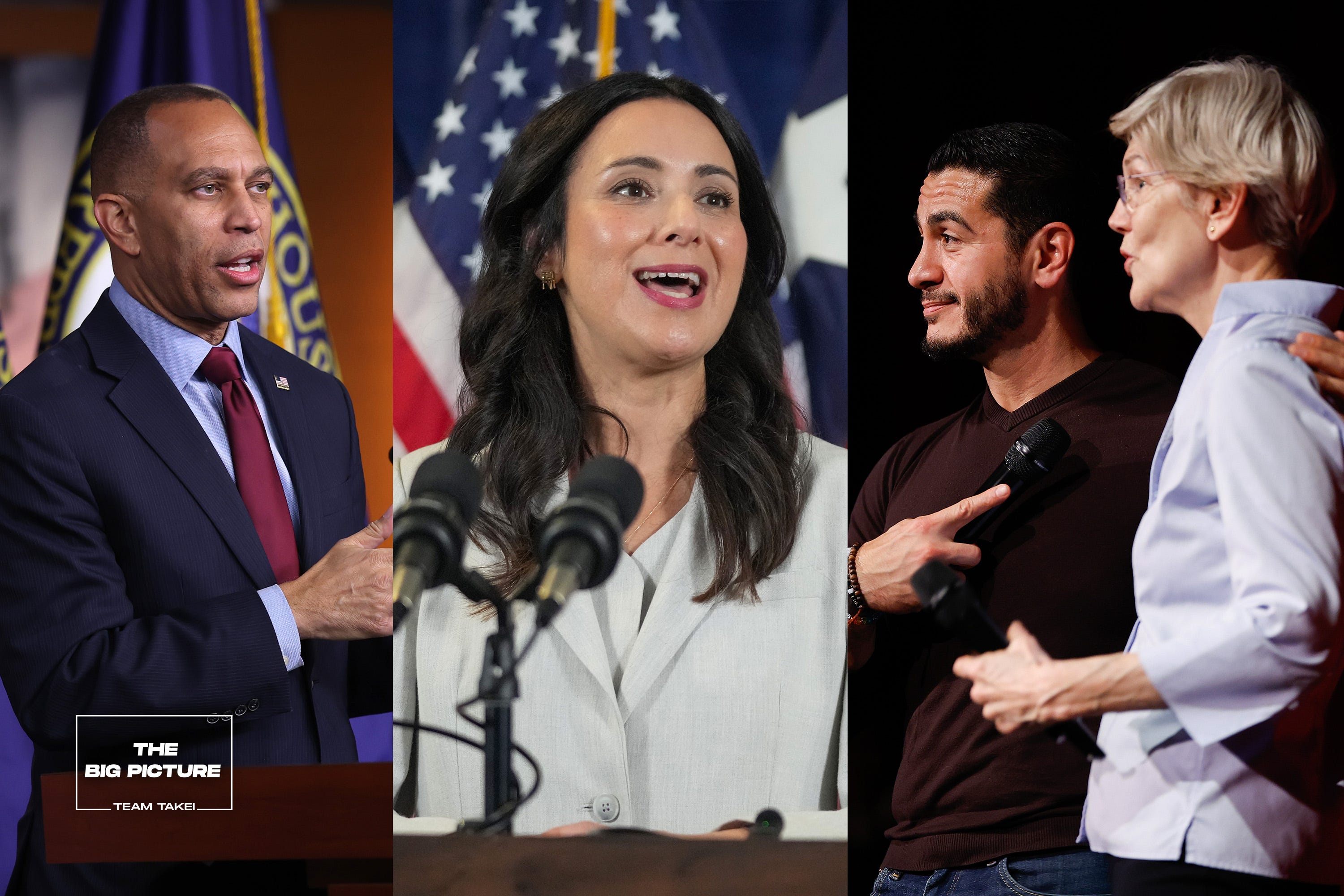
House Minority Leader Hakeem Jeffries, the likely next speaker, laid out the plan for reporters on Monday.
With a potential 260-175 majority in the incoming House, such rollbacks of Trump’s policies would be within Democrats’ legislative reach.
It’s a bit more complicated in the Senate, where Democrats could top out at a 56-44 majority, four votes shy of the 60 votes generally needed to overcome a Republican filibuster. And even legislation that passes both chambers would still face the threat of a Trump veto. But Sen. Elizabeth Warren (D-MA) has a plan for that: budget reconciliation.
As Warren told the Popular Mandate conference on Tuesday:
“The reconciliation process allows us to pass big chunks of legislation that would improve people’s lives without a single Republican vote. Reverse the health care cuts the Republicans put in place, expand health care coverage, and fund universal childcare – all with a 51-vote majority in the Senate. And, to pay for it, we can start by reversing the tax breaks Trump and the Republicans handed out to millionaires and billionaires – again with 51 votes. A Democratic majority in Congress can also send the president a resolution that revokes his authority to wage war in Iran – again with 51 votes.”
Warren also pointed to Democrats’ leverage over federal spending bills:
“And let’s not forget one of our most powerful tools: Democrats have power on spending bills that require our votes, and we should use it. No more funding for a forever war with Iran. Cancel the looming cuts to health insurance and nutrition benefits put in place by Republicans last summer.”
When Warren and Jeffries talk about rolling back the “cuts to health insurance” contained in Republicans’ OBBBA last summer, they are referring, in part, to the Medicaid cuts enacted by congressional Republicans due to the work requirements built into the law.
NPR explained the work requirements:
Republicans’ One Big Beautiful Bill Act passed last year, cut nearly a trillion dollars from Medicaid over 10 years by requiring beneficiaries to prove that they’re working or volunteering or going to school, or that they have a condition that makes them unable to do those things. If they can’t prove either, they could lose their health coverage.
Experts estimate that as many as 5 million Americans currently enrolled in Medicaid could lose coverage as a result of these work requirements.
But there’s one major problem when it comes to rolling back these cuts: states must begin implementing the work requirements by Jan. 1, 2027, before the new Democratic majorities are seated.
So, Democratic states’ attorneys general are suing to block the Centers for Medicare and Medicaid Services (CMS) from withholding funds from states that refuse to implement the work requirements contained in the 2025 OBBBA.
Under the law, many adults who receive Medicaid via the Affordable Care Act’s Medicaid expansion must document 80 hours of work, volunteering or qualifying educational activity each month to maintain coverage, unless they qualify for an exemption.
In the new lawsuit, filed by state attorneys general from Oregon, Minnesota, New Mexico and Washington, plaintiffs argue that this goes beyond the scope of the CMS’ authority and infringes on states’ sovereign interests. Under the law, states have little option but to comply with the work requirements, considering the federal Medicaid funding at stake.
Importantly,
The lawsuit asks the court to declare the withholding of federal Medicaid funds unconstitutional. The plaintiffs also seek a preliminary and permanent injunction on funding cuts for states that do not enact work requirements.
Meanwhile, even before the new Congress convenes, Senate Democrats are seeking to delay implementation, arguing that the requirements could cause millions to lose coverage.
Progressive Democrats in the U.S. Senate who have been waiting for an opportunity to advance their economic agenda see the next Congress as a huge opening.
Not because they are under any illusion that the majorities elected last Tuesday represent uniformly “progressive” House and Senate caucuses, but because, as I wrote back in March, “Economic Populism Is Not Just For The Left Anymore.”
Take this tweet from Sen. Bernie Sanders, laying out the public support for policies ranging from Medicare for All and a $20 minimum wage to a wealth tax and moratorium on new data centers.
Sanders has also outlined proposals intended to translate that support into legislation.
Illinois Gov. JB Pritzker made a similar case to Heather Cox Richardson this week about the importance of leading with a minimum wage increase.
Warren has similarly highlighted the range of economic proposals embraced by successful Democratic candidates, including those not generally identified with the party’s progressive wing.
As she laid out here:
In Texas, James Talarico
saidbluntly that “the system is rigged” andpledgedsupport for Warren’s bipartisan bill with Republican Sen. Josh Hawley to break up big medicine.In Ohio, Sherrod Brown
channeledvoter fury against AI data centers and said, “A handful of corrupt billionaires think they can buy power and keep this rigged system working in their favor… We’re proving that our voice is louder than their money.”In Kansas, Adam Hamilton won by calling for a crackdown on corporate price gouging, stopping data centers from jacking up utility bills, and expanding Medicare.
In North Carolina, Roy Cooper
releasedan ad in the final weeks of the campaign saying he would “fight the insurance companies and take on the utility monopolies.”In Iowa, Josh Turek put
forwarda plan to scrap the cap to tax the richest Americans so we can extend Social Security.In Michigan, Abdul El-Sayed defended one of the most vulnerable Senate seats on the map with a full-on embrace of Medicare for All, a wealth tax for billionaires and universal child care.
As Warren told The New York Times, Democrats need to “get to work” and show voters they’re trying to deliver.
“If Democrats don’t deliver — or at least get caught trying — then it will be damned hard to go back to the American people and ask them to put us in charge again.”
At Tuesday’s Popular Mandate Conference, Warren showed that she still “has a plan” for advancing progressive economic priorities i…