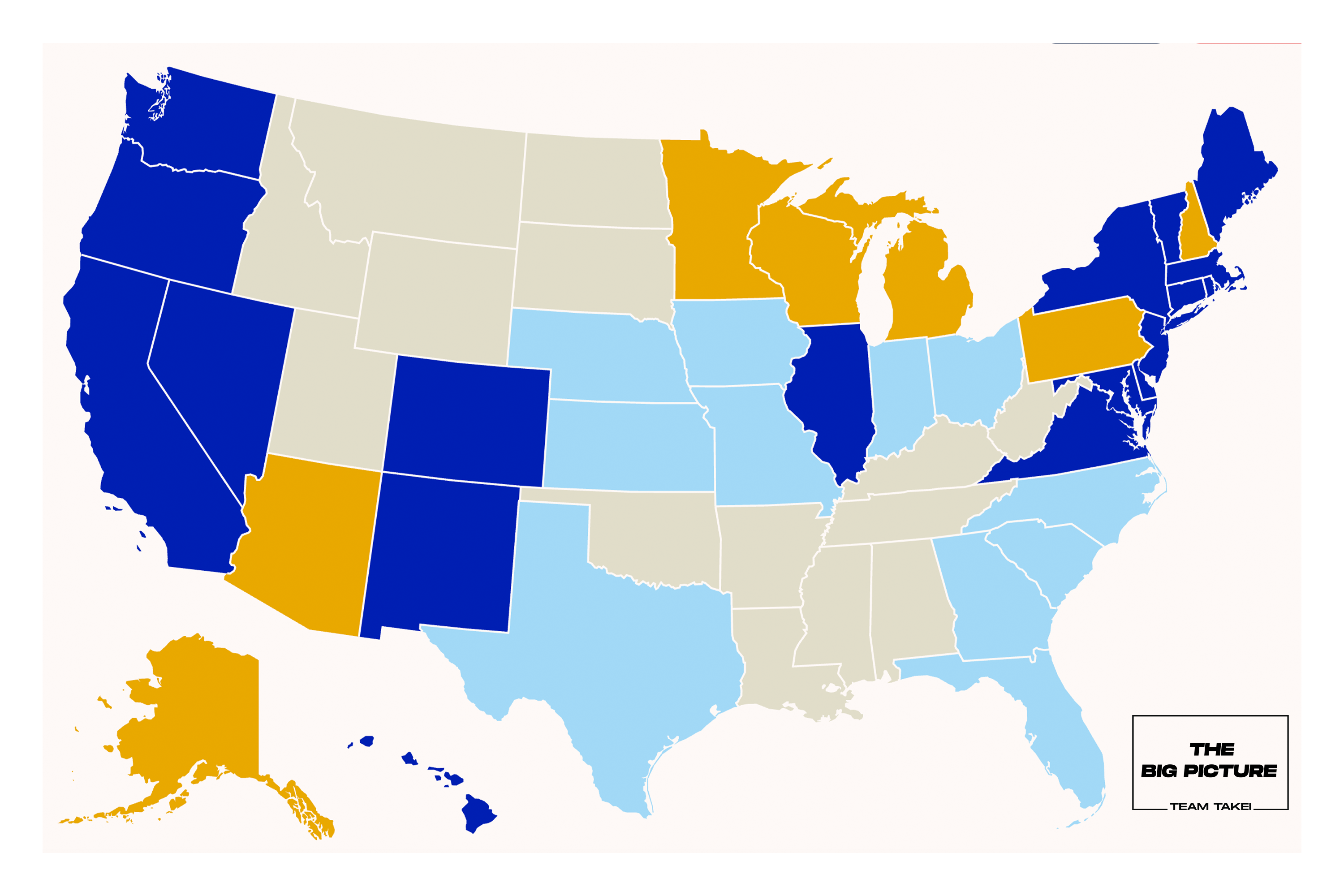
In 2010, in the midst of the debate and ultimate passage of the Affordable Care Act, and as the first midterm election of President Barack Obama’s tenure approached, Republicans made a strategic investment. It was aimed at, as Vox put it, “engineering statehouse takeovers.” And it paid off. Big time.
That November, Republicans gained control of 16 state legislative chambers, including control of both legislative chambers in six states. By 2014, Republicans controlled 66 out of 99 state legislative chambers, including full control of state government (meaning they had the full trifecta: control of the governorship, the state house and the state senate) in 24 states. Crucially, they were able to cut the number of Democratic trifectas in half, from 14 to 7.
Now, in 2026, Democrats appear to finally be taking a page out of that playbook.
According to Stateline, “GOP lawmakers currently hold nearly 55% of the nation’s 7,386 state legislative seats.” That translates to GOP trifectas in 23 states and Democratic trifectas in 16, while 11 states have split government. This year, the Democratic Legislative Campaign Committee (DLCC) has a plan to flip those numbers completely.
As Stateline reported:
The committee is touting record numbers of Democratic candidates running for office in some states and has announced plans to spend a record $50 million on state legislative races this year, with aims of flipping more than 650 legislative seats.
The DLCC has identified seven target battleground states where “Democrats must focus our attention and resources in 2026” in order “to win back power across the country.” Their goal:
By taking advantage of this once-in-a-generation opportunity and environment to build power, we can capture new majorities, supermajorities, and governing trifectas, while flipping seats in every chamber on the ballot and breaking GOP supermajorities.
There are five states in particular where, assuming Democrats maintain the governorship (which, per Center for American Politics’ latest map, 𝕏looks likely), the battle for legislative seats is going to make the difference as to whether Democrats can win a trifecta of power: Pennsylvania, Wisconsin, Minnesota, Michigan and Arizona.
So, what are the stakes as Democrats launch an unprecedented effort to retake state legislative seats this year? And what is the state of play in these targeted states?
Heather Williams, president of the DLCC, put their efforts to flip state legislative seats this way:
“2026 is a once-in-a-generation opportunity to fundamentally transform state legislative power.”
This represents a sea change in how Democrats talk about electoral politics. While Democrats may just be coming around to understanding the importance of building and wielding electoral power, Republicans have long known the stakes of state legislative elections.
As NDRC describes Republicans’ Project REDMAP (short for Redistricting Majority Project) from the 2010 cycle,
Republicans strategically invested in state legislative races and other key elections in swing states like Wisconsin, Pennsylvania, Ohio, Florida, and Michigan so they could control the map-drawing process after the 2010 census. This was the core of Project REDMAP.
After 2010, Republicans leveraged their trifectas to pass a slew of conservative legislation, including, as Vox reminds us, 205 new abortion restrictions across 30 states between 2011 and 2014. Also, “Twenty-two states, 18 with Republican majorities, passed laws making it more difficult for people to vote.”
But more than that, per REDMAP’s mandate, Republicans drew the electoral maps in the majority of states, which in 2012 enabled them to “take back the House majority despite getting fewer votes than Democratic candidates.”
And that is precisely what Wisconsin Republicans did at the state level after they won a trifecta there in 2010, gerrymandering themselves into structural majorities despite being a 50-50 state. It was only in the last few years that Democrats, under the leadership of Ben Wikler at the helm of the Wisconsin Democrats, were able to unrig the state.
It’s no accident that winning as many trifectas as possible in 2026 is Democrats’ task number one in Wikler’s book “This Is The Plan.”
As Ben told us during our Q&A last month, Democrats need to
“...focus on winning state governments. Blue state-level trifectas can dictator-proof their states and also pass the National Popular Vote Interstate Compact, which would make the Electoral College a ceremonial body and award the presidency to whoever wins the national popular vote.”
Democratic House Minority Leader Hakeem Jeffries also sees the critical importance of Democratic trifectas in 2027. Per CNN:
Jeffries and his allies have designed plans for the next two years to push Democratic-held states to set aside nonpartisan redistricting rules or gerrymander even more aggressively, with an eye toward producing a dozen or more new Democratic-held seats by November 2028, people familiar with the matter said. They’re eying seats from Oregon to New York in an effort that will cost hundreds of millions of dollars more in the next two years.
Let’s dig into the target states.
Last month, Brandon Dukes won a special election to represent Pennsylvania’s State House District 12 by fewer than 100 votes. This is a district that voted for Trump in 2024 by 18 points and where the GOP rep won by 30.
Dukes’s win is just the latest in a string of 31 GOP legislative seats Democrats have flipped blue this cycle. In that same period, Republicans have flipped exactly zero.
No wonder Democrats are bullish that in Pennsylvania, with a strong performance by Governor Josh Shapiro at the top of the ticket (𝕏he’s currently polling ahead by double digits), Democratic state legislative candidates will be able to hold onto the state Senate, which Democrats control by just two seats, and win back the state House, which Republicans control by just 4.
As Stateline notes, divided government in Pennsylvania “has left hundreds of Democratic bills to die in the upper chamber.” Which is why Governor Shapiro is campaigning explicitly on Democrats retaking complete power in Harrisburg.
Shapiro said that if Democrats take back the legislature in January, they would raise the minimum wage within “the first 30 days.”
“We will codify abortion rights into law in the commonwealth of Pennsylvania,” he said at
[a campaign rally]. “We’re going to build more affordable housing and take on those utility companies that keep jacking up our rates here in Pennsylvania.”
And as Pennsylvania Democratic Party Chair Eugene DePasquale told Carolyn Fiddler of This Week In State Action, he is optimistic they can achieve a Democratic trifecta this year and break that GOP gridlock.
There are two reasons DePasquale is bullish on Democrats coming out of Election Day with majorities in both legislative chambers this year.
First, just as they are doing nationally, within Pennsylvania Democrats are expanding the map.
“It’s the Philadelphia suburbs, it’s Lehigh Valley, a little bit up in the Scranton area, and yes, Western Pennsylvania… although an emerging area of the state is central Pennsylvania, where we believe we’re not only going to hold the Lancaster County state Senate seat, but we’re going to flip a state House seat in Cumberland County. So, that is an area of the state that is starting to move in our direction.
A lot of these seats are in play, and that’s why I believe we’re going to expand our state House majority and flip the state Senate.”
And then there’s the message he is hearing from voters all over the state. And not just from Democrats:
“It is exactly what happened in the special election, it is what all of our candidates hear when they canvas, when our coordinated campaign canvases, they hear the same thing over and over again: Stop Trump, do something about these prices. It does not really matter what region of the state — that’s we’re hearing.
And I mean, I get the data back every week, and there’s always more than a handful of anecdotes every day in every region — it’s Republicans saying: We have to stop Trump. Trump voters saying we have to stop Trump.”
In 2022, voters gave Democrats in Minnesota a trifecta in state government, reelecting Governor Tim Walz and Lt. Governor Peggy Flanagan at the top of the ticket and electing slim Democratic state legislative majorities.
As the DLCC notes, with that power, Democrats “moved swiftly and protected reproductive rights, passed paid leave, and provided free breakfast and lunch for all public school students.”
Dubbed the “Minnesota Miracle,” MinnPost laid out a more exhaustive list of Democratic accomplishments during those two years of full control.
Democrats
[codified abortion rights], paid[family and medical leave], sick leave, transgender rights protections, drivers licenses for undocumented residents,[restoration of voting rights]for people when they are released from prison or jail, wider voting access,[one-time rebates], a tax credit aimed at low-income parents with kids, and a $1 billion[investment in affordable housing]including for rental assistance.Also adopted were background checks for private gun transfers and a
[red-flag warning system]to take guns from people deemed by a judge to be a threat to themselves or others. DFL lawmakers banned conversion therapy for LGBTQ people,[legalized recreational marijuana], expanded education funding, required a[carbon-free electric grid by 2040], adopted a new reading curricula[based on phonics], passed a[massive $2.58 billion capital construction package]and, at the insistence of Republicans, a $300 million emergency infusion of money to nursing homes.
After the 2024 election, the Minnesota state House reverted to a 67-67 tie, resulting in a power-sharing agreement. But in 2026, the DLCC is committed to winning back the trifecta, “launching 32 Target Races across the battleground state of Minnesota for control of the House and to retain the majority in the Senate.”
The SC Times described the lay of the land heading into November:
Currently, Gov. Tim Walz is DFL and the party has narrow control in the Senate, 34-33, but because of the tie in the House, there is no trifecta. Republicans flipped three House seats in the 2024 election — districts 7B, on the Iron Range; 18A, in the North Mankato area; and 26A, in Winona — which tied the numbers, 67-67.
Going into the November election, however, Democrats regained a slight voting majority following Joe Schomacker’s, R-District 21A, resignation in June. His district has historically been conservative, with Schomacker having won by 68% of the vote in 2024.
When Rep. Ilhan Omar (D-MN) endorsed Amy Klobuchar for Governor in January, she put a fine point on the stakes of 2026:
I’ll be supporting Amy Klobuchar to be our next governor.
Not only will she help us win back the DFL trifecta, she’s the right person to lead our state.
This November, the DLCC is targeting 12 Minnesota state Senate seats and 20 state House seats.
Likewise, Michigan held a slim Democratic trifecta after the 2022 election, which reverted to divided government after 2024. Democrats currently hold the governorship as well as a two-seat majority in the state Senate, while Republicans hold a six-seat majority in the state House.
Per the DLCC, during that two-year span of unified Democratic power, Democrats “made historic progress, passing free school meals legislation, expanding gun safety laws, and repealing anti-worker legislation.”
Republicans, on the other hand,
“...have used their House majority to try to gut Michiganders’ health care and critical programs to help working families while attacking Michiganders’ rights. Putting Democrats back in charge of both chambers of the legislature will provide a critical bulwark against MAGA chaos before the presidential election and let Democrats get back to work fighting for Michiganders.”
To achieve a trifecta in Michigan this year, Democrats must hold onto their slim state Senate majority and flip four GOP state House seats blue, the latter of which Michigan Senate Majority Leader Winnie Brinks calls a “tougher lift.”
But Brinks is optimistic:
“I feel very confident that we will be working with a Democratic legislature in both chambers next term,” she said.
Following months of GOP obstruction in the House, Democratic control of both chambers would reverse the current gridlock in Lansing. Brinks, who is term-limited, said she expects a Democratic trifecta will focus on the issues that matter to Michiganders, including regulations on data centers, childcare accessibility and affordability.
“There are things that we know we could do that make people’s lives easier and more affordable,” she said. “So I think that in general you’ll see us try to tackle those things.”
Last month, Brinks became the Democratic nominee for Lieutenant Governor alongside Democratic Governor nominee Jocelyn Benson. During Michigan’s nominating convention, Brinks made clear she understands Democrats’ assignment this year:
Addressing the audience after her official nomination, Brinks said another big goal for Democrats is building off of the party’s brief trifecta in 2023 and 2024, during which Democrats voted for reproductive and LGBTQ rights, pro-labor initiatives and clean energy policy.
“I pledge to work every day to lower costs, to raise wages, and make Michigan a place where everyone can live and thrive,” Brinks said. “And I can’t wait to do it with another Democrat trifecta.”
In Arizona, Governor Katie Hobbs leads a divided state, where both chambers of the legislature are controlled by Republicans (17-13 in the Senate and 33-27 in the House.) With Hobbs 𝕏looking strong for reelection heading into November, the DLCC is targeting 17 races in…