Greetings all. A failed war that just keep failing. A trade policy that just keeps failing. Trade wars with allies. Escalating tariffs. Slower growth. Slower job growth. Inflation has been reignited, interest rates remain too high, our deficit has exploded, and the bond markets have become spooked. Unprecedented official corruption. A new partisan Fed Chair who whiffed bigly out the box, and a Treasury Secretary resorting to voodoo rather than anything that resembles sound, smart policy…..it’s ugly stuff, and the US clearly needs a better path forward.
I asked our good friend and economist ** Rob Shapiro **to come by and talk to us about the economic and geopolitical crises Trump has created for the United States, and what Democrats should be doing in the coming years to help us lead us out of it. For the job of our leaders in the next Congress will not only be to lower costs and improve health care but to take on a far greater set of economic and fiscal crises Trump and his buffoonish cronies have created for us.
I hope you watch and listen to this discussion. Rob was very good today. As the primary architect of the Clinton economic plan, arguably the most successful economic agenda of any American President in the past fifty years, Rob has experience in crafting a broad, strategic response to challenging economic circumstances. What he offers today is an early rough sketch of a comprehensive agenda, one that starts with a significant commitment to raising revenue and getting our fiscal house in order.
Or as I call it * making the oligarchs pay*.
Here’s an excerpt from our discussion:
I think one of the things Democrats need to propose, when they come back to power in Congress, is to get the budget back in order. And relieve some of the pressure on the national debt. We know how to do that. Because Bill Clinton did it — by raising taxes on high-income people and cutting defense. We now spend $954 billion on defense. That’s more than the combined defense budgets of Russia, China, India, and Europe. And Trump wants to add another $500 billion to that next year, bringing it to $1.5 trillion. We say no. In fact, we can cut the defense budget. And all we’ve used it for –– for the last 20 years is wars we lose. The other is raising taxes on high-income people — that’s what Bill Clinton did. When he did those two things, he produced the strongest economic growth of any president in the last 50 years.
He brought unemployment from 6.9% to 4%. He brought the poverty rate down from 15% to 11%. He had the strongest gains in real median income of any presidency in 50 years, starting with Reagan through Trump. So, you can do this and have a stronger economy. One reason was because these policies brought down the benchmark 10-year interest rate by 3.3 percentage points. And that spurs business investment, spurs housing. We need to show that we can do this. And the American people support, in overwhelming numbers, cuts in defense and higher taxes on high-income people and profitable corporations. We’ve got the lowest corporate tax rate in the advanced world — it used to be 35%, back when we had an investment boom and a business boom under Bill Clinton. It’s 25% now. Let’s raise that.
Bill Clinton understood something else –– that getting deficits under control is a precondition for enacting new progressive programs. The next Democratic president is going to have two unavoidable tasks: one is the solvency of the Social Security system, and the second is universal health care. We can lay the foundation for that by bringing deficits down to two or three percent of GDP from seven percent — through revenue and defense policies that the American people support, and by regaining the trust of the global investors we depend on for the stability of our financial system.
In our discussion today we commit to take some of the thinking in here and flesh it out a bit more in the coming weeks, which we will.
This event kicks off a new, more intense series of live events Hopium will be hosting most days through the Election. Links to all our events can be found on our Events page. To watch a live event simply head to the main Hopium site at the start of each event and watch it live on our home page. Learn how to change your settings to receive dedicated notices of our upcoming live events on our Housekeeping page. All of our live events will be shared with the Hopium community soon after the conclusion of the event in case you miss it.
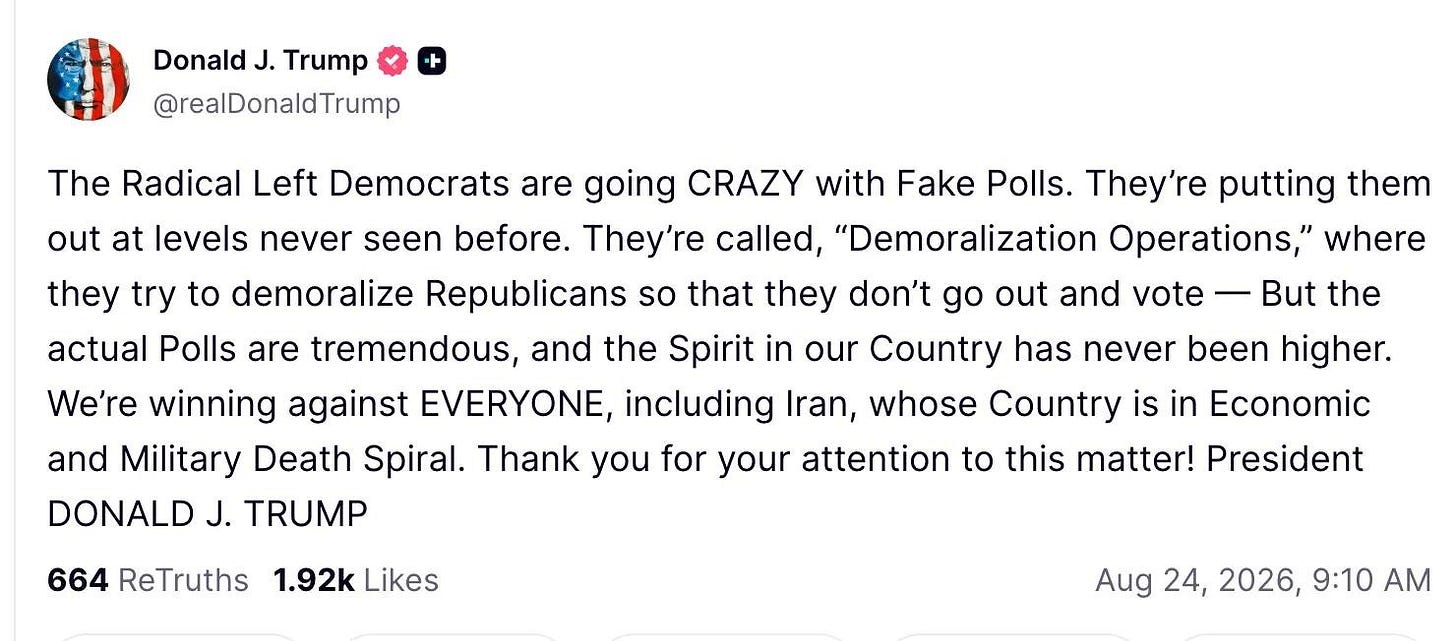
Next up is our good friend Tom Bonier tomorrow at noon ET about what we can can do about the growing problem of manipulating polling and prediction markets. Here’s Trump today:
Watch our discussion today, hit like so more will see it, share it with others, offer feedback below, and keep working hard all. We have a country to save, and elections to win all across the country, together - Simon
Robert J. Shapiro, a Washington Monthly contributing writer and a Senior Fellow at the McDonough School of Business at Georgetown University, is chairman of Sonecon, LLC, a private firm that advises U.S. and foreign businesses, governments and nonprofit organizations. Shapiro has advised, among others, Presidents Bill Clinton and Barack Obama, U.K. Prime Minister Tony Blair, and numerous members of the U.S. and U.K. cabinets and U.S. Congress; private firms including AT&T, Exxon Mobil, Google, Gilead Sciences, Nasdaq, Nordstjernan of Sweden, and Fujitsu of Japan; and nonprofit organizations including the International Monetary Fund , the U.S. Chamber of Commerce, and PhRMA. He also is a director of Overstock.com and an advisory board member of Civil Rights Defenders, Cote Capital, and the Pricing Carbon Initiative.
From 1997 to 2001, Shapiro was U.S. Under-Secretary of Commerce for Economic Affairs. In that position, he directed economic policy for the Commerce Department and oversaw the nation’s major statistical agencies, including the Census Bureau while it planned and carried out the 2000 decennial census. Prior to that appointment, he was co-founder and vice president of the Progressive Policy Institute and legislative director for Senator Daniel Patrick Moynihan. He was the principal economic advisor to Governor Bill Clinton in his 1991-1992 presidential campaign and a senior economic advisor to Albert Gore, Jr., John Kerry, Barack Obama, Hillary Clinton and Joseph Biden in their presidential campaigns. Shapiro also has been a fellow of Harvard University, the Brookings Institution, the National Bureau of Economic Research, and the Fujitsu Institute. He holds a Ph.D. and M.A. from Harvard University, a M.Sc. from the London School of Economics and Political Science, and an A.B. from the University of Chicago.