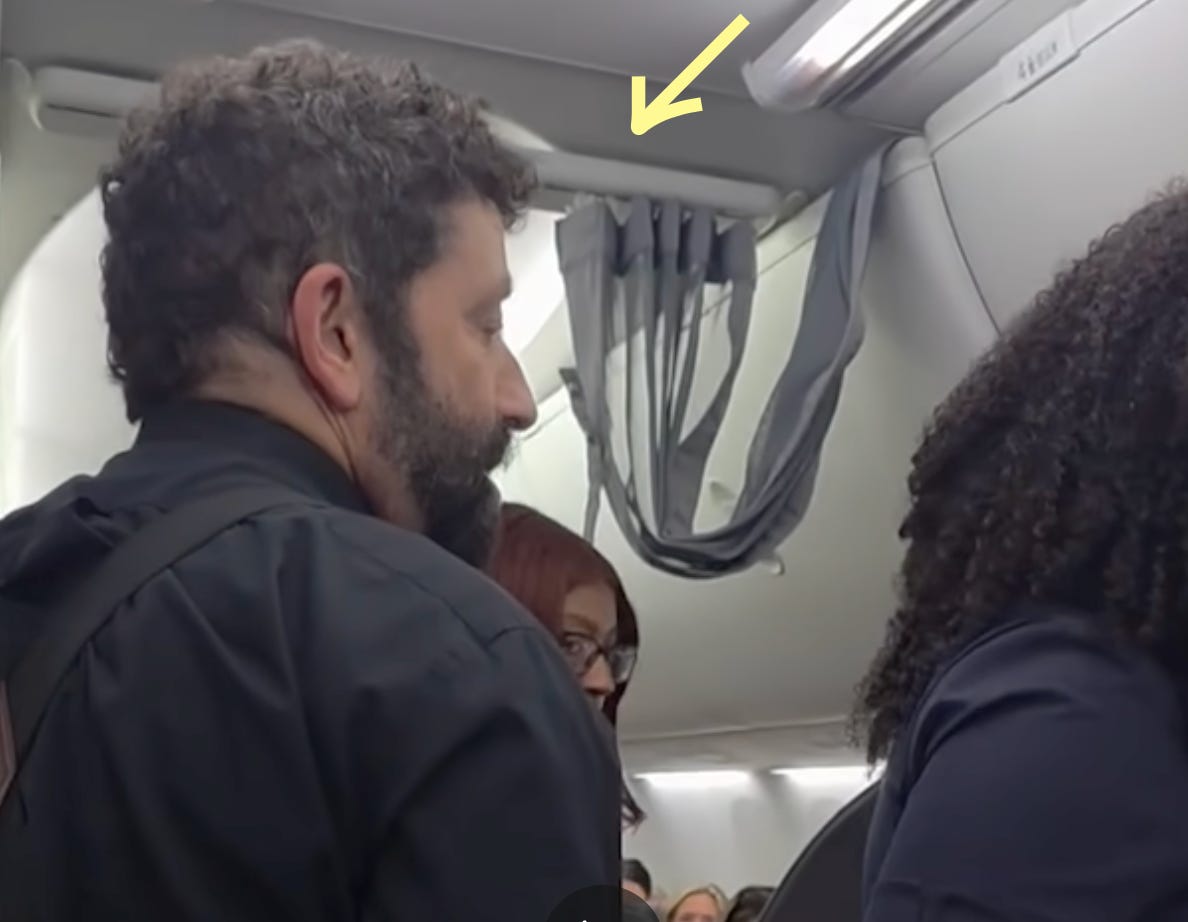
Here’s a wild story that happened to a friend of mine, the pastor Jonathan Cahn. That’s him above, in a screengrab from a video made by a fellow American Airlines passenger. And here is the guy Jonathan was seated next to, Arthur Lundeen, 67:
According to the account published in The New York Times:
Mr. Lundeen then became physical with his seat mate. Mr. Lundeen struck the laptop of the man next to him [Cahn], and then grabbed the man’s throat, Mr. O’Lenick said. When a woman in a seat ahead of the scuffle tried to intervene, Mr. Lundeen started to attack her as well.
Two fellow passengers, O’Lenick and Mejia, jumped up to restrain Lundeen:
It was not immediately clear what precipitated the violent outburst. A flight attendant rushed over with zip ties but even with his hands restrained, Mr. Lundeen continued to fight.
“I started trying to tell him to relax, we don’t want to hurt you, we just want you to settle down,” Mr. O’Lenick said.
… The self-defense training both men have practiced was vital for the next 10 minutes, as Mr. Lundeen violently struggled, screamed that the plane was going down and bit Mr. Mejia on his hand, Mr. O’Lenick said.
Well, Jonathan Cahn put out a video yesterday saying “what precipitated the violent outburst.” His account below is chilling. In Cahn’s telling, Lundeen initiated a pleasant, if distracting, conversation with Cahn about what he does for a living. When Cahn told him he is a Christian (Messianic Jewish) pastor who writes books, Lundeen said he’s an atheist. But then, Lundeen started behaving violently, blaspheming, cursing, using racial epithets, and so forth. Cahn was working on his laptop on something to do with his latest book, * The Altar Of Pergamon*, a fantasy mystery novel about a famous ancient pagan relic. It had been published a day or so before this attack. When Lundeen touched the screen, blackness spread all over it, so that Cahn couldn’t work anymore:
Here’s Cahn’s entire account. He gets into the blow-by-blow of the attack at around 17:00:
Cahn was nice enough to send me a copy of* The Altar Of Pergamon*
Three years ago, on a tour of the Seven Cities of Revelation, I visited the site of ancient Pergamon, on an acropolis overlooking the modern Turkish city of Bergama. I wrote about it here. Here is where Pergamon (or Pergamum) appears in the Book of Revelation, chapter two:
12“To the angel of the church in Pergamum write:These are the words of him who has the sharp, double-edged sword.
13I know where you live—where Satan has his throne. Yet you remain true to my name. You did not renounce your faith in me, not even in the days of Antipas, my faithful witness, who was put to death in your city—where Satan lives.
14Nevertheless, I have a few things against you: There are some among you who hold to the teaching of Balaam, who taught Balak to entice the Israelites to sin so that they ate food sacrificed to idols and committed sexual immorality.15Likewise, you also have those who hold to the teaching of the Nicolaitans.16Repent therefore! Otherwise, I will soon come to you and will fight against them with the sword of my mouth.
17Whoever has ears, let them hear what the Spirit says to the churches. To the one who is victorious, I will give some of the hidden manna. I will also give that person a white stone with a new name written on it, known only to the one who receives it.
The altar was dedicated to Zeus, the head of the Greek pantheon. I wrote then:
What was Satan’s throne? N.T. Wright, whose book
Revelation For Everyone, has been my companion this trip, speculates that it has to do with the fact that Pergamum, the Roman capital of Asia Minor, was a center of emperor worship. Augustus established emperor worship, and authorized Pergamum to be the first place in the Roman east to establish a cult there. Given the role that the Roman Empire played in the early Christian imagination, it is not difficult to imagine why Jesus might have identified the foremost city of emperor worship in Asia Minor as host of the throne of the Prince of This World, being worshiped in the guise of worshipping the supreme ruler of the Empire.
If you visit that acropolis, you can see the base where the altar stood before the Germans took it away:
Here’s a pic I took from behind the altar’s base. It looks out over Bergama:
In the novel, Cahn makes connections between the discovery of the altar and its relocation to Germany, and the rise of Nazism. It’s fiction, but the dates associated with this enterprise are at the very least a fascinating coincidence. Maybe more. Probably more. Nazi architect Albert Speer said of the stage he built for Hitler at the 1934 Nuremberg Rallies: “Undoubtedly it was influenced by the Pergamum altar.”
In my 2023 writing about Pergamon/Pergamum, I said:
After visiting the Pergamum acropolis today, reading Wright, and reading
[this essay from Biblical Archeology Review,]here’s what I think Jesus meant by “Satan’s throne”.The Antipas mentioned by Jesus in the Revelation passage was the city’s bishop, ordained by St. John himself, and martyred gruesomely by the Romans (they put him inside a large bronze bull, and lit a fire under it, roasting him inside) for refusing to worship the emperor and honor the local gods. Idol-worship is the chief temptation facing the Pergamene church — idol worship to which they come through sexual immorality and participating in community feasts featuring food offered to idols. (Jesus’s message for the church in Thyatira is essentially the same.)
I think Jesus is reminding his followers that they
really areengaged in spiritual warfare, and not to be lulled into compromise with evil. The city in which they find themselves is a world center of the deification of earthly power, and the worship of false gods. It was very easy, apparently, to fall into false worship if you compromised on sexual morality, and integrated yourself so closely into the community that you soiled yourself by eating meat that had been sacrificed to false gods.Moreover, in the Bible, mountains are associated with revelation, as places where earth meets heaven. The acropolis of Pergamon, which was even higher than the one in Athens, is where Roman civilization manifested its most sacred values: worship of false gods, including the Roman emperor. Pergamum was the most important city for this cult in the Roman east. Jesus was warning the local church that they live in the very heart of Satan’s kingdom, and not to be lulled into spiritual complacency, and an indifferent syncretism, just to be part of the city’s life.
Cahn says his novel eventually gets into what he believes is the relevance of that altar to our own time. We’ll see — I hope to finish it today. I got to know Cahn (though only by e-mail) when I read his eye-opening book * The Return Of The Gods* while working on my book
Cahn, quoted by the Daily Mail, recalled:
‘He said he was at one point a Christian, but he rejected Jesus after he got divorced and he felt judged by Christians over the divorce.
‘I was trying to help him, I was trying to encourage him and say Jesus had trouble with religious hypocrites.’
But it was when married Cahn, 66, started talking about his own experiences of God that Lundeen allegedly saw red and ‘turned.’
‘His face changed, his voice changed, and he said... almost in a whisper, he was like, “I have something to tell you,” and he said, “Bulls***,”’ Cahn alleged.
‘He’s getting louder, and he starts cursing God, cursing Jesus, cursing me.
‘And then he said, “Go f*** yourself.”
‘This was from nothing. It wasn’t like there was any real argument.’
‘It was a split second. The change was like unbelievable. It was two hours of friendly, and then in one second it just changed to the most different voice, different faith, different guy,’ Chan added.
‘It was as if something had taken him over.’
More:
In a bid to defuse the situation, Cahn said he showed Lundeen the cover of his new book, the Altar of Pergamon, on his laptop.
‘When he saw the book cover, that’s when he started getting violent,’ Cahn alleged.
‘I could only describe it what happened as demonic. It was like he was influenced by the dark side.’
He claims Lundeen hit his chest and abdomen ‘like he’s trying to start a fight,’ before allegedly threatening: ‘I’m gonna punch your f***** Jewish face in.’
‘I knew I was in danger. I knew it was it was going towards violence. I was trying to keep calm.
Lundeen later broke Cahn’s laptop and injured his arm before passengers intervened to restrain him.
Later in the clip, Cahn reminds us that the real battle we all face is spiritual. Yep. In an e-mail to me yesterday, Cahn said that the way Lundeen would toggle from being normal and friendly to being crazy and violent was bizarre. He wrote that almost every time he publishes a book, he receives a demonic attack:
I was fully expecting to be attacked that week – I told others to pray – But this is the first time, the attack came in the fury of a flesh and blood instrument – and the first time it brought an airplane down
[meaning the plane was forced to make an emergency landing — RD]– and became world news. (!)… With the
Duct-Taped-Manit was exactly that – he would have intervals in the midst of his fury, where he would suddenly be friendly again – and apologize to me – And then he would be taken again and begin attacking – until escalating with physical attacking and his lunging to destroy my computer.Yet God was with me – Aside from a broken computer and a bruised arm and shoulder, I’m good.
My friend Joshua Treviño works in public policy, and travels a lot to Mexico for it. He messaged me the other day to encourage me to have a look at this review of a 1991 scholarly book about the Aztecs, also called “the Mexica”. From the review:
That empire was not gentle. Few empires are, but even by the sad standards of human history, the Mexica were extreme. I’m not speaking here about their legendarily creative and inventive ways of humiliating subject peoples,
[I’m speaking about the human sacrifices. No, these were not exaggerated by the colonizers, as some revisionist historians would have you believe.]2[If anything, the Spaniards lacked the conceptual framework to fully comprehend the industrial-scale, ever-so-civilized and bureaucratic evil of the Mexica, and so they inadvertently downplayed it. The reality, as Clendinnen brilliantly documents, is that human sacrifice was not an occasional or incidental religious custom for the Mexica, like an extra-spicy church service for the people who only show up on Christmas or Easter. No, the mass-butchery of wailing, pleading captives of both sexes and all ages was the core activity around which their entire civilization and society revolved. Their art, their music, their poetry, their approach to warfare, their entire economic system, their kaleidoscopic array of holidays and festivals, all were singularly dedicated to the killing (often preceded by inventive torture) of helpless human beings. And everybody had their role to play:]3
The killings were not remote top-of-the pyramid affairs. If only high priests and rulers killed, they carried out most of their butchers’ work en plein air, and not only in the main temple precinct, but in the neighborhood temples and on the streets. The people were implicated in the care and preparation of the victims, their delivery to the place of death, and then in the elaborate processing of the bodies: the dismemberment and distribution of heads and limbs, flesh and blood and flayed skins. On high occasions warriors carrying gourds of human blood or wearing the dripping skins of their captives ran through the streets, to be ceremoniously welcomed into the dwellings; the flesh of their victims seethed in domestic cooking pots; human thighbones, scraped and dried, were set up in the courtyards of households — and all this among a people notable for a precisely ordered polity, a grave formality of manner, and a developed regard for beauty.The scale of it boggles the mind. The Mexica record with pride a single festal occasion on which over twenty thousand victims were sacrificed, the blood rolling in a slow curtain down the steps of the pyramids as four lines of manacled slaves trudged along the great processional ways towards their doom. It was the job of special priests to greet the captives as they entered the city and to explain in detail the honor that was to await them. And it was always human beings. Many primitive cultures have practiced forms of animal sacrifice. The Mexica were neither primitive, nor interested in animals. There was also no “othering” at work here. The Mexica knew that they were killing people who thought and felt and dreamed and loved as they did. Indeed,
that was the entire point of it. They constructed an efficient and well-run machine that had as its sole purpose delivering living, breathing, conscious and informed human beings to the killing-stone or the furnace. A whole battery of sophisticated psychological techniques were employed to ensure the compliance of the victims to the end.[Yes, the Spaniards lacked the vocabulary to describe it, but we who live in the aftermath of the twentieth century do not.]4
The thing is, the Mexica were not uncivilized savages. When the Spanish arrived, they found a city that was far more architecturally advanced than Spanish cities. What they encountered was a 16th century version of the most culturally and scientifically advanced 20th century nation in the world at the time, Germany, carrying out industrial-scale mass murder amid its sophistication.
Treviño sent me a document he prepared in which he translated contemporary (from the Spanish conquest) accounts of what the Spanish saw; some of what he draws from are Nahuatl testimonies. He gave me permission to quote them, and credit him. It’s staggering to read about the intensity and scale of the demonic evil that the conquistadores banished, thank God. You want to talk about spiritual warfare blending with actual warfare? Look to Mexico.
This is long, so I will have to finish the narrative tomorrow. But first, here are accounts of the omens sent to the Aztec (Mexica) emperor Moctezuma before the Spanish arrival. This is from stories the Aztecs told:
Ten years before a single Spaniard set foot on the causeway, the sky over Tenochtitlan was said to have caught fire. The old men who dictated their memories to the friars remembered a tongue of flame in the east, wide at the base and narrow at its point, that seemed to bleed light into the middle of the night and did not leave for a full year. It was the first of the omens.
There were others, and the Nahua who recalled them counted eight. The temple of Huitzilopochtli burst into flame from within, and the more water was thrown, the higher the fire climbed. A bolt of sun — a blow without thunder — struck the straw-roofed shrine of the fire-god Xiuhtecuhtli at Tzonmulco. A comet split into three and streamed across the daylight sky. The lake that cradled the city rose and boiled without wind, foaming up against the houses. And in the dark, a woman’s voice went weeping through the streets:
O my children, we are lost; O my children, where shall I take you?Fishermen brought Moctezuma a strange ashen bird with a mirror set in its crown, and when the king loo…