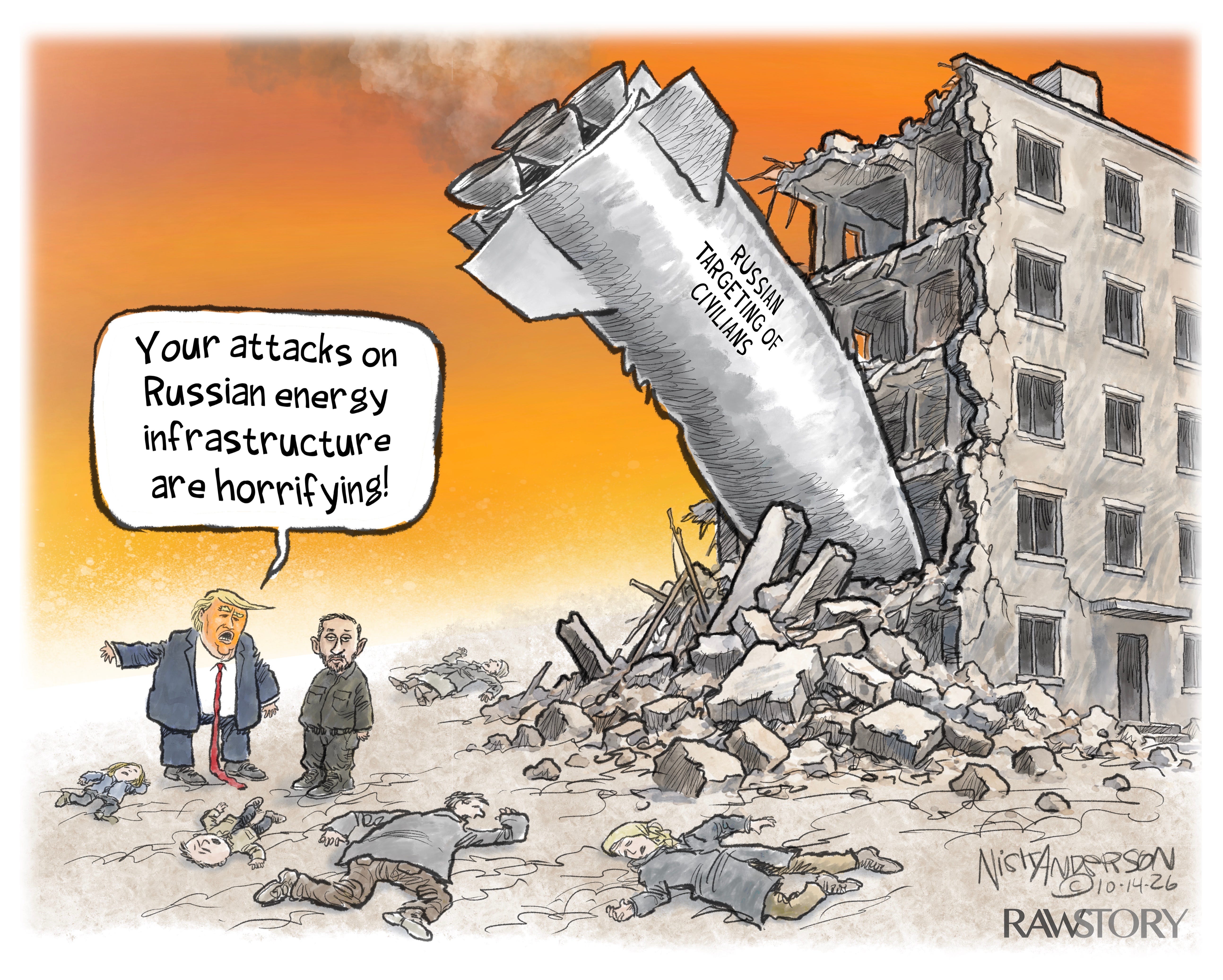
President Trump’s latest confrontation with Ukrainian President Volodymyr Zelensky has exposed a growing contradiction in his approach to Russia’s war against Ukraine: While promising to negotiate an end to the conflict, Trump is pressuring the country defending itself to stop attacking Russian energy infrastructure, even as Moscow continues striking Ukrainian cities, targeting civilians.
The immediate dispute centers on diesel fuel. With American fuel prices soaring amid the U.S. war with Iran, Trump has turned to an unlikely supplier for relief: Vladimir Putin’s Russia.
On October 9, Trump announced an agreement to purchase Russian diesel, easing restrictions on a country whose energy revenues help finance its military campaign against Ukraine. The following day, Trump suggested that Ukraine needed a new president, accusing Zelenskyy of prolonging the war and contributing to high fuel prices by attacking Russian refineries.
“I suggest they get a new leader who can make a deal because he could have made many deals and for some reason he never does,” Trump told reporters.
The remarks represented another escalation in Trump’s increasingly contentious relationship with Zelenskyy, once again demonstrating a genuine affinity for an authoritarian while expressing contempt for a democratically-elected ally.
Ukraine’s attacks on Russian refineries have a strategic purpose: by disrupting fuel production and distribution, Kyiv hopes to weaken Russia’s military logistics and reduce the energy revenues that help sustain its invasion. From Ukraine’s perspective, these facilities are legitimate military-economic targets in a war for national survival. From Trump’s selfish perspective, the attacks have become an obstacle to lowering diesel prices for American consumers, thus threatening the GOP’s hold on Congress.
Zelenskyy responded sharply to the agreement, describing it as a move that will prolong the war rather than help end it. His criticism came as Russian strikes hit residential buildings in Zaporizhzhia, causing civilian casualties. So, Ukraine faces pressure to curtail attacks on Russian refineries, while Russia continues bombing Ukrainian population centers.
There is also a broader economic question. The current diesel shortage cannot be explained by Ukrainian strikes. The U.S.-led war with Iran has obviously disrupted energy markets, particularly shipments from the Middle East. Trump’s effort to attribute high diesel prices primarily to Zelenskyy is an attempt to gaslight and distract American voters from the actual cause.
Meanwhile, Western governments (including the United States) have spent years attempting to reduce Russia’s energy revenues through sanctions and other restrictions. A new American agreement with Moscow trashes that effort and rewards Russia without making asking for any concessions in return. The pressure is absurdly uneven, particularly when Trump publicly calls for a change in Ukraine’s leadership while portraying Putin as willing to negotiate. A negotiating strategy that places disproportionate demands on the invaded country changes the incentives for the invading one.
Trump’s suggestion that Ukraine replace Zelenskyy adds another dimension to the dispute. Ukraine has postponed national elections under wartime martial law, a decision that has generated debate about democratic accountability and the practical difficulties of voting during a full-scale invasion.
Millions of Ukrainians have been displaced, substantial territory remains occupied, and soldiers are deployed across an active front. Holding an election under those conditions presents serious logistical and security challenges.
Nevertheless, Trump has repeatedly criticized Zelenskyy’s leadership and questioned his willingness to negotiate. The American president is publicly urging political change in an allied country while negotiating economic arrangements with the country invading it.
That position also risks weakening Zelenskyy’s bargaining power. Moscow has repeatedly questioned the Ukrainian president’s legitimacy, making Trump’s demand potentially useful to Russia’s diplomatic narrative.
Events on the ground underscore the distance between diplomatic announcements and military reality. On October 14, Russian missile and drone attacks killed three people and damaged approximately 30 energy facilities in Ukraine, according to Reuters. Hundreds of thousands of residents were left without electricity as colder weather approaches.
Ukraine also faces concerns about disruptions to American intelligence support and communications technology, further complicating its ability to defend against Russian attacks.
Trump has consistently portrayed himself as uniquely capable of negotiating an end to the war. His administration argues that engagement with Moscow and pressure for compromise offer a path toward ending a conflict that has already inflicted enormous human and economic costs. But the diesel dispute illustrates the competing priorities shaping that approach. The danger is that short-term economic incentives could undermine the leverage necessary to achieve those longer-term objectives.
The saddest part is that, according to experts, the deal with Russia is too small to meaningfully dent diesel prices here, while it offers a significant boost to Putin’s war machine.
Ed Hirs, an energy economist at the University of Houston, told * Newsweek* that the logistics of fuel distribution make meaningful short-term price relief unlikely.
“The diesel that will be consumed over the next three weeks is already in the pipeline to consumers,” Hirs explained.
Transporting, refining and distributing fuel takes time, meaning that even if Russian diesel becomes available to American buyers, consumers may see little benefit before Election Day.
Hirs also raised concerns about the quality of Russian diesel and whether major American fuel distributors would be willing to handle it. “Russian diesel fuel quality is spotty in the best of times,” he said.
According to Hirs, major companies such as ExxonMobil, Chevron, BP and Shell would be reluctant to guarantee the product.
The assessment undermines Trump’s shaky political argument. His administration is pursuing a controversial agreement with Moscow in hopes of reducing energy costs, but the benefits are unlikely to provide meaningful relief to voters.