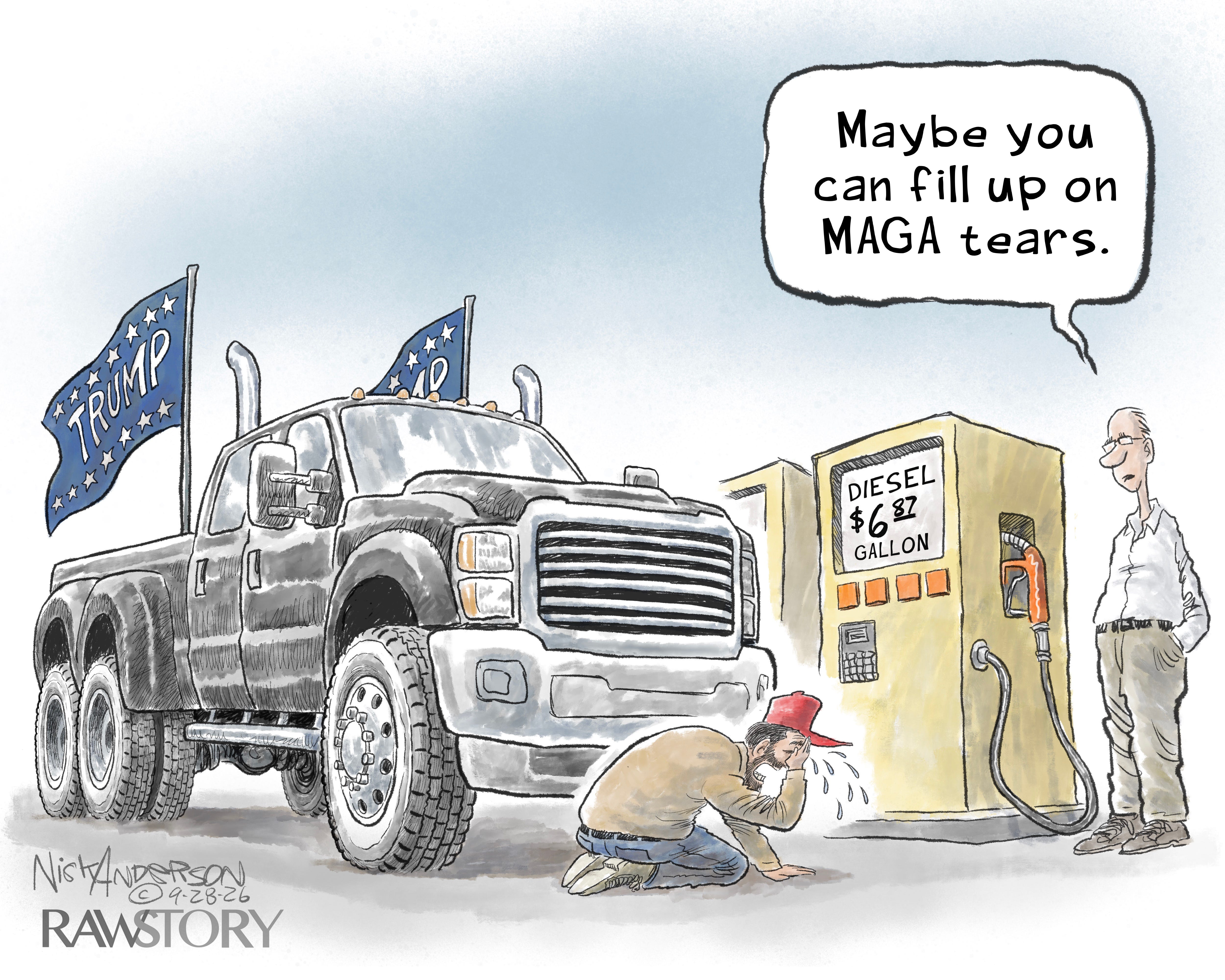
The demographic that actually purchases heavy-duty diesel trucks and fills them up at the pump is highly specific:
Gender: Fully 90% of diesel truck buyers are men.
Race: More than 84% identify as white.
Geography: They are heavily concentrated in rural regions and Western states (such as Wyoming, Montana, and Idaho) where diesel makes up the largest proportion of the local fuel mix.
Political Identity: This group leans heavily Republican. According to market tracking, conservative buyers purchase eight heavy-duty trucks for every one purchased by a Democrat.
Beyond individual truck owners, specific working-class vocational demographics are being crushed by these overhead costs:
Farmers: The agricultural sector relies heavily on diesel to run combines, tractors, and harvesting machinery. Because farming schedules are rigid, they cannot choose to “drive less” when prices spike.
Independent Truck Drivers: Small-business logistics operators and long-haul truckers are bearing the immediate brunt of paying up to $180+ per tank fill-up.
Unfortunately, the record price of diesel isn’t merely another unpleasant number glowing above America’s gas stations. It’s a warning about costs that could soon work their way through nearly every corner of the economy.
U.S. on-highway diesel reached about $6.53 a gallon in late September, eclipsing the previous nominal record set during the energy shock following Russia’s invasion of Ukraine in 2022. The increase has been extraordinarily rapid: Reuters reported that diesel prices had risen roughly 76% from a year earlier by late September, substantially more than gasoline. The result is an energy shock concentrated in the fuel that powers much of America’s freight, agriculture and heavy industry.
That distinction matters. Gasoline prices are highly visible because most Americans encounter them personally every time they fill their cars. Diesel works differently. Consumers may never buy a gallon of it themselves while still paying for it repeatedly—in the cost of moving food, packages, construction materials and manufactured goods around the country. And unlike a commuter who can postpone a road trip or drive less, many diesel users have little choice about how much fuel they consume.
The timing is particularly punishing for American agriculture. Record diesel prices have arrived during fall harvest, when combines, tractors and trucks are running constantly.
Reuters reported that South Dakota farmer Drew Peterson expects to spend as much as $1,500 per day to fuel a single combine, roughly twice what he spent last year. His explanation captures the problem facing farmers across the country: “You can’t just say, well, diesel is expensive, I’m not going to harvest.”
Those costs don’t necessarily appear immediately in supermarket prices. Farmers may absorb some of them through lower margins, and existing freight and supply contracts can delay the impact. But economists and agricultural experts told Reuters that sustained diesel prices at these levels are likely eventually to increase food costs, particularly for products requiring refrigerated transportation. Farmers were already confronting shrinking margins before the latest fuel shock.
Then comes the trucking bill, because the same math applies to America’s freight system. Diesel fuels much of the trucking network that moves goods from ports and warehouses to stores and homes. For large trucking companies, higher fuel expenses can often be passed along through fuel surcharges. Smaller carriers and independent truckers have less room to maneuver, particularly in an industry already operating on thin margins.
Reuters estimates that diesel alone accounts for roughly $51 billion of the $112 billion in additional fuel costs Americans have incurred during the Iran war. U.S. freight transportation consumes roughly 3 million barrels of diesel each day.
Consumers can already see how the transmission mechanism works. FedEx adjusts its Ground fuel surcharge weekly according to the national diesel price. For shipments beginning September 28, its Ground surcharge rises to 29.75%, up from 25% in mid-July. UPS’s corresponding Ground surcharge reaches 30.25%, compared with 24.75% in mid-July. Those aren’t necessarily charges consumers see itemized on an online shopping receipt, but they illustrate how higher fuel costs move into the price of transporting goods.
The immediate problem isn’t simply that America has run out of oil. It is increasingly a refining and refined-products problem aggravated by two wars.
The war involving Iran has disrupted Middle Eastern energy flows and traffic through the Strait of Hormuz, one of the world’s most important energy chokepoints. Before the conflict, nearly one-fifth of global oil and gas moved through the strait. Traffic has since been severely disrupted, although some oil continues to move through it.
At the same time, Ukrainian drone attacks have hammered Russian refining capacity. Half of Russia’s six largest diesel-producing refineries had either substantially reduced production or shut down in September because of damage from drone attacks. Russia has responded to its domestic fuel shortage by restricting exports of diesel and other fuels, removing additional supply from an already strained international market.
Reuters estimates that disruptions associated with the Iran and Ukraine conflicts have reduced diesel and other refined-product exports from Russia and the Gulf by roughly 1.6 million barrels per day since February.
America can’t simply turn a valve and make up the difference. U.S. refineries are already running near their practical limits—around 97% utilization recently—leaving little spare capacity to dramatically increase diesel production.
The price shock has produced an unusual political problem for President Trump and congressional Republicans heading toward the midterm elections. Republican lawmakers from agriculture-heavy states have pushed for restrictions on U.S. diesel exports in hopes that keeping more fuel at home would reduce domestic prices. Senators John Thune and Chuck Grassley have been among those advocating action.
Trump has also said he has advocated halting diesel exports. But even within the administration there are concerns about unintended consequences. Energy Secretary Chris Wright has warned that if refiners lose overseas markets for the diesel they produce, storage could fill and refiners could ultimately reduce overall production—potentially affecting gasoline and jet-fuel supplies as well.
That illustrates why there is no easy policy lever. Diesel is traded in an interconnected global market. Restricting American exports could increase domestic supply in the short term, but it could also intensify shortages elsewhere, distort refinery economics and provoke consequences that eventually feed back into U.S. prices.
The broader danger is that diesel becomes an inflation multiplier.A consumer notices immediately when gasoline rises 50 cents because the number appears on the pump. Diesel inflation is less visible. It arrives disguised as something else: a higher delivery charge, a more expensive box of vegetables, increased construction costs, a farmer raising prices to recover operating expenses, or a trucking company adding a fuel surcharge. And those increases can accumulate.
That makes today’s record diesel price more consequential than the cost of filling a pickup truck. Diesel sits deep inside the machinery of the American economy. It powers the tractors harvesting crops, the trucks carrying those crops to processors, the refrigerated trailers delivering food to supermarkets and the delivery vehicles bringing packages to people’s doors.
The person eventually paying that diesel bill may never touch a diesel pump. They’ll find it at the checkout counter.