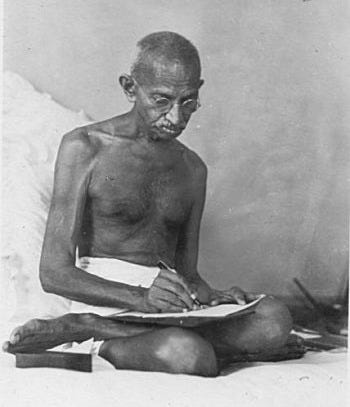
On August 18-19, Mumbai-headquartered Saffronart recorded a sale worth ₹16.2 crore for a compilation of aphorisms and thoughts written by Mahatma Gandhi, addressed to freedom fighter Anand T. Hingorani, who also published them in a book titled A Thought for the Day.
“The exceptional response to Lot 80—a series of reflections written by Gandhi for Hingorani—reinforces its rarity and historical significance. Together, these reflections offer a rare insight into how Gandhi lived the principles he advocated publicly, making this an especially valuable record of his thought and practice,” Dinesh Vazirani, co-founder Saffronart, said in a press release circulated after the historic sale. Co-founder Minal Vazirani said that such multi-crore sales of historic collectibles had “implications beyond the market.” “Private collectors and family estates that hold rare documents will see a greater incentive to potentially offer them into public circulation,” she said.
Minal Vazirani’s point is not incorrect. Private collectors of historic documents and artefacts often open their collections for viewing, or lend them to museums to exhibit — after all, display is as much part of the sentiment of collecting as possession is.
But does this constitute public good? This question guides the central plaint of a note that A Annamalai, director of the National Gandhi Museum in New Delhi, sent out over WhatsApp a few days after the sale.
“Gandhi’s letters, manuscripts and personal belongings are not merely private possessions. They are part of the common heritage of India and belong to our shared history,” he wrote, appealing to all those in possession of Gandhi’s hand-written manuscripts or articles to come forward and hand them over to the museum for preservation, instead of putting them up for sale.
I caught up with the director to ask him about his note. One main point emerged from our conversation: This is not a new question.
In 1996, UK’s Phillips Auction House returned Gandhi’s manuscripts, without auction, to the Indian authorities reportedly on the basis of a will in which Gandhi left his writings, books, articles etc to the Navjivan Trust (formed in 1929). The manuscripts were kept by Gandhi’s former secretary, V. Kalyanam, but it is unclear how these documents reached the auction house — a few unverified stories about their journey from Chennai to London circulate on the internet. However, what’s of significance is that the Indian government eventually received the documents and handed them to the Nehru Memorial Trust (”We made copies and have them at the Museum too,” Annamalai said).
In 2009, Antiquorum Auctioneers made a high octane sale of Gandhi’s memorabilia in New York; in Delhi, Navjivan Trust moved the high court seeking a stay on the basis that the pieces belonged to it as per Gandhi’s will. Even the Indian government reached out to the United States asking them to return the objects. Vijay Mallya, who reportedly bought the pieces for $1.8 million, told the Washington Post that he intended to gift the items — a brass bowl, a plate, metal rimmed glasses, a pocket watch among other things — to the Indian government.
At the same time, there have been auctions of Gandhi’s items that took place unchallenged. For instance, in 2013, among many items that included a drop of Gandhi’s blood on a slide (collected after an appendectomy) and his sandals, the highest-selling work (GBP 55,000), ironically, happened to be the “last will and testament” of Gandhi at an English auction.
For Annamalai, the question is also one of proving authenticity. “People wonder whether private archives are better managed than the public ones. Does the National Gandhi Museum have the space to actually preserve the documents? This has to be addressed. We don’t have the proper facilities yet, we have to create them, and we would gladly take the help of private partners to build such an archive facility. It is important for an institution like us to exist because we remain the site of authentic documentation. If not today, years down the line, an institution like ours can help check whether a document is original or not, real or fake. This becomes all the more important in times of AI, which is very dangerous.”
However, Saffronart is clear about their recent sale. “The provenance is the collection of Anand Hingorani and then by descent,” Dinesh Vazirani said.
Dhamini Ratnam is culture editor at Hindustan Times. Ways of Seeing is her fortnightly newsletter that takes you through only the most important cultural happenings you need to know of. You can write to her at dhamini.ratnam@htlive.com or comment on this newsletter below.