Does Georgism Work? Five Years Later
S. states and the election of LVT-friendly national leaders in the UK and South Korea. As for me, I now work full-time for the Center for Land Economics and write for Progress & Poverty substack.
Hi, this is Lars Doucet, author of the book review of Henry George’s Progress and Poverty that won the first ACX book review contest, as well as the three-part follow-up guest post series, “Does Georgism Work?” A lot has happened since then, including land value tax (LVT) enablement laws passing this year in two U.S. states and the election of LVT-friendly national leaders in the UK and South Korea. As for me, I now work full-time for the Center for Land Economics and write for Progress & Poverty substack.
I’d like to reflect on what I wrote five years ago: what I was right about, what I’ve changed my mind on, and what the outlook for LVT is in 2026. But first, here’s a brief summary for those who either have no idea what I’m talking about or just need a refresher.
In 2021, I wrote a book review for ACX on the book *Progress and Poverty, *the magnum opus of the famed 19th-century economist and populist firebrand Henry George:
If I had to summarize the book in a single sentence I would put it this way: poverty and wealth disparity appear to be perversely linked with progress, The Rent is Too Damn High, and it’s all because of land.
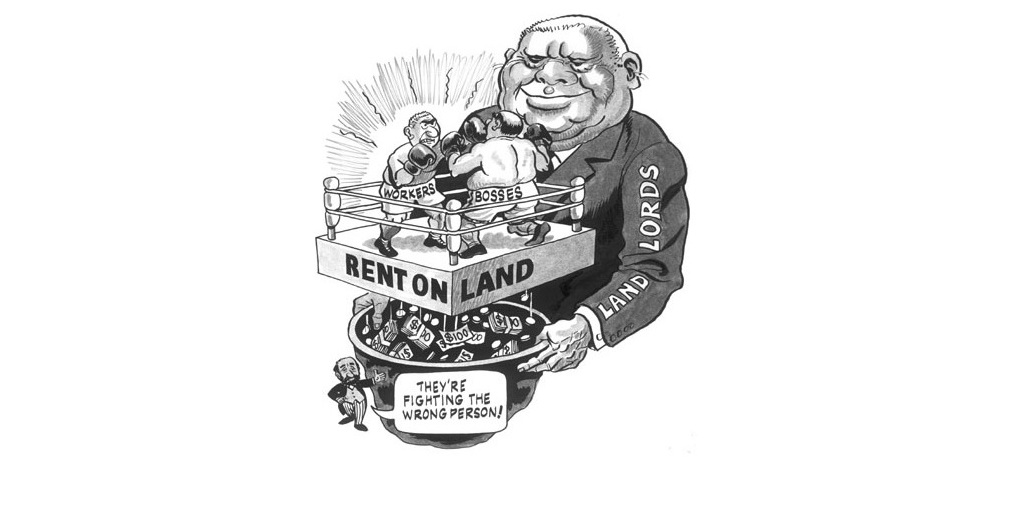
George argues that poverty paradoxically advances alongside progress because, as material conditions improve, landowners can charge more rent for locational benefits they didn’t create. People who earn more than the local average salary (e.g., software engineers) can stay ahead of this trend, whereas those who don’t (teachers and service workers) are priced out of the homes they rent. Eventually, even upper-middle-class families can struggle to afford services like daycare, because daycare businesses must charge more to pay business rent and employee wages. Landlords, rather than daycare owners or workers, collect most of the service price increase parents pay.
Henry George’s remedy is the land value tax, or LVT. In its ideal form, this tax would capture and redistribute the annual rental value of land; that is, the recurring value of the land* excluding *the value of any buildings or other improvements on top of it. In practice, this looks a lot like a conventional property tax paired with a “universal building exemption.” Notably, George isn’t simply in favor of a land value tax; he’s also opposed to taxes on both labor and capital.
George further proposed the single tax—a policy in which land is taxed at its full annual rental value, *and *LVT is the only tax.1 Although the feasibility of the “single tax” remains controversial among economists, land value tax itself is surprisingly well accepted by economists left, right, and center as the ideal tax policy, with mainstream criticism mostly centered on practical and political concerns.
After the book review contest results were announced, ACX readers inundated me with questions, which led to the three follow-up posts. After those ran, I reposted all four articles on the standalone site www.gameofrent.com, and later consolidated them into a book, * Land is a Big Deal*.
Here’s what’s happened since.
Five years ago, LVT was mostly a hypothetical idea people debated on blogs. Today, it has the most legislative momentum it’s seen in decades. Many states introduced bills this year, and Virginia and Kentucky passed land value tax enablement laws in April. These laws allow municipalities to opt into split-rate property taxes, which lower tax rates on buildings and raise them on land. My organization, the Center for Land Economics, maintains a public legislation tracker with an interactive map that makes it easy to keep tabs on these trends.
Virginia and Kentucky were the big winners for the 2026 legislative season, enabling various cities in those states to implement land value taxes. However, even bigger opportunities are coming. In Washington State, my organization is collaborating with the Sightline Institute on an upcoming LVT bill. Meanwhile, in New York, Governor Hochul extended authority for cities to utilize land value capture to fund new transit stops, a tool that can be used for the new Inter-Borough Expressway (IBX) subway expansion. We’re working with Niskanen Center, Center for Public Enterprise, and Institute for Progress to turn this idea into a real policy proposal.
Nor is interest in land value tax limited to the United States. The UK just elected a new prime minister, Andy Burnham, who has long openly advocated for a land value tax, and South Korea did the same last year with the election of new president Lee Jae Myung. Additionally, in January 2025, the German state of Baden-Württemberg implemented a new LVT that survived a subsequent court challenge. Although we’re tempering our expectations (the effective tax rate of the German LVT is quite low, and it remains to be seen how ambitious the Burnham and Lee administrations will be), it’s clear that LVT is no longer an obscure idea, nationally or internationally.
Finally, many now believe that the economic effects of AI developments may accelerate support for LVT and Georgism more generally. As newly minted AI millionaires bid up land prices in San Francisco and Seoul, Adam Ozimek argues that land will be a winner in the age of AI. Similarly, Aksel Sterri, co-founder of the Norwegian Effective Altruist think tank Langsikt, calls for an explicitly Georgist framework for understanding the AI era. (I’m also Norwegian; see my piece on Norway’s century-old Georgist tradition in natural resource management for more context on what Aksel’s talking about.)
So what have I learned?
I used to think LVT advocates had to change popular and elite consensus before moving on to the boring scut work of implementation. Now I realize that the boring scut work is actually what precedes, and even leads to, changing the consensus.
If you go back to the original series’ comments, you’ll see me trying to answer every concern that comes up, and falling for the bait when someone drags me into a tendentious comment thread dozens of replies deep. These would sometimes terminate in the interlocutor declaring that they’re the “exact kind of person Georgists need to convince!”
I’ve since learned that overly online keyboard warriors are the *least *important people to convince. The most important people are on your local city council or state legislature. Furthermore, instead of wasting time with hard cases or elected officials who are dead-set against your ideas, you’re much better off finding and working with people who are already interested in your principles. This often means giving up on your own city or state, at least for the time being, and pursuing a “succeed anywhere” strategy instead.
Changing policy where people want to change it is also how you overcome the “cold start problem,” when someone likes your idea but wants to see someone else do it first. Rather than trying to change that person’s risk aversion, find the person who is adventurous enough to try something new and work with them first. This builds case studies that you can use as social proof for the second, more cautious, wave of reforms.
I’ve also found that many online and academic objections are somewhat imaginary. When you talk to actual people in office, either their objections are entirely different from the ones you see in social media and comment threads, or they’re surprisingly open to being convinced if you listen patiently and present a clear argument backed by data and research.
Which brings me to…
No politician on earth has the time or inclination to independently learn about your philosophy, ingest all the arguments for it, evaluate a bunch of empirical and theoretical research, model its impacts on their locality, anticipate and respond to all possible objections, then wrap it all up into a tidy package complete with PowerPoint presentations, slick graphs, interactive websites, and a convenient, printable “one-pager” to hand out to interested parties.
You know who can do all those things? You.
For instance, some people get confused about land value tax, thinking it will wreck single-family homeowners, or that I’m out to get them personally, because obviously all the land value in town is concentrated directly underneath their specific home. This isn’t a disagreement about values or mechanics but rather a simple misunderstanding of what land value is and where it is most concentrated.
The first thing I do to disabuse people of this notion is to point out how much land value in any typical U.S. city is concentrated in downtown areas, and how much that value attenuates in the suburbs. We do this by loading up CivicMapper, our free, open-source 3D visualizer that takes local assessed land values and puts them on a map.
Here’s Washington, D.C.
Here’s Austin, Texas.
Here’s Seattle, Washington.
Not all cities look the same, and not all assessments are of equal quality, but you see the same basic patterns everywhere. Land in the city center is worth much, much more than outlying areas.
Then, we show people how much of that high-value land is dedicated to extremely low-value uses, like surface parking. Here’s Houston, which has over 3.5 billion dollars of land value locked up in surface parking alone.2
And no, it’s not just Texas. Here’s Portland, Oregon.
We can even zoom in and show how much of that surface parking occurs in the most valuable areas, such as Houston’s downtown district, which alone accounts for nearly half a billion dollars’ worth. These are exactly the places where it makes the most sense to concentrate development.
Having established that Land Is a Big Deal and that we’re also squandering it, we do the math and build a model of who wins and who loses under a revenue-neutral land value tax shift, or “Universal Building Exemption.” To do this, we use LVTShift, a free, open-source Python library maintained by the Center for Land Economics. In most of our models, the biggest losers are vacant land and surface parking lots, and among the net winners is the typical median single-family homeowner.
In addition to doing the math, we find compelling stories to tell. For instance, in this report on Cincinnati that we collaborated on with the Notre Dame Student Policy Network, we illustrate how conventional property taxes punish those who improve properties and invest in the city by providing housing and business, while those who own vacant lots or surface parking lots are rewarded for holding land out of use.
Here’s a similar comparison from our report on Spokane, Washington. The lots with houses on them pay more than seven times as much per square foot of land as the vacant lot does, even though all the land is equivalently zoned and similarly located.
We built up this methodology from crude beginnings by talking to people, trying things, learning from our mistakes, and refining our approach. Finally, we condensed everything we learned into a concrete political playbook entitled Enacting Land Value Return in Your Hometown, then published it as a guide for others to follow.
This playbook is now leading to wins. One of our activists, Jackson Arnold, a member of the Abundance Network, wanted to implement LVT in his hometown of Louisville, Kentucky. He got in touch with us, joined the OpenAVMKit Discord,3 and ran the playbook all the way from inception to getting a bill passed in his state legislature. We are now trying to figure out how to inspire and enable more Jackson Arnolds.
While the first wave of LVT fans were local citizens, we’re now attracting lawmakers’ attention. The most salient example is Bill Blessing, a Republican state senator from Ohio and chair of the Ways and Means Committee, who introduced an amendment to Ohio’s state constitution this year to legalize local opt-in LVT.
That’s all very exciting. But we still have one question to ask before we get carried away.
My three-part article series was structured as an investigation into the three most common objections to Georgism. We should revisit those and see where things stand in light of what I’ve learned since. The three objections were:
**Land just isn’t a big deal anymore in the modern economy.****Land value tax will just be passed on to tenants.**Land value can’t be accurately assessed separately from buildings.
In Part 1, Is Land A Big Deal?, I ran the “land isn’t a big deal” theory against several testable hypotheses. Among the findings was the fact that sky-high urban real estate prices were primarily driven by land appreciation, and that land was a large and steadily increasing share of bank loans.4 The article’s centerpiece was an original estimate of the total land value of the United States, which was much larger than many had expected. Although this estimate fell short of what a “single tax” would require, it was still large enough to convince many that LVT had been unfairly dismissed as a serious policy proposal.
This article has aged the best of the three, but I still have a few updates to share.
If land is a big deal in the USA, it’s an even bigger deal in South Korea, which has all the prerequisites for a national LVT and enough land value to approach a full-on single tax, or other ambitious projects like Universal Basic Income (UBI). Here’s a snippet from my piece, UBI Advocates should watch South Korea:
For UBI or LVT to succeed anywhere, they must first succeed somewhere…therefore, if you want UBI or LVT to succeed, you should scour the world for a place where these two policies are the most:
Economically feasible
Technically feasible
Politically possible
Socially and politically urgent
That place is South Korea.
South Korea has the highest land value-to-GDP ratio in the entire OECD, in excess of 500%. To put that in perspective, the figures from my own estimates of the USA’s total land values—which surp…
Send this story to anyone — or drop the embed into a blog post, Substack, Notion page. Every play sends rev-share back to Astral Codex Ten.
We’ve simplified responses to 👍 / 👎. Past comments are archived but no longer visible.