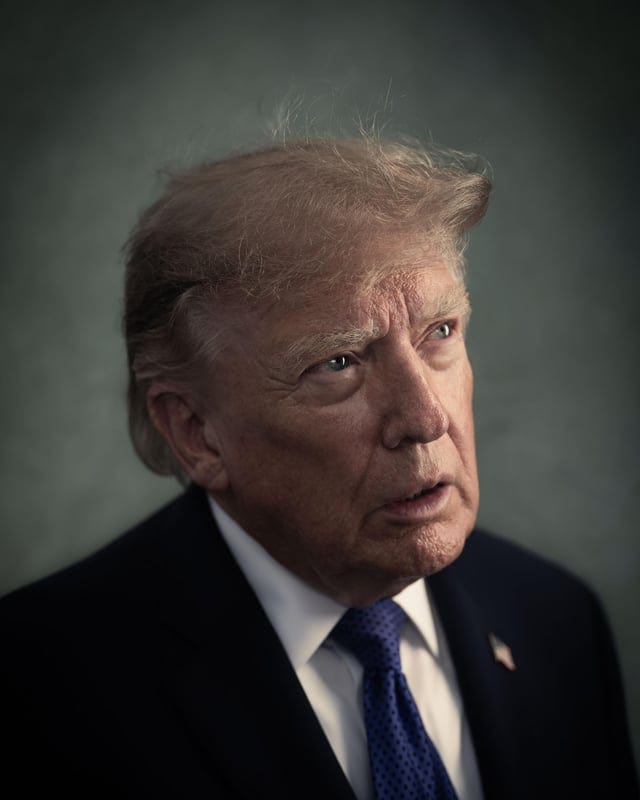
Dan Winter’s recent picture of Trump for Time has made the rounds, including on my social media. What parts of the photograph expose Trump’s state, and what doesn’t?
Writers like Roland Barthes and Susan Sontag have written extensively about photography as a tool for objectifying and codifying cultural meaning. Both argue that the photograph is not a mirror of reality but the photographer’s choice of how to describe it. Photographs can lie.
I’d also argue that photographers can tell truths the sitter hopes to hide. Photojournalists are artists and journalists in one. Right now, with a narcissist in office, they often have a special level of access to Trump, who has rarely shied away from media attention. These are also people who have spent their life observing humanity to get the right shot.
Winters falls into both photojournalism and portraiture. Portraiture is a particularly persnickety career. If you’ve ever had your picture taken, you might have wanted to look your best. You might stand at an uncomfortable angle, maybe remembering advice that you look better from a certain angle. In that discomfort, you get captured in a less-than-flattering way. You feel disappointment or frustration. Now imagine doing that for a job.
Portrait artists often have a way of putting their sitters at ease, often by creating an emotional connection. This rapport, even if temporary, allows sitters to drop their guard. Rather than asking them to pose, they allow them to just be. Then they take a series of images. Similarly, you might find you look better in candids than seated portraits; it’s because you’re not consciously posing.
Winters is playing in a form with a long history. Roman emperors loved a fairly realistic portrait. After all, those rugged features headed the largest empire in the world. Why “airbrush” it? Artists like Holbein, Rubens, and VanDyck made their name in royal portraiture. Royal portraiture from the Renaissance on had to walk the line between flattering and recognizable as the sitter.
Goya broke this tradition, showing the Spanish Royal family with honest fidelity. He’d been well-regarded by then and likely had enough rapport with the sitters to be allowed this access and expression. The Family was said to love how he’d caught their finery and opulence.
This duality of the sitter’s understanding and the artist’s intention underlies Winter’s portrait of Trump. Time recently announced that Trump was featured more than any other person on its cover. If you look at Winter’s suite of images of Trump, including two of Trump standing at the new not-to-code helipad, three show an old man posturing strength. In the standing ones, he tries to look surefooted. In the seated one, he looks at the camera, not quite the steely gaze so often employed in “The Apprentice” marketing. The fourth image shows Trump slack-mouthed and vacant-eyed.
Time also published images of the photographs being captured. Winters is seen from behind, with Trump posing in front of a backdrop. The preview composition shows a man who seems uncertain. Light streams in from the right, which softens the droopiness of his face. By contrast, in full daylight, the sitter looks as if he is trying to do his best mean mug. In this comparison, you see photography's trick of framing ideas as needed. Susan Sontag said, “To photograph people is to violate them, by seeing them as they never see themselves, by having knowledge of them they can never have.” Winters is doing just that here. Winters is representing Trump’s weakness, that which he is trying to mask, in the image.
Given Trump has spent a lifetime trying to hide his weaknesses and fool the fools, is this type of disclosure groundbreaking? You’ll see a major uptick in media coverage of Trump’s weaknesses. But this is not that he is weaker or that he’s become dementia-addled. The media has spent the last decade cleaning up his act, paraphrasing him, and publishing flattering images when it pleased them. Journalism has ethics; entertainment has profits. This picture isn't a disclosure of something new, but another choice the media ecosystem made to offer something that will sell. Now that his popularity has tanked, this image will easily take off.