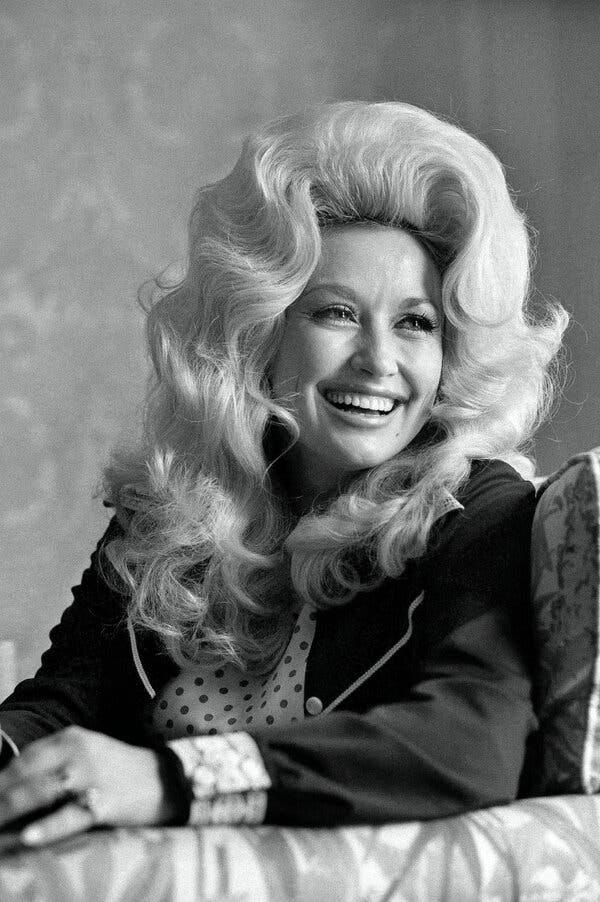
Dolly Parton looked cheap and easy, and she lived rich and fulfilled. In her biography, the earliest beauty she knew was the town tramp. Rather than castigate that fallen woman, perhaps she heard the crux of the preacher’s sermons about love, or perhaps from a young age she was willing to love everyone. Either way, that aesthetic became cemented in her young mind as the pinnacle of beauty. In fame, she never wavered from her personal style, even when people assumed she was a two-bit floozy. When asked how she reacts to being called a dumb blond, paraphrasing, she commented, ‘Nothing. I know I’m not dumb or blond.’ Unflappable wit with a self-effacing nature is a rare combination. She was one of a kind.
Yesterday, I was writing about the Chanel “shoes” as a sign of how the wealthy are disconnected and, as such, perform status in outlandish ways, assuming no end to their power. But, in Dolly’s style, we see the opposite: someone for whom style was an expression of self, not an exertion of power. How did she become this way?
Compared to Dolly, I wonder why so many Americans focus so unflaggingly on hate or selfishness. Her aesthetic helps us see how her path was so different, or as she said, “If you don't like the road you're walking, start paving another one.”
Born in Tennessee directly after WWII, Dolly Rebecca Parton was the fourth of 12 kids born in a one-room cabin in an Appalachian community. Her father had been a sharecropper, and money was tight.
While they had a radio, they didn’t have running water or electricity. Rather than focus on her deprivation, she highlighted how “We were rich in things that money don't buy.” Her family's love and her “silly” belief that she could be more than a farmer’s daughter pushed her toward music. Her goal, though, was to have “pretty things.” Her sense of beauty was shaped by the things that charmed her in youth: rhinestones and big hair. Given how far she went from her early roots, her connection to her earliest visions of beauty highlights her deep sense of self.
The strength she said came from her faith. Her childhood faith also affords us a look at a central element in the national ethos. As I’ve discussed, much of our national character was shaped by the forms of Christianity practiced in rural America, with its itinerant preachers and general fervor. Those with real power, the urban elite who sat in Episcopalian or Presbyterian pews on Sunday, publicly supported the idiosyncratic faiths of rural America. Why? Just as our national economy grew out of the financial gains of novelty, rural preachers of the 19th century often gained traction for more and more outlandish sermons. Speaking in tongues, adding in snakes, and other performance aspects became commonplace. These preachers often scared the beejeesus out of people, creating what was considered an easily controlled populace.
In this fractured, localized faith practice, Christianity intertwined with the needs of the people. While some regions did foster high control, the people of Appalachia often took their Christian faith as a call in a different way. There was its share of snakes and brimstone; there was also a community-centered advocacy. Relative isolation could foster either collective action or bitterness. In Appalachia, for generations, communities chose collective action and social care.
Much of our nation’s early union organizing was born in these communities, as miners came together against corporations' inhumane actions. They stood tall for workers because, culturally, they were communities who had no one else.
While the rural South had slightly negative connotations, Appalachia evoked backward, sister-marrying yokels. The prejudice against people from these hard-scrabble communities kept many from moving into cities. Those who went into cities for work were often relegated to the most menial of jobs. Hearing their accents, employers assumed low intellectual ability. Hillbillies could only do so much.
I tell all this history because Dolly’s resolve is integral to much of the Appalachian Christian story. In popular American society, this background has come to seem like a hateful, xenophobic, backward-looking character, as typified by the vice president, who claimed Appalachia shaped him. For her, those rural roots resulted in an iron will to be herself, as well as a belief in the good of people. She said, “Find out who you are and do it on purpose.” Her sense of self, paraphrased, meant she’d fight through the rain to enjoy rainbows. Why? More than anything, her life and career were typified by her motto: “I know who I am, and I don't try to be nobody else.”
Vance, on the other hand, spends much of his time seemingly moving with the winds of white supremacy and changing position as needed. Of course, Vance’s Appalachian roots are somewhat contested, as he did not spend his youth in that region. He’s taken up that mantle to push a specific narrative much as many a grifter in today’s America. His empty sense of self combined with a craven desire for power results in his brand of stuffed-shirt boredom. Vance’s windbag Appalachia is a fabrication.
Dolly was authentically Appalachia, with her glittering style, her strength, and her sense of community. To stick to her visual roots through all her albums and successes is quintessentially Appalachian.
Visual style and philanthropy are linked, as I’ve discussed. Style is an expression of self within the social structure. Historically, philanthropy was also a means of asserting self in relation to community. You wear who you are. You share wealth to support your beliefs.
Dolly’s exuberant visual style was matched equally by the strength of her philanthropy. She said, “If your actions create a legacy that inspires others to dream more, learn more, do more, and become more, then you are an excellent leader.” She said her plentiful rewards were expansive. Riches were to be shared, because her heart felt she needed to. Dolly saw her wealth as a means of giving back; never making it to billionaire status, she always aimed to share her blessings.
In the 21st century, many of our wealthiest individuals, the technofeudalists, see themselves as ordained to occupy the upper echelon of society. Unlike Dolly, most of us who are Uber wealthy hail from upper-middle-class backgrounds. Is it their lack of suffering that makes them act without empathy? Or is it their childhoods in suburban, disconnected single-family homes? It’s hard to say what made so many of our uber-wealthy selfish and self-centered.
But I go back to her childhood in that small town, where she saw beauty in someone on the outskirts of society. Even after finding out about that woman’s circumstances, Dolly held fast to her aesthetics. Style can be an assertion of self, but only if you truly know yourself. The machine of trends has made a few people very wealthy. Much of a consumer culture, though, is based in the insecurity of increasingly disconnected, isolated people. Rather than dressing for who they are, they buy to avoid finding themselves. You’ll do whatever it takes to show off because you can’t show self—you don’t know yourself enough to do so.
Bezos, for example, sits like Scrooge McDuck with more plastic surgery. While he happily jumped on the Dolly eulogy bandwagon, his remarks highlight how empty words can feel. If your existence is constantly avoiding your own truths, how can you possibly have time to find empathy for others? After all, you have no empathy for yourself. Wealthy beyond belief, his ex-wife will have made a much more lasting positive impact on society than he has. Given his recent moves for attention, like his high-profile connection to the Met Gala, he’s yearning to be seen as cool.
Dolly, though, understood that cool starts within. She said, “It's hard to be a diamond amongst rhinestones.” Being true to yourself is hard in a society where people fake self-knowledge. Dolly’s style, therefore, is not a costume, but instead a manifestation of inner acceptance. While her hair might have been fake, she was the real deal. Style isn’t frivolity when it’s an expression of your being, just as true generosity is easy when wealth isn’t measured solely by your bank account.
Dolly suggested donating to her Imagination Library, supporting your library, or reading to a child in lieu of flowers.