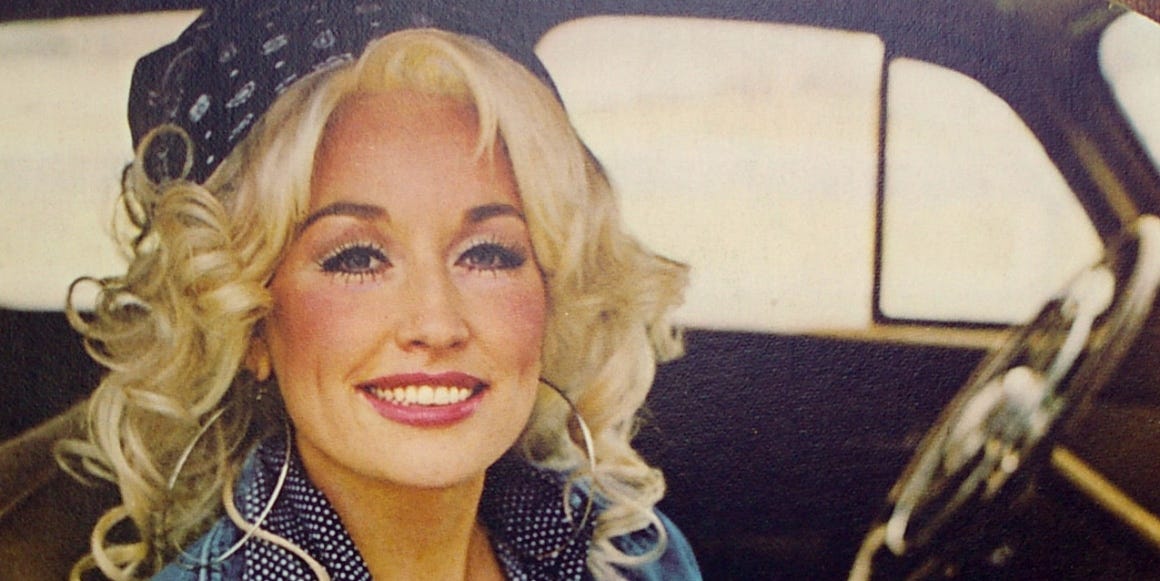
On January 19, 1946, Avie Parton was in a cabin in the Appalachian Mountains of Eastern Tennessee, giving birth to her fourth child. That daughter said she was raised in a family rich in what matters — love. Less than 6 months later, at a hospital in Queens, Mary Trump gave birth to her fourth child. That son noted that his family had a cook and a chauffeur. In Dolly Parton and Donald Trump, we see the two trajectories of American life, as well as some edifying messages about how to transform society to ensure we have more future Dollies and fewer Donalds.
Dolly was a fixture of my childhood. My parents were firm rock-and-roll fans, so it wasn’t her music. The movie “9-5” must have been on television at least once a month, or at least that’s how it felt. I can still recite lines from memory, despite not having seen it this millennium. On Dolly’s passing, I thought about playing the movie. But even remembering the promise the movie held, I just couldn’t.
In my youth, I vividly remember the speech that said any of us could be the President. Not one of us, despite all of us being girls, and most of us being Black or people of color, questioned our teacher. Our own mothers worked. The books we read and the movies we watched seemed to be getting ever more like the world we lived in.
But that childhood in the 1980s was already living on borrowed time in terms of equity. As I’ve discussed, using Madonna’s career as an index, the 1980s represented a time when the wealthy and powerful were actively destroying the ladders they climbed.
If Madonna’s career helps show that an unknown now very likely can’t make it to superstardom, the comparison between Dolly and Donald helps us understand how Boomers have shaped our current moment in history, one in which wealth disparity is nearly as bad as it was in the Gilded Age.
This is the weekly paid post. It’s too long for email, so read it on the web or in the app for the full thing. I appreciate every one of you. If you can upgrade, it would be helpful, as I’m using these earnings to focus on writing my book. Suppose you can’t afford to buy me a coffee. I run on caffeine. If you can’t, no fear, I always make lots of my content free.
When (Robert) Lee Parton handed the doctor a bag of homegrown cornmeal in payment for attending his wife’s home delivery, that doctor was not surprised. Rural life in that part of the Appalachians was largely still a barter existence. Electricity hadn’t arrived in the mountains. Many people, like Parton, farmed other people’s land to put food on the table.
Given the negative connotations of Appalachia in the 20th-century consciousness (which still persist), Dolly’s stratospheric rise meant she fielded numerous questions about her poor childhood. Dolly, in adulthood, remained close not only to her siblings but also to their children. Much of her family worked in her businesses. These generational bonds show the deep roots of love between the siblings. Dolly pointed out the ways in which kindness was woven through her family’s life. To live with love and kindness is a gift many families don’t afford their children.
Donald took his first breaths at Jamaica Hospital in Queens. His mother had arrived from Scotland and later married a wealthy developer, Fred Trump. The Trumps were flush thanks to Fred’s ability to finesse the Federal Housing Authority. He built low-income housing while keeping an eye on costs, and his profits soared. While many suffered in the Depression, Fred found the 30s fruitful. With that financial cushion, he was positioned to make bank with the post-war investment the Federal government was making in housing. He and his family enjoyed a home cook and chauffeur, while the people living in his buildings, allegedly, had the cheapest he could find. In 1954, when Donald was 8, Fred was called before the Senate Banking Committee. The Senate was investigating how developers were misusing government funds, such as when he overstated the cost of a Brooklyn project by $3.7 million (approximately $46 million today). Grift seems to run in the family, but that’s a different topic.