Yesterday morning, for a brief moment, it looked like the market might break.
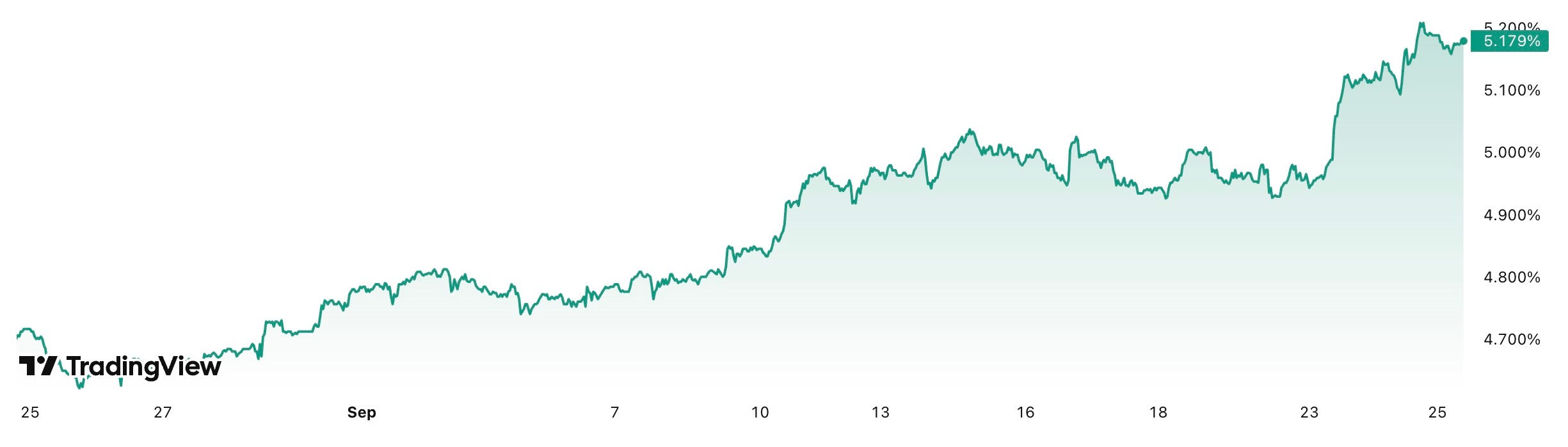
Oracle was down 5%. Bond yields were screaming higher. The 10 year had pushed above 5.1%, the 30 year was hitting levels not seen in more than two decades, and the Oracle “force majeure” headline landed on top of an AI trade that is already showing signs of serious strain.
On top of that we had a shitty 7Y auction with its biggest tail since March.
Investors understandably didn’t love seeing the words “force majeure” attached to one of the enormous data center projects underpinning the AI boom. For a while, the market looked like it didn’t love it either.
Then, almost on cue, an Iran headline showed up to save the day, when Reuters reported at around noon EST that U.S. and Iranian negotiators were discussing a potential phased agreement under which Iran would reopen the Strait of Hormuz while the United States lifted its economic blockade.
Stocks immediately ripped off their lows. The S&P 500 and Nasdaq erased much of their declines, with the Nasdaq briefly turning positive, before the S&P ultimately finished roughly flat.
If this sounds familiar, that’s because it is. By my count, we’ve now seen roughly 8-10 major rallies or reversals over the last six months where an ugly trading day has been rescued, or at least substantially improved, by some variation of a positive Iran or Hormuz headline.
And this doesn’t even count the dozens of smaller Iran and Hormuz headlines that have briefly juiced futures, knocked oil lower, or sparked smaller intraday rallies along the way.
The details change, but the trade is basically the same: peace talks, negotiations, a ceasefire, Hormuz reopening or blockade relief hits the tape, oil drops, stocks rip off their lows and everybody breathes a sigh of relief. So far, obviously, none of these headlines have led to any actual progress…only to saving the trading day momentarily.
The problem is that we still don’t have a durable resolution to the underlying situation. There may very well be diplomacy occurring behind the scenes, but the actual situation remains fluid, contradictory and unresolved.
And yet here we are this morning, with U.S. stock futures higher again as yesterday afternoon’s relief carries into another session.
As far as I’m concerned, this is simply another pit stop on the road to where I still believe this market is eventually headed: much lower.
The Iran headline didn’t make Oracle’s problem disappear. It didn’t make $18 billion of debt associated with its New Mexico data center project magically healthier, debt that was already trading below par amid concerns surrounding the project and Oracle’s growing debt burden. It didn’t lower the cost of capital for the hundreds of billions of dollars being poured into AI infrastructure. Most importantly, it didn’t fix what continues to concern me most: the bond market.
Take the MOVE Index, which can essentially be thought of as the bond market’s version of the VIX. It measures expected volatility in U.S. Treasury rates, so when MOVE rises sharply, the market is telling you that investors are increasingly uncertain about where interest rates are headed and, by extension, increasingly uncertain about the price of the money upon which virtually every other asset is valued.
It surged another 9.6% yesterday to 104.6, after jumping roughly 21% the prior session, taking bond volatility to its highest level in months as yields continued to rip higher
Rates continue grinding higher this morning. Long duration assets continue getting more expensive to finance. AI companies and hyperscalers continue committing extraordinary amounts of capital to projects whose economics increasingly depend on reasonable financing costs, flawless execution and enormous future demand. The higher rates go and the longer they stay there, the more pressure gets applied to every one of those assumptions.
Oracle probably won’t be the last headline like yesterday’s. There will be more projects that run into delays, more financing that suddenly doesn’t look as attractive with Treasury yields above 5%, more debt that banks thought they could easily distribute but wind up holding, and more stress in private credit.
There will also be more leveraged companies discovering that refinancing in this environment is a very different proposition than refinancing when money was essentially free. Every additional move higher in rates tightens those screws a little further.
That’s why absolutely nothing material about my broader thesis has changed since I wrote that an AI crash is coming, nor since I argued that the bond market is eventually going to grind the stock market to a halt. If anything, yesterday reinforced the point.
The market was staring directly at the two things I’ve been warning about, stress around enormous AI infrastructure commitments and a bond market violently repricing the cost of money, when it was temporarily distracted by yet another optimistic Iran headline.
Maybe Iran and the United States eventually reach a real agreement. I hope they do. Maybe Hormuz reopens permanently, oil collapses and one major source of inflationary pressure disappears. But until that actually happens, yesterday’s headline doesn’t change the financial math underneath this market. I think Iran knows this.
Treasury yields are still historically high and moving higher. Bond volatility remains elevated. AI infrastructure still requires staggering amounts of capital. Private markets still have to digest years of aggressively underwritten credit. Companies still have to refinance debt, and equity valuations still have to compete against a risk free rate that looks nothing like the one that helped create this bubble in the first place.
Yesterday’s Iran headline cauterized the bleeding for a few hours, it didn’t cure what ails the market. Don’t confuse the two.
QTR’s Disclaimer**:** Please read my full legal disclaimer on my About page here.
Contributor posts, guest posts and curated posts have been hand selected by me, but have not been fact checked and are the opinions of their authors. They are either submitted to QTR by their author or reprinted under a Creative Commons license with my best effort to uphold what the license asks, or with the permission of the author.
I cannot guarantee the accuracy of any or all facts and figures included in this article though I made an effort to get them right. I have been wrong before and will be wrong again, and encourage you to always double check, do your own research and speak to a licensed financial professional, which I am not.
This is not a recommendation to buy or sell any stocks or securities, just my opinions. I often lose money on positions I trade/invest in. I may add any name mentioned in this article and sell any name mentioned in this piece at any time, without further warning. None of this is a solicitation to buy or sell securities. I may or may not own names I write about and are watching. Sometimes I’m bullish without owning things, sometimes I’m bearish and do own things I’m bearish on. Just assume my positions could be exactly the opposite of what you think they are just in case. If I’m long I could quickly be short and vice versa. I won’t update my positions.
Starting in 2026, I have been attempting to no longer actively trade as much as I once did ( read my story here). My goal is for my investing/saving to be done by recurring contributions mostly to sector ETFs and a few select equities, trusted third parties who oversee my accounts, and advisors. Such advisors or funds, through individual equities, options, index funds, mutual funds, ETFs, or other securities, may have positions in, exposure to, or holdings of names mentioned herein that I know nothing about. It is possible I could own, have exposure to, or not own anything, at any point. In an attempt to lead a healthier lifestyle, I’ve also excluded myself from fantasy sports, sports betting, online and in-person casinos and prediction markets.
Any of my positions can change immediately as soon as I publish, with or without notice and at any point I can be long, short or neutral on any position. You are on your own. Do not make decisions based on my blog. I exist on the fringe. If you see numbers and calculations of any sort, assume they are wrong and double check them. I failed Algebra in 8th grade and topped off my high school math accolades by getting a D- in remedial Calculus my senior year, before becoming an English major in college so I could bullshit my way through things easier. Hence, why I am a writer.
The publisher does not guarantee the accuracy or completeness of the information provided in this page. These are not the opinions of any of my employers, partners, or associates. I did my best to be honest about my disclosures but can’t guarantee I am right; I write these posts after a couple beers sometimes. Many times I edit after my posts are published because I’m impatient and lazy, so if you see a typo, check back in a half hour.
Also, again I just straight up get shit wrong a lot. I mention it multiple times because it’s that important you understand.