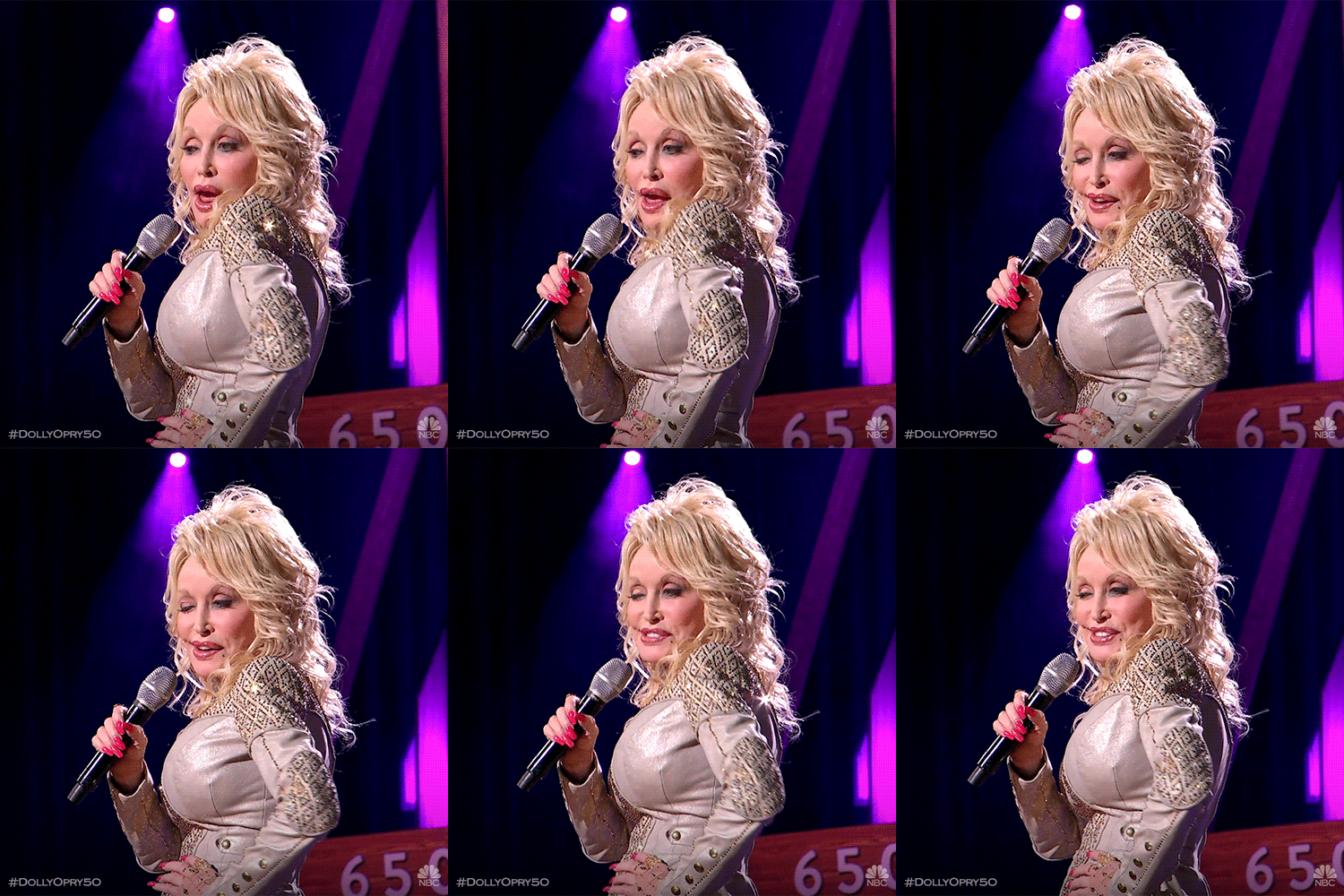
Before we get into the week, we need to raise a glass to Dolly Parton, who died Tuesday at 80.
She also knew a thing or two about business. Beyond the music, Dolly built Dollywood, launched businesses, gave millions of books to kids through her Imagination Library, and somehow turned herself into one of the most recognizable brands in America without ever becoming annoying about it.
Singer. Songwriter. Businesswoman. Philanthropist. And proof that you can be wildly successful and still have people genuinely like you.
Here’s to Dolly. 🦋
Now, onto the week.
Chili’s Big ComebackHas a Surprisingly Simple RecipeModerna and Merck Want to Turn
Tumor Data Into Custom MedicineYour
Burrito Has Clearancefor TakeoffCan Your Shirt
Beat the Heat?SpaceXIs Making More Room for RocketsBig Tech is
**Borrowing Like the Tab Doesn’t Matter****And From Around the Web:**Sushi on a Bus, Plastic on a Plate, and Malls Testing Our Patience
The news shaping business, finance, and technology, for better or considerably worse.
Get your wet naps ready. Chili’s baby back ribs from the ’90s are making a comeback.
While Applebee’s and other casual-dining rivals struggle, Chili’s has pulled off what some are calling one of the best restaurant turnarounds ever. The recipe: fewer menu items, better food, sharper marketing, more staff, and a return to the unapologetically fun Chili’s people actually remember.
The chain started in Texas in 1975 and eventually became a mall-era institution built on sizzling fajitas, frosty margaritas, ribs, and a jingle now permanently lodged in several million brains. But after the Great Recession and pandemic, Chili’s lost customers and wandered into things like ghost kitchens.
Then CEO Kevin Hochman arrived in 2022 and started cutting. About 50 menu items disappeared, including, wonderfully, chili. Burgers got bigger. Chicken and fries got crispier. Rib portions grew 50%. Margaritas dropped to $6, while value deals went straight after fast-food prices.
Then the Triple Dipper went viral, and Gen Z discovered that appetizers can, in fact, constitute an entire meal.
Hochman also asked employees what needed fixing and credits them with** 80%-90%** of the changes. Chili’s spent $100M on repairs, increased staffing **30%-40% **per restaurant, and found ways to get food out faster.
It worked. Same-store** sales are up 50% over three years.** Revenue jumped** $1B** last year to $5.34B, while traffic rose **20% **in 2024.
Now Chili’s is bringing back brighter, retro restaurant designs and even revamping its famous jingle. Apparently, the future of dining was hiding somewhere around 1998.
Chili’s turnaround is a pretty good reminder that growth doesn’t always require something new. Sometimes you cut what isn’t working, listen to the people closest to the customer, and get much better at what made people like you in the first place.
🔗 See how Chili’s turned ribs, mozzarella sticks, and basic competence into a billion-dollar comeback.
Moderna and Merck just cleared a major hurdle in the race to** make cancer treatment personal.**
Their individualized mRNA therapy, intismeran autogene,** delivered positive Phase 3 results in high-risk melanoma** when paired with Merck’s Keytruda after surgery. The INTerpath-001 trial enrolled 1,137 patients with Stage IIB–IV melanoma. The combination beat Keytruda alone on both recurrence-free survival and distant metastasis-free survival.
That makes it the first successful Phase 3 result for an individualized neoantigen therapy and for an mRNA-based cancer therapy of any kind. Not exactly a small box to check.
The treatment is often called a personalized cancer vaccine, though it’s given after cancer has already been diagnosed. **Doctors take samples of a patient’s blood and tumor, sequence them, and identify mutations found only in the cancer. **Software then predicts which mutations the immune system is most likely to recognize.
Moderna selects up to 34 of those tumor-specific targets, called neoantigens, and builds an mRNA drug specifically for that patient. Once injected, it teaches the immune system to recognize those targets and create T cells capable of hunting cancer cells carrying the same mutations. Keytruda helps those T cells stick around by blocking one of the signals tumors use to suppress an immune response.
Earlier Phase 2b results were encouraging: **the combination cut the risk of recurrence or death by 49% versus Keytruda alone, while also lowering the risk of distant metastasis. **The companies haven’t released detailed Phase 3 data yet, but the much larger trial appears to confirm the earlier result.
Now Merck and Moderna are pushing the approach into earlier-stage cancers, including a study in high-risk Stage I lung cancer after surgery.
The science is only half the challenge. Each dose has to be designed and manufactured for one person. **Faster sequencing, better software, and more automated production **could make that process cheaper and quicker.
**So this trial is testing two big ideas: **whether a patient’s own tumor mutations can train the immune system to fight cancer, and whether drugmakers can turn one person’s molecular data into a custom medicine at scale.
The first idea just got a major vote of confidence. The factory part comes next.
Personalized cancer drugs are moving from an impressive scientific idea toward something that may actually be manufactured at scale, which could reshape both cancer treatment and the business of making medicine.
Zipline and Uber are aiming very high. Literally.
The companies announced a partnership targeting one million drone deliveries per day by the end of 2029. That’s a steep climb considering Zipline has completed about 2.7 million deliveries worldwide since 2016.
Uber brings serious volume as the No. 2 U.S. delivery platform. Zipline also works with Wonder/Grubhub, the third largest. DoorDash, meanwhile, is taking the DIY route. The country’s largest food delivery platform is building its own drone network, DoorDash Air, after becoming an air carrier.
Amazon is also trying to make up for lost time. After years of experiments, setbacks, and regulatory scrutiny,** it plans to reach nearly 500 cities and towns by the end of 2026 **while delivering hundreds of thousands of packages this year. Its new tethered “gentle delivery” option should also help with one minor flaw: drones dropping packages into swimming pools.
Elsewhere, Manna recently launched in Tulsa, while Walmart has passed one million drone deliveries with Alphabet’s Wing and Zipline. Walmart is targeting more than 270 drone delivery locations in 2027.
Put it together, and the market could reach roughly $160 billion by 2030. At scale, drone delivery could cut last-mile costs by more than 90%, from about $15 today to under $1.
Drone delivery has spent years looking like a very expensive science fair project. This may be the year it starts looking like infrastructure.
If drones can really push last-mile delivery below $1, they could change the economics of everything from restaurant orders to retail fulfillment.
Summer has made doing anything outside more physically demanding than simply existing. Runners usually deal with that by wearing less clothing. Activewear brands have another idea: wear more, but make it weirdly high-tech.
Enter a new crop of “active cooling” gear that claims to actually lower skin temperature.
Omius sells a $234 Cooling Cap embedded with graphite stones that absorb water, spread it across your forehead, and speed evaporation. Ultramarathoner Viktoria Brown credits the hat with helping her break world records.
East Peak’s Ice Bandana takes a less subtle approach: it has a pouch capable of holding two pounds of ice. Mission sells $20 cooling sleeves made from a material it says can drop as much as 30 degrees below average body temperature when wet.
Then there’s Nike’s $150 ACG Radical AirFlow top, which is basically less than a full shirt, with giant openings around the armpits and forearms for ventilation.
Athletes swear by some of this stuff, although experts maintain that wearing less clothing remains one of the best and considerably cheaper ways to stay cool.
Unfortunately, being half naked isn’t always an option for the rest of us. Fashion designers have noticed.
Some wedding dress makers are using zinc oxide to create fabric that feels cool to the touch. Brands including Rick Owens, Junya Watanabe, and Anrealage have shown inflatable tracksuits, jackets, and dresses with built-in fans, producing a look best described as “Michelin Man, but make it fashion.”
There is real money behind all this. The global air-conditioned clothing market is worth about $2 billion today and is expected to reach $4.6 billion by 2034.
Brands are now trying to make cooling clothes less ridiculous-looking while keeping the technology intact. For the moment, however, staying comfortable in August still requires choosing between heat stroke and dressing like a small household appliance.
As hotter summers create new problems for workers, athletes, and regular people, companies are turning personal cooling into a fast-growing product category.
SpaceX is building a second Starbase, this time in Louisiana, as it looks to dramatically increase Starship launches.
The company already operates Starbase in Boca Chica, Texas, and launches more equipment into orbit each year than anyone else. Starship is supposed to widen that gap.
The Louisiana site will include five complexes with two Starship towers each, for 10 launch pads total. Each gets its own propellant farm, with fuel produced onsite.
SpaceX is pushing for a much faster launch schedule after raising $86 billion in June’s record-setting IPO.
And it has plenty to launch. The company’s ambitions include reusable missions to Mars, orbital data centers, and advanced AI models. Apparently Earth was getting a little cramped.
SpaceX isn’t just building more rockets. It’s building the infrastructure needed to launch them at a pace that could make space look a lot more like an industry than an occasional event.
🔗 Tour the plans for SpaceX’s 10-pad Louisiana rocket complex before the bayou gets considerably louder.
One minute of money talk. Several expensive mistakes avoided.
with Matthew R. Meehan
Big Tech has developed another expensive habit: borrowing enormous piles of money to build AI.
Amazon, Alphabet, Meta, and Oracle issued about ** $194 billion in bonds through early July**, up
Because everybody is competing for the same pool of money.
When demand for capital stays high, longer-term borrowing costs can stay high too, even if the Fed starts cutting short-term rates.
So if you’re looking at equipment, real estate, an acquisition, or expansion, don’t build the whole deal around the hope that money gets a lot cheaper six months from now.
Run it using today’s numbers.
If the investment still works, that matters. If waiting means paying more later, losing the property, or watching somebody else buy the business, that matters too.
And if rates eventually come down? You can look at refinancing then.
Waiting for the “perfect” rate can sound smart. But sometimes it’s just expensive procrastination. The rate matters. But so does the cost of waiting.
If you’ve got something on the table, book a call with our team. We’ll show you what funding options are available now, what the payments look like, and you can decide from there.
The internet’s least supervised corner. Useful? Debatable. Entertaining? Always.
**Sushi With a Side of Traffic:**Tokyo is getting adouble-deckerwhere 20 diners can eat conveyor-belt sushi upstairs while touring the city for 70 minutes. Tickets are about $100.Sushi Bus*Turns out regular motion sickness wasn’t premium enough.*Finally, a Use for Microplastics:Scientists at SIU Carbondale turned yeast, agricultural waste, andupcycled plasticintoThey apparently smell good, but nobody has tasted one yet, which feels like a fairly important gap in the cookie résumé.edible 3D-printed cookies for a NASA-backed food project.**Cover Charge:**Malls across the country are, with Willowbrook Mall in New Jersey asking $2.45 for the first hour. Malls spent years begging for foot traffic.charging shoppers extra for “preferred” parking near the entrance**Now they’d like a few bucks before you provide it.**Interesting strategy.
Stay connected with ** Credit Banc**, proud sponsor of