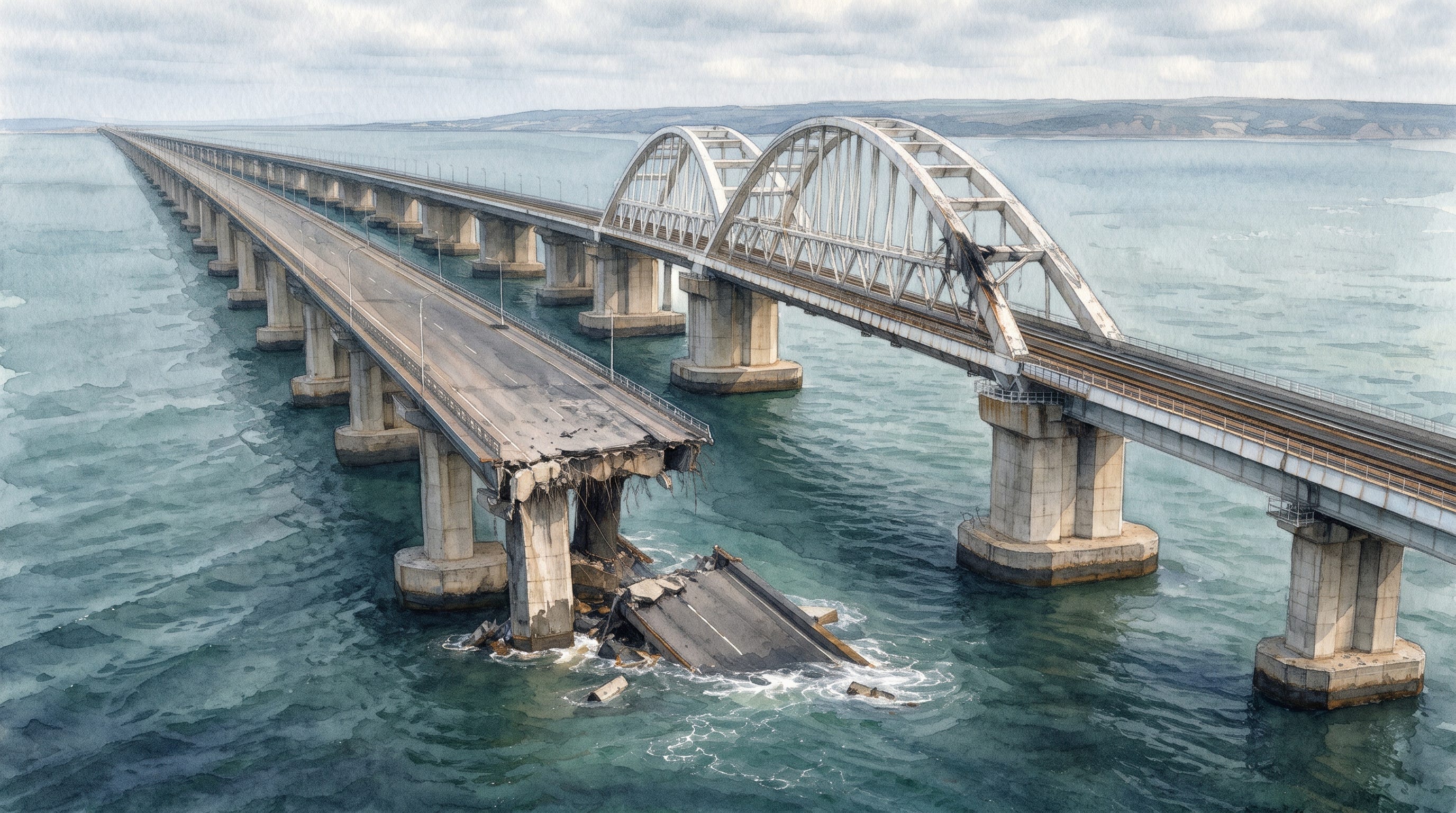
**ODESA—In May 2018, Vladimir Putin drove a truck across the Kerch Bridge **to open the road from Russia to occupied Crimea. Eight years later, Ukraine released another film of the crossing. This time the camera was aboard a Ukrainian cruise missile.
The steel arch grows larger in the frame. The camera keeps transmitting as the missile closes the distance, giving someone far from Crimea a view that once would have belonged to a pilot. Just before impact, the film ends.
We publish this newsletter every day at 9:05am NYC time / 4:05pm Kyiv.Your subscription fuels our work.
Daylight supplied the next picture. On November 17, a section of the road Putin had opened lay in the Kerch Strait. Beside the gap stood the railway arch, damaged but still carrying its tracks. To understand what happened to the road beside it, the story has to begin while both spans were still standing.
Ukraine’s Security Service and General Staff had begun the operation about a month earlier. By then the SBU had attacked the crossing three times. A truck bomb damaged it in 2022. The following summer, Sea Baby drones, small boats with nobody aboard, reached it by water. In June 2025 came an explosion beneath the surface. Each time, Russia had managed to keep the crossing in service or bring it back. By the autumn of 2026, both sides had spent four years learning what it took to damage a bridge and what it took to keep one open.
The November campaign unfolded across seven stages.
As Flamingo flew toward Kerch, the pictures traveled the other way. Its operators still had a view of the crossing in the last seconds of flight.
For much of the operation, the fighting took place outside the view of anybody watching the bridge. Ukrainian forces struck Russian air defenses, including the radars searching for incoming aircraft and the electronic equipment that could interfere with their signals. Among the aircraft involved was Da Vinci, a long-range, one-way attack drone built by the Dutch company Destinus. Ruta, a cruise missile that flies on wings under jet power, carrying an explosive charge inside its fuselage and a second design from the same company reached the crossing on two consecutive days.
By the second night, aircraft from several manufacturers had converged on the same strip of water. On the road side came * Palianytsia*, named for a loaf of Ukrainian bread. Kyiv’s Luch Design Bureau had packed a hundred-kilogram warhead into a jet aircraft only
The SBU’s Alpha unit flew Palianytsia against the road section. Across the narrow space separating the two bridges, Ruta joined two Ukrainian cruise missile designs in the attack on the railway. One was Neptune, another Luch weapon. Six years earlier, in tests off the Odesa coast, its engineers had been working on the problem of hitting a ship at sea. Now a missile from that family had reached the railway linking Russia to Crimea.
The other was FP-5 Flamingo, the missile that brought back the pictures.
Under Fire News joins the Dzyga’s Paw charity to provide Ukraine’s Da Vinci Wolves 1st Assault Regiment with crucial life-saving equipment. This fundraiser’s goal is $10,000 out of our $250,000 overall target.
The funds collected—tax-deductible for U.S. donors—only go to the non-lethal support: drones to assist with essential recon, supply delivery, and evacuation to save lives and enable the Da Vinci Wolves to protect free people.