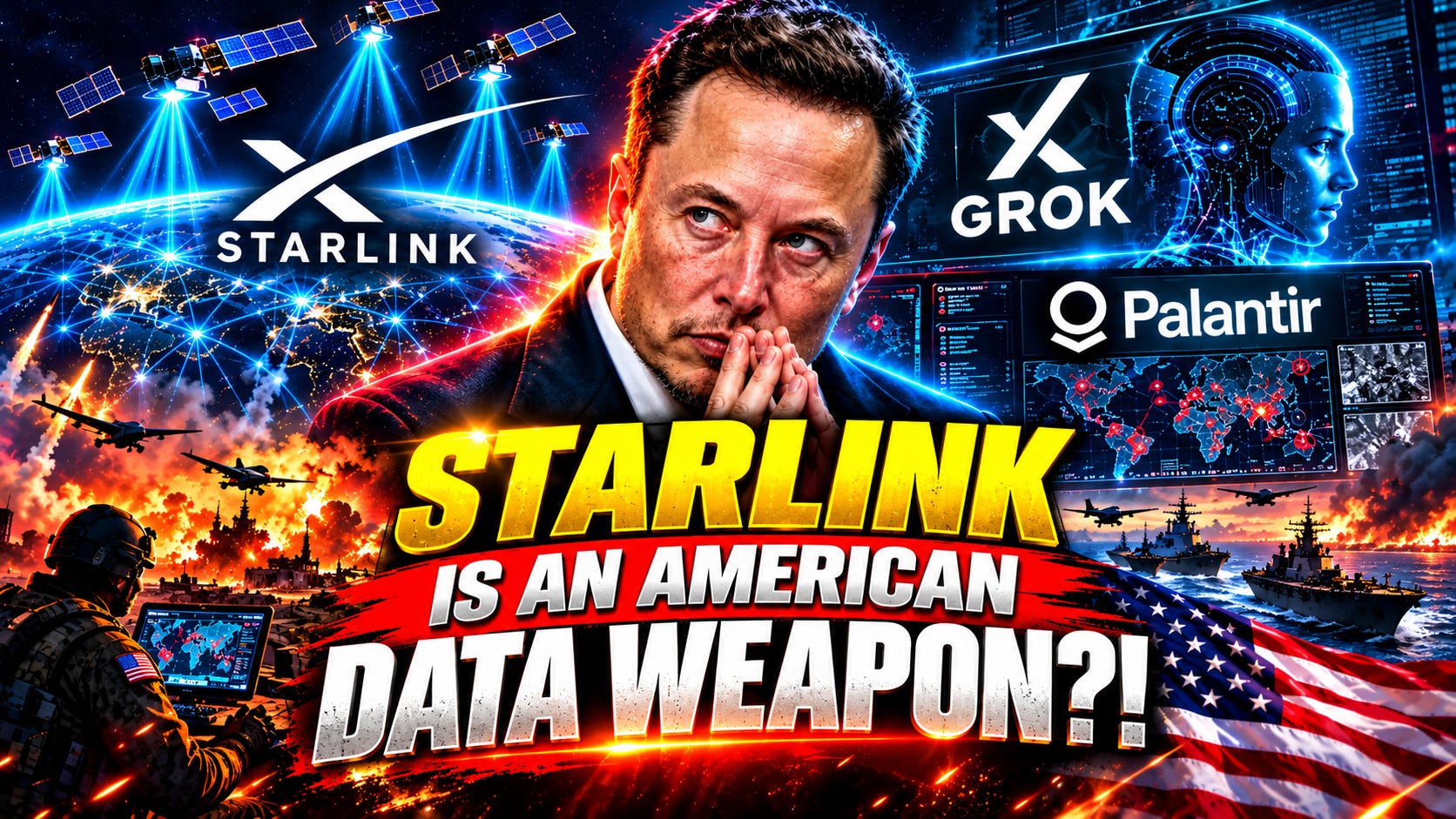
What follows is not speculation. It is architecture. The evidence is in the contracts, the battlefield, the data flows, and the counter-measures already being deployed by the very powers this system was built to contain.
What if the satellites promising to connect the world are actually building the backbone of a new kind of warfare—one where you’re both user and sensor?
Starlink looks like humanitarian infrastructure. Rural broadband. Disaster relief. Digital inclusion for forgotten corners of the globe. And yes, it does all that.
But strip away the marketing, follow the contracts, trace the data flows—and you’ll see something else entirely: the connective tissue of American military doctrine, built through private capital and normalized through civilian adoption.
This isn’t conspiracy. It’s structure. And it has consequences that reach far beyond Ukraine, far beyond the tech world, into the future of how power actually works.
Let us show you how we got here.
Rewind to the 1980s. The Cold War is raging. America faces an existential rival in the Soviet Union and deploys two strategies that will reshape geopolitics forever.
Strategy One: Pull the Soviets into Afghanistan. Manufacture a jihad. Bleed their resources in mountains and deserts until the superpower collapses from within.
Strategy Two: Launch the Strategic Defense Initiative—**”Star Wars.” **Not because it would work, but because it would force the Soviets to spend themselves into oblivion trying to counter it.
The Soviets were always reactive. Every time America launched a project, Moscow scrambled to match it—never asking why, never calculating the cost. They played America’s game, and it destroyed them.
But here’s what history books gloss over: Star Wars had a secret second objective. America wanted to create a military-civil fusion template—where private companies would invest their own capital to execute military objectives.
Giants like Boeing and Lockheed Martin jumped in. Many suffered catastrophic losses. The template failed—or so it seemed.
The lesson wasn’t that the idea was wrong. The lesson was: Don’t ask companies to fund military goals. Instead, make military goals profitable.
Hold onto that sentence. Everything that follows is its execution.
Fast forward to the post-Cold War world. The Soviet Union is gone. America is the sole superpower. But the Pentagon and CIA have learned something profound:
Don’t build military infrastructure yourself. Align private incentives with strategic objectives. Let capitalism do the heavy lifting while you guide from the shadows.
Enter Elon Musk.
SpaceX and Starlink didn’t start as military projects—but they’ve evolved into critical infrastructure for US defense and intelligence customers. What began as private ventures are now operational pillars of American power projection.
The evidence is not in a single document. It is in the pattern. And the pattern has five interlocking components, each documented in the public record.
The first pattern is contractual. In 2021, SpaceX’s Starshield business unit signed a classified contract with the National Reconnaissance Office—the agency that manages America’s spy satellites—to build a network of hundreds of satellites with Earth-imaging capabilities that can operate as a swarm in low orbit. The NRO does not buy internet. The NRO buys intelligence, surveillance, and reconnaissance. The same company that operates the civilian Starlink constellation is building America’s spy satellite architecture.
The pattern extends. By 2026, Starshield contracts with the US government exceeded $6 billion, including a multibillion-dollar Space Force award for the communications layer of the Golden Dome missile-defense initiative and a multibillion-dollar contract for a constellation to track airborne targets from orbit.
But the relationship did not begin with the big contracts. It began small. In September 2023, the Space Force awarded SpaceX its first Starshield task order—worth up to $70 million. The contract included terms not found in commercial service agreements. It was the moment the relationship was formalized. The big contracts came later. The small one is the proof that this was sequenced, not accidental.
The second pattern is industrial. SpaceX’s own job listings state that Starshield “leverages SpaceX’s Starlink technology and launch capability to support national security efforts.” The two systems share manufacturing infrastructure, satellite bus design, optical communications terminals, and launch capacity. The same production lines build both. The same rockets launch both.
The third pattern is data governance. Starlink publishes no transparency reports on government data requests. A rigorous civil society evaluation concluded: “Starlink does not publish transparency reports detailing the number of data requests made to it by government agencies, nor how often the company provides this type of information.” The available documents state only that the company “may provide user data if required to do so by law.” No quantification. No systematic disclosure. No independent oversight.
The fourth pattern is deployment. Starlink appears in contested spaces—Ukraine, Iran, Manipur—wherever US strategic interests require it. The architecture is convergent with US objectives because the company that operates it is contractually bound to US military and intelligence customers.
The fifth pattern is governance. A single individual exercises sovereign-like control over critical infrastructure used by militaries and civilians worldwide. He has stated that Ukraine’s front line “would collapse” if he turned off Starlink. He has refused activation over Crimea. This is not infrastructure governance. This is private sovereignty over public security functions.
Three systems emerged, each wrapped in commercial legitimacy:
Starlink — thousands of small satellites in low Earth orbit, marketed as seamless global internet, funded by venture capital, celebrated as innovation. Structurally: a persistent global sensing and communications network that no government could build openly.
Palantir — supercomputer-powered data analytics designed to process massive information flows. Every click, every search, every movement—intercepted, analyzed, weaponized. The software that Palantir builds is integrated into the main contours of intelligence, targeting, data analysis, and strike execution for the US military and its allies, with Starlink ensuring uninterrupted satellite communication for Ukrainian forces.
Grok AI — artificial intelligence layered on top of the infrastructure. Real-time processing turns raw data into actionable intelligence. The system learns. The system adapts. The system recommends targets.
And the connection between them is not incidental. Peter Thiel co-founded Palantir. Thiel sits on the board of SpaceX. Thiel was an early investor in xAI. This is not three separate companies. It is a network of interlocking corporate entities controlled by a small group of individuals, executing a strategy that no government could execute openly.
Individually, these look like Silicon Valley success stories. Together, they form something unprecedented: a distributed military-intelligence architecture disguised as consumer technology.
The entire ecosystem runs on private capital, operates under civilian cover, and executes strategic objectives that would be politically impossible if labeled as government programs.
We will soon share classified intelligence-grade analysis on the secret plan of Russian and Chinese intelligence against Starlink.
Moreover, what you've just read is the surface. The full architecture is reserved for The Spy Analyst Deep State members on Buy Me A Coffee. This article is where the story starts. The rest is where it ends.
Because of the deep sensitivity of this analysis—and to do full justice to our highest paid tier while maintaining an unshakeable operational firewall—this entire series will be posted exclusively for The Spy Analyst Deep State tier members.
Not the sanitized, watered-down version the mainstream media serves up with your morning coffee.
It will be the raw, unredacted dossier. The kind of briefing that circulates in closed, soundproofed rooms, shared between officials who speak in hushed, urgent tones because they know the stakes.
We are a team of analysts who have spent years gathering the threads that others either cannot see or are simply too afraid to pull.
Very soon, we will pull all of them at once—and we will lay the entire hidden architecture bare before you.
You will not find this analysis anywhere else. Not in the news. Not in any other newsletter. Not in any other intelligence briefing. This is exclusive to The Spy Analyst Deep State tier.
You are either inside the firewall or you are not.
The closest you can get to classified secrets without a clearance!
P.S. The people who need this most are always the ones who wait. Don’t be one of them.
If Starlink is the public face, Starshield is where the architecture reveals itself.
Built on similar satellite technology, Starshield explicitly supports classified defense missions. The same satellites providing Netflix in rural Montana are equipped with intelligence-gathering capabilities for military operations worldwide.
This is not speculation. The Space Force contract for the Space Data Network Backbone explicitly requires Starshield satellites to serve as the backhaul transport layer for a network designed to “link sensors to shooters”—the missile-defense chain that connects warning sensors to interceptor weapons in near real time. As Reuters confirmed, the SDN will provide “the communications pathways for integrating and moving data from missile warning and tracking sensors to interceptors in near real time—a capability seen as foundational to the Trump administration’s Golden Dome missile defense initiative”.
Read that language carefully. This is not a communications network. It is the data transport layer for a weapons system.
The Starshield specification is equally direct: satellites “hardened for defence use: encrypted links, optical inter-satellite communications, missile-warning sensors and target-tracking payloads.” That is not a communications satellite. That is a weapons system built on Starlink’s industrial base.
The legal firewall between Starlink and Starshield exists on paper. It does not exist in practice.
In 2026, Reuters reported that SpaceX argued the Pentagon should pay more for using the network to operate kamikaze drones during the Iran war. Musk’s public response was not a denial. It was a confirmation. He stated that the military had made “improper use of the Starlink civilian system for military purposes” and that it was “a direct violation of terms of service”.
Read the structure of that admission carefully. Musk did not say the Pentagon used a military system. He said the Pentagon used the civilian system—the one marketed as rural broadband, the one sold to families and hospitals and schools—to guide suicide drones. His objection was not that it happened. His objection was contractual: the Pentagon should pay more, and should use the military-branded product instead.
The Pentagon complied. It agreed to pay the increase—nearly doubling the cost of each drone, which had originally cost around $30,000 per unit. As a senior fellow at the Center for Strategic and International Studies told Reuters: SpaceX “certainly has the US government over the barrel”.
That is the civilian cover operating in real time. The same infrastructure served both markets simultaneously. The weapons ran on the civilian network. And when the CEO objected, he objected on billing grounds, not on the grounds that the civilian network had been mistaken for a weapons system.
The firewall is institutional, not architectural. The same company, the same CEO, the same factories, the same launch infrastructure, and the same optical terminal technology serve both systems. When the Pentagon needs a weapon, it reaches for whatever network is already overhead. The civilian branding is not a barrier. It is the cover.
Here’s where it gets uncomfortable: Given Starshield’s role and US surveillance law, many analysts worry that data flowing through such systems could, in some circumstances, be accessible to US intelligence, though the exact mechanisms and extent remain opaque.
Think about that structure for a moment. Every terminal becomes more than a router. It becomes a sensor node embedded in civilian life. Every device connected to Starlink potentially feeds information into a network that intelligence agencies can access under specific legal conditions.
This architecture underpins what the Pentagon calls mosaic warfare: AI-directed drones, satellite-linked command systems, decentralized targeting. It’s faster, cheaper, harder to attribute than traditional warfare—and it fundamentally blurs the line between civilian and combatant.
Why did Elon Musk keep insisting that traditional fighter jets were obsolete? Why did he relentlessly push drone warfare? Because he was not just building the future—he was building the infrastructure that made that future operationally possible.
The F-35 fighter jets Trump tried to sell and get rid of? That’s the old guard. Defense contractors clinging to legacy platforms worth billions in existing contracts. Musk represents the new paradigm: satellite-coordinated, AI-optimized, drone-executed precision warfare.
The internal American power struggle between traditional military-industrial complex and Silicon Valley defense innovation isn’t our problem. But understanding it explains why this technology exists in its current form.
Starshield’s operational debut came in Ukraine. Not in a single dramatic moment, but in the systematic transformation of a civilian communications network into a battlefield weapons system.
Starlink terminals flooded the country. Soldiers created instant internet hotspots in active war zones. Russian forces captured terminals and used them—creating bizarre scenarios where both sides operated on the same commercial infrastructure.
Tensions emerged. Biden wanted captured terminals disabled. Musk claimed he couldn’t identify specific users. The line between commercial service provider and military contractor became impossible to parse.
And by early 2025, US negotiators allegedly threatened to limit Ukraine’s access to Starlink if it did not accept a critical minerals deal. Musk denied the linkage. But the credibility of the threat—and the anxiety it generated—proved something structural: Starlink is not just infrastructure. It is leverage.
But the real innovations were darker and more profound.
Psychological Operations: The **CIA **reportedly used Starlink to deliver targeted disinformation directly to Russian soldiers who had captured Starlink devices from the Ukrainians. Messages about supply shortages, lack of winter uniforms, frostbite epidemics spreading through ranks. Morale warfare delivered via satellite.
Ukrainian cyber units reportedly used a fake Starlink registration service to trick Russian soldiers into revealing their positions and terminal data — turning the system Russia was illicitly using against the soldiers using it. Russian troops who lost Starlink access were later captured frostbitten and starving, their only link to command severed.
Civilian Sensorization: In 2023, Ukrainian civilians were encouraged to upload images of Russian troop movements using Starlink connectivity.** A large number of civilians** participated. These images were analyzed by NATO commanders using AI and used to direct precision drone strikes.
Let that sink in. Ordinary people became intelligence gatherers without trai…