The internet is full of Elon stans celebrating his incredible flying car. Of his feat, Elon basically said he was delivering on the promised flying cars. The whole episode helps us consider how futurism impacts the present. Elon Musk’s flying-car stunt highlights how the present is defined by the futures of our past, and how big headlines often outstrip real technological advancement.
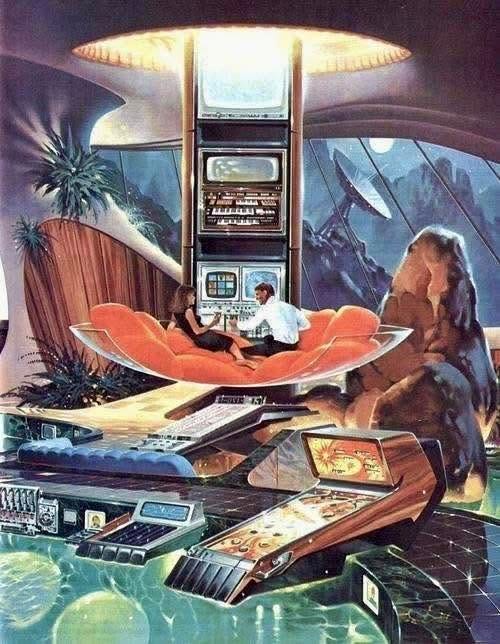
Futurism is a broad term for thinkers who try to imagine what lies ahead. What does the future look like in your mind? How do the ways the past dreamt of the future help frame your present? Our ideas of the future are often rooted in our current moment, but also in the ideas people used to frame their future. Now, as I sit in what feels like somebody else’s terrible plans for a dystopian future, I cannot help but wonder why technology didn’t manifest in ways that felt as celebratory as the retrofuturists promised.
The Industrial Revolution really kick-started the idea of futurism. As the pace of real-life change seemed to speed up, writers thought there was an artist trying to imagine what would come next. But Blue Sky Thinking is still rooted in people’s existing frameworks. If I asked you to imagine how people get from here to there in the future, your ideas will likely start with what actually happens in your life. As a result, many historical visualizations of the future are largely tied to the past. This retrofuturism helps us understand what people of the past hoped for.
Many of the depictions focus on speed, convenience, and ease. Who wouldn’t want technology to ease the hard things? And some of these fast easy technologies have come to fruition a 1930s image shows two women talking to their husbands and children on a handheld screen. Are you reading this text on a handheld screen?
A 1925 depiction of the urban landscape shows busy layered streets. Parts of the American freeway system, largely built after World War II, are double-decker roads.
In a German postcard from 1900, they suggested moving walkways would be common in the 20th century. Many airports, of course, have moving walkways, and some cities, like Barcelona, have escalators outdoors.
Flying cars were a common feature of futurism, from newspaper articles to “The Jetsons.” But why was this the future they wanted? Much of Futurism is predicated on the promise of industrialization and capitalism. The car is one of the first forms of individualization and nuclearization of the family. Sure, families owned horses and carts, but that wasn’t an era of extended families. Families might lend horses to the community to help a neighbor who needed an extra plow horse; carts might be shared in times of need. The first cars were a luxury purchase. But soon after, car manufacturers understood that meeting universal needs was essential to becoming incredibly profitable. The car had to become a need, not a want. But even as cars became more essential, the outlay was still significant for most families. While a cart could last a long time and a horse might help you breed more horses, the car was an expense that depreciated immediately. As a result, people didn't share cars the way they had historically shared carts. Imagining a future of flying cars was basically committing to the fairly recent concept of the nuclear family and individual successes.
Many times when I’ve searched for parking I long for a car that will fold up to the size of a briefcase like in The Jetsons. in bumper to bumper traffic I dream of being able to fly over the crowd. The media planted those ideas in my mind. They continue the intellectual lie that individualism is better. If futurism had shown me Mass transit at the speed of light, or futuristic cities as walkable as Gobleki tepe, I’d ask something else of our burgeoning technology. The challenge with futurism is that it’s often about product placement and giving consumers very specific ideas of what to expect.
So thank you, Elon Musk. His foolish stunt, launching a shell of a car into the air, really helped me focus on the foolishness of solving a problem for just one very rich driver. Other countries have solved traffic; Chinese high-speed trains are exceptional. Incidentally, they’ve also been working on flying cars and robots and have those Technologies well in hand. Musk replicated one of the worst strains in American technological advancement. We solve problems that make company owners a lot of money but don’t fix the bigger structural problem. We have been trained to love the shiniest and newest, because companies need to increase profits for their stakeholders. In doing so, they hope people are satisfied enough with the paltry advances so as not to question why technology hasn’t solved the much bigger problems of our day, like systemic racism and the highest rate of incarceration amongst similar nations. Elon’s ugly, not-actually-flying car helped disabuse me of my Jetsons dream and reminded me to push technology companies for more.