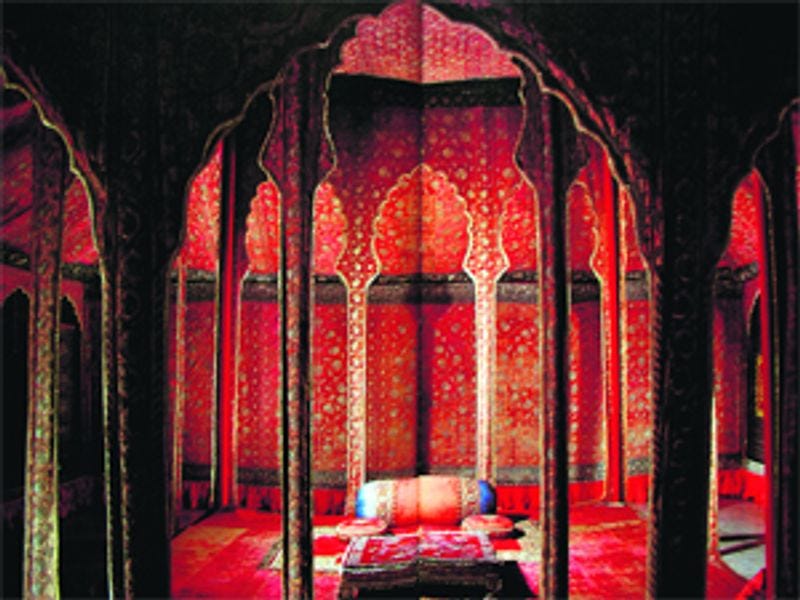
You’re ushered into an enormous tent. I’m not talking about a pup tent made from squeaky fabric that you erect yourself in the buggy warmth of Summer. This velvet structure is taller than a double-decker bus. Silver and gold flowers and vines crisscross the deep red. It’s reminiscent of the Pavilions with their Colonnades, but here there are three colonnades all made from velvet. At the center of this enormous structure, the emperor is seated. From head to toe, he is covered with the finest cloth; even his seat cushions are expensive. Around you, many other people (men) are standing, each wearing their finest garments. Music wafts in from outside. A breeze flows through the tent.
August 27, 28, & 29, I’ll be running conversations about Indian textiles, like a seminar class for paid subscribers. This free article offers a glimpse into what we will discuss.
To have the pleasure of being in the *Shahi Lal Dera, Red Royal Tent *when originally created, you’d likely have been a man living in the 17th century who was the subject of the Mughal Emperor. The Mughals ruled South Asia from the 16th through the 19th century, but their Roots were in the vast steppe of Central Asia. In the West, much of the history of this region is boiled down to the exploits of Genghis Khan and his habit of pillaging. In reality, for much of human history, Central Asia was populated by largely nomadic groups. In the US, yurts have gained popularity as a glamping tool, but these structures allowed Central Asian communities to follow their herds while remaining essentially at home. The concept of home, therefore, was not a place but a people. For people like Genghis Khan and Tamerlane (Timur), power had to be distributed by presence. Living a settled life would mean parts of your Empire might defect. The itinerant life also helped thwart assassins. Finally, if the court had to pull up stakes regularly, they had less time to consider the stakes in planning a coup. All in all, a peripatetic life was ideal for many Central Asian rulers.
The Mughals continued this tradition. Their workshops likely created numerous luxurious tents. The quality was essential because it projected the emperor's power. Instead of developing a casual, outdoorsy aesthetic for the moving Court, the Mughals brought the splendor of fixed architecture to mobile spaces.
Akbari court chronicler Abu’l Fazl wrote, "When large, it is able to contain more than 10,000 people. It takes a thousand farrashes a week to erect it with the help of machines. There are generally two-door poles, fastened with hinges. If plain (i.e. without brocade, velvet, or gold ornaments), a bargah costs Rs 10,000 rupees and upwards, whilst the price of one full of ornaments is unlimited." Tents were an enormous outlay of effort. The equipment alone required 100 elephants, 500 camels, 400 carts, and teams of bearers. Rather than just one imperial tent, whole cities would pop up to house the court. One observer noted the mobile Imperial court rivaled Elizabethan London in size, though the splendor was quite its own.
The Mughals were very interested in ensuring their legacy and so wrote extensively about their court. As such, scholars note many tents must have been produced; the fine textiles are both sadly susceptible to climate and easy to cut down. As such, the Shahi Lal Dera is the only surviving structure of its kind. Scholars debate who commissioned this outdoor Pavilion. Local lore suggests it was created for Shah Jahan, who commissioned the Taj Mahal, and then was captured and taken back to Rajasthan, where it remains. Stylistic elements now suggest it might have been produced during the reign of Aurangzeb, a man who seized the throne after murdering his brothers and imprisoning his father.
While exact dating is a challenge, we can compare the scrolling floral imagery to both the Taj Mahal and Mughal manuscript painting. For a culture that came out of the great steppes of Central Asia, the garden was an incredibly evocative image; many of those arid landscapes were coaxed into offering Flowers by thoughtful leaders. These walled Gardens came to be known as paradises in Persia. But even with the most powerful of rulers, those paradisical flowers wilted. Embellishing space with flowers that never die was a visual reminder of the glories of Heaven. The Mughals were Muslim, and so spaces associated with faith maintaining a lack of anything that could be skewed as icons was essential. For the Taj Mahal to be the ideal resting place for the emperor's favorite wife, it had to evoke heaven without being sacrilegious. It’s worth noting that the same wife, Mumtaz Mahal, was pregnant for her whole adult life and died in childbirth. She certainly deserved the gifts of Heaven.
Floral images, therefore, worked on many levels at the Mughal Court. Embroidering them on this tent would have been seen as symbolic of all those things, but because the embroidery was in silver and gold, it had another function. From the manuscripts that show Emperors sitting in intense poses, you see vassals paying obeisance. The Mughal emperors largely left local power to deal with the day-to-day Administration of their hereditary lands. These Rajaa paid money to the emperor in the hope of keeping their local power. In return, they had the benefit of defense against other potential Invaders. But this power system also hinged on maintaining Mughal authority. To walk into a tent glistening with precious flowers was to remember who was wealthier. As the night grew dark and the lamps came out, the flowers would glisten, adding visual delight to the power on display.
For those of us far removed from the era's history, the tent also affords us the lived experience of the era's wealthy and powerful. The people drinking wine spiked with opium and watching dancing girls in this tent would have been some of the most privileged people in the world. For the uber-wealthy, this type of splendor, while commonplace, was also a celebration of pleasure, in comparison to our largely minimalist contemporary spaces. With the devaluation of textiles after the Industrial Revolution, we’ve also lost some of the visual pleasure of texture and color that hand-adorned cloth offers. Imagining yourself as the original audience of textiles can help you gain a better appreciation for the craftsmen’s skill and the owner’s importance.