For daily news updates and analysis, be sure to follow us on Instagram.
Today I’m bringing you a conversation with Bishop Rob Hirschfeld of the Episcopal Church of New Hampshire. His words last week stopped me cold — and, strangely, gave me something I hadn’t expected to feel in a week like this one: reassurance.
That might sound odd, given what he’s talking about. He’s talking about martyrdom.
At a vigil for Renee Good, Hirschfeld explained that he told his clergy to get their affairs in order. To write their wills. He said statements — the carefully worded condemnations, the official expressions of concern — “haven’t moved the needle one bit.” What he said next is what struck me:
“It may be that now is no longer the time for statements, but for us with our bodies to stand between the powers of this world and the most vulnerable. We may be entering an era — a new era of martyrdom.”
I spoke with Bishop Rob Tuesday morning. I wanted to understand what he sees in this moment that compelled him to warn his clergy they may need to prepare to die. We talked about fear, about history, about what it means to resist when resistance itself has become dangerous.
To be clear: he is not calling for violence. In his words, “I’m not calling anybody to just go find a rifle to stand in front of or to go find a club to get beaten by — but to stand with their neighbor, even the neighbor they don’t like or they don’t know, knowing that’s going to be risky, but that God’s love is stronger even than death.”
We’ve read about chapters like this — in other countries, in other eras of our own history. We study these moments at a safe historical distance, as lessons about courage in someone else’s time. Hirschfeld is saying that distance has closed.
I want to be clear about something else. I don’t believe we are fated to be martyrs. There are real signs the country is turning against ICE and its tactics. Awareness is making a difference — which is why I continue to focus on Minneapolis today and share verified videos you can send to your networks. Sunlight still matters.
But it’s worth pausing to notice what we’re seeing.
Here’s our conversation:
In today’s newsletter: The DOJ declines to investigate the agent who shot Renee Good to death; they’re investigating the dead woman instead. Stephen Miller tells ICE agents they’re above the law. The FBI raided a reporter's home; what were they in search of? A White House meeting on the future of Greenland. Grok, banned in multiple countries, gets an official welcome at the Pentagon. The US orders key personnel out of middle east bases as Trump considers a strike on Iran. And News That Doesn’t Suck about a peace walk.
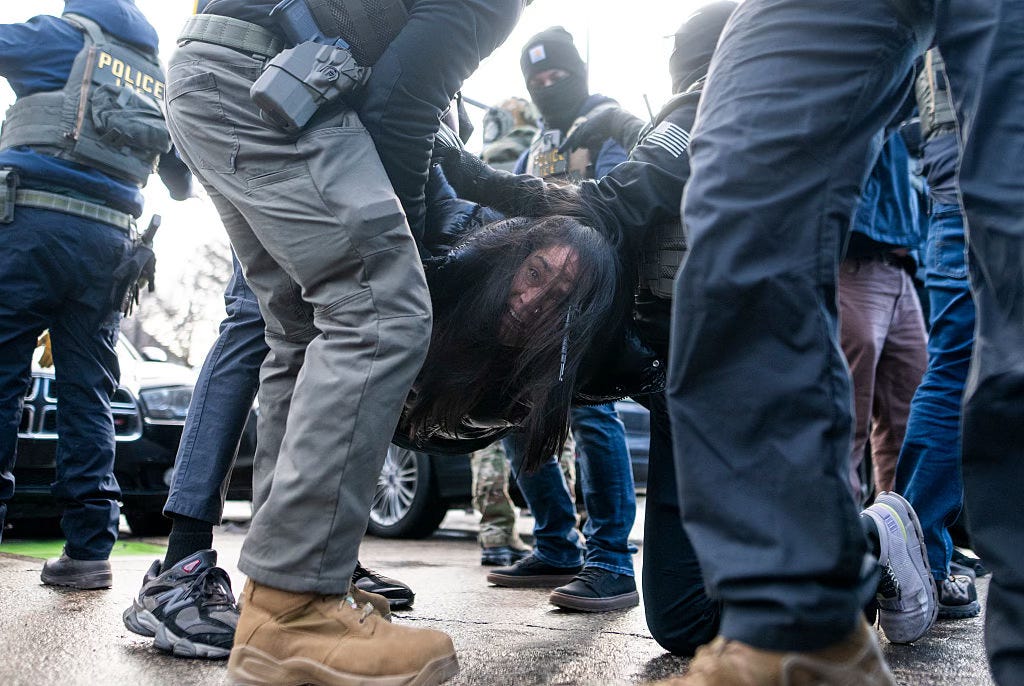
Department of Injustice: Trump’s Justice Department says itwon’t investigate Jonathan Ross, the ICE agent who killed Renee Nicole Good. Instead, it’s investigating her. The DOJ is investigating Good’ssupposed ties to leftist activist groupsand pushing for acriminal investigation into her widow. Six federal prosecutors have resigned in protest. Among them is Joseph H. Thompson, who oversaw the fraud investigations in Minnesota, which DHS claims is the basis for its ongoing operation in the state. “When you lose the leader responsible for making the fraud cases,” Minneapolis’police chief noted, “it tells you this isn’t really about prosecuting fraud.”Above the Law: DHS on Tuesday𝕏posteda “reminder” to ICE officers, asserting that they “have federal immunity” while doing their jobs. The post quotes Stephen Miller, who claims no one — including city and state officials — can prevent ICE agents from fulfilling their duties, and that anyone who “tries to obstruct [them] is committing a felony.” Legal experts disagree. For example, formerICE Director John Sandweg told News Not Noisethat DHS is governed “by the same use of force standard you see across all law enforcement.”DHS policy alsoDHS rules allowonly force that is “objectively reasonable in light of the facts and circumstances.”instructs officersto never approach a vehicle from the front or fire into a moving vehicle.Remarkable Recovery: Federal officials claim that Jonathan Rosssuffered internal bleeding in his torsowhen Good’s car allegedly made contact with him. One problem:Analyses of multiple videosof the incident clearly show Good’s car was turningawayfrom Ross when he opened fire. Homeland Security Secretary Kristi Noemsaid Ross was hospitalizedafter the shooting and released the same day. US Border Patrol Commander Gregory Bovino saysRoss has been movedto “a safe location,” where he’s “recovering from those injuries.” Afundraiser supporting himhasraised over $630,000; the person who created it islinked to online accountsthat have posted Nazi imagery and called Good “a stupod [sic] bitch who got what she deserved.” (A fundraiser for Goodraised over $1.5 millionbefore the organizerstook it offline, asking funders to give their support to other worthy causes.) So that’s two fundraisers, only one hosted by a seeming Nazi sympathizer.Direct Retribution: Trump announced on Tuesday his administration willhalt federal fundingto “sanctuary cities or states having sanctuary cities.” This isn’t the first time Trump has tried to defund sanctuary cities; two previous efforts wereblocked in court. The DOJ haspublished a listof so-called “Sanctuary Jurisdictions.” The list includes 11 states, Washington DC, three counties, and 18 cities — all of them Democratic-run. This follows the administration’s decision towithhold $2 billion in Medicaid fundingearmarked for Minnesota;and said they will appeal.state officials on Tuesday warnedthis “punitive action” would have “catastrophic consequences”Blow the Whistle: ICE’s violence and is generating significant pushback. Now it’s starting to alienate Trump supporters, too. Podcaster and Trump supporter Joe Rogan on Tuesdayexpressed concernat “militarized people in the streets just roaming around snatching people up.…Are we really going to be the Gestapo?… Is that what we’ve come to?” Maybe this is driven by the fact that social media is filled with videos clearly showing excessive force in Minneapolis over the last few days. Here are several such videos, all verified by additional reporting, showing agents:detaining US citizens at work,breaking into a house without a warrant,violently abducting a US citizen on his lunch break,piling on top of a protestor,dragging a man out of his car,pulling a woman out of her car,and more.
Democracy Dies In Darkness: FBI agentssearched the homeof Washington Post reporter Hannah Natanson on Wednesday morning,seizing personal and work laptops, a phone, and a smartwatch.The paper’s executive editorsaid the agents arrived “unannounced,” and neither the paper nor the journalist were aware they were targets of a DOJ investigation. Natanson covers the federal workforce and has discussed developing sources within it. Attorney General𝕏Pam Bondi accused Natansonof “obtaining and reporting classified and illegally leaked information from a Pentagon contractor.” But thecriminal complaintagainst that contractor, who isaccused of taking home classified intelligence reports, makes no mention of him sharing that material. Agentsreportedly told Natanson she hasn’t been accused of wrongdoing. Which raises the question, what were they really after?Chilling Step: The Postcondemned the raidas a “highly unusual and aggressive” act that “raises profound questions and concern around the constitutional protections for our work.” The 1980 Privacy Protection Actgenerally prohibits search warrantsfor journalists’ work materials.Search warrants like these are incredibly rare. The last such case was in 2023, when the FBI. In 2019, San Francisco policeraided the home of a Florida journalist; half the charges against himhave since been dismissedraided the home of a freelance journalistwhile investigating his confidential sources; judges later ruled the warrants to search his home, phone, and office were invalid; the city paid a six-figure settlement and called the raid a “shameful moment.” In 2017, Trump’s DOJobtained phone records of journalistsfrom multiple mainstream outlets.That led the Biden administration to create policies protecting journalists’ phone and email records— policies Trump’ssecond administration revoked, arguing it “will not tolerate unauthorized disclosures that undermine President Trump’s policies.” (Disclosures on Signal chats, though, seem to be just fine.)
Greening Out: The foreign ministers of Denmark and Greenland met with Vice President JD Vance and Secretary of State Marco Rubio on Wednesday.The Danish ministersaid the three parties agreed to form a “high-level working group” to “find a common way forward” — but there remains a “fundamental disagreement” over Greenland’s future. Translation: Trump isn’t giving up on taking the island (today he claimed“anything less” than US control is “unacceptable”) despite the idea being soundly rejected by Greenland, Denmark, NATO, the EU, andthe majority of Americans.Better Safe Than Sorry: US allies continue to strengthen Greenland’s defense.Germany,Sweden, andNorwayon Wednesday announced they will send military personnel to the island, and Denmark isincreasing its presencethere due to “security tensions.”Unilateral: ARepublican lawmaker has introducedthe “Greenland Annexation and Statehood Act” to make Greenland the 51st state. It authorizes Trump to take “such steps as may be necessary … to annex or otherwise acquire” the territory. Maybe Trump will simply declare it’s his and view the matter closed.
Return to Sender: The Supreme Court on Wednesdayruled that political candidates may challengerules governing how ballots are counted in their races. The Justicesrevived a Republican congressman’s lawsuitobjecting to rules in Illinois that allow mail-in ballots to be counted up to two weeks after election day.Tipping Point: Iran partiallyclosed its airspaceforat least two hourson Wednesday evening. The US and allies are reportedlywithdrawing personnelfrom bases in the Middle East, the latest signs that Trump is[seriously considering military action](https://www.cnn.com/2026/01/14/po…