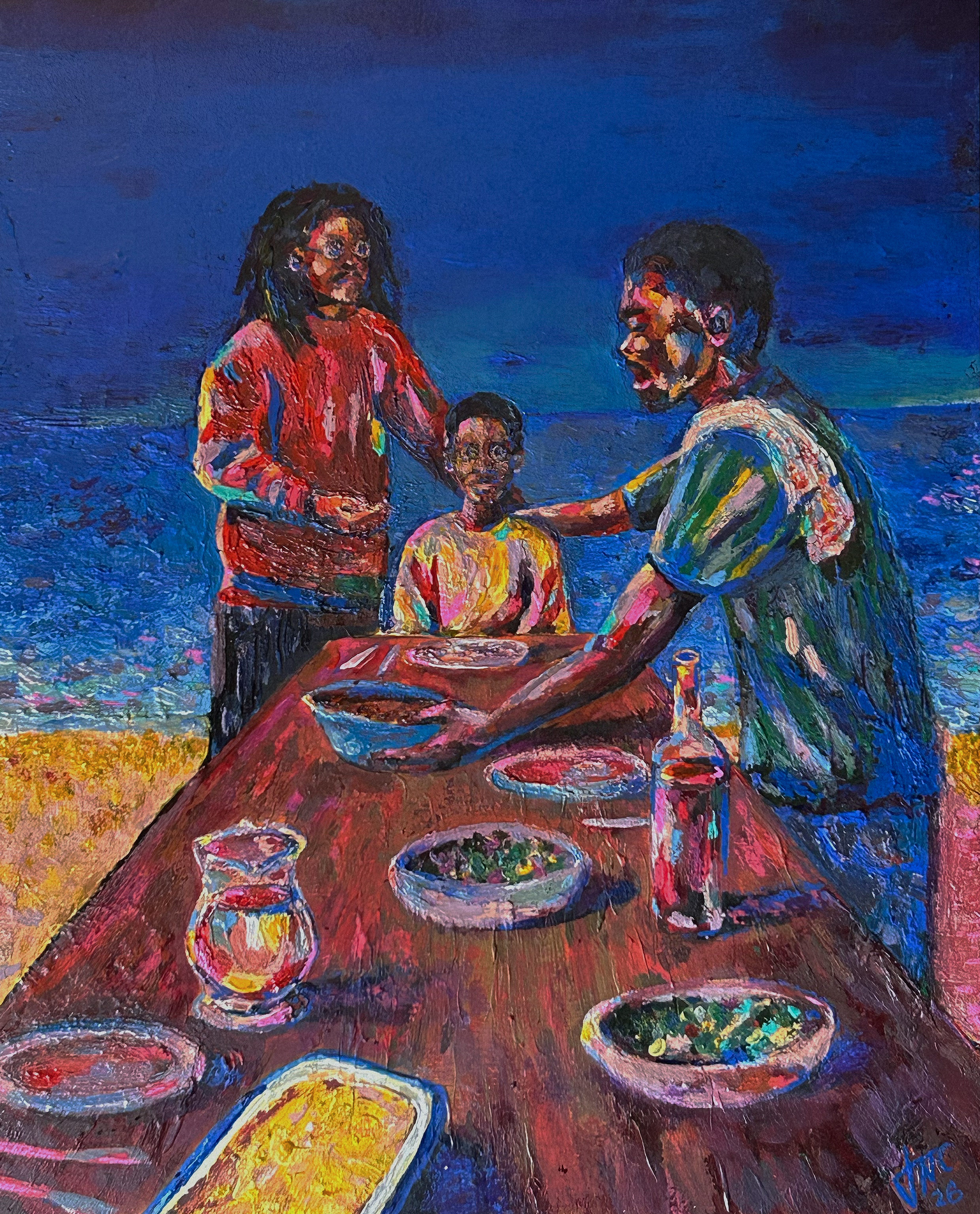
Good morning and welcome back to Vittles. Today we’re publishing another piece from our third print issue, The Influencers*. *In this essay, Calum Jacobs writes about his father’s cooking, and his failed attempts to cook Guyanese food in the aftermath of his father’s death.
You can now buy a bundle including The Influencers and our second print issue, ** Bad Food**, at a
By the time I was born, my parents had pooled their savings to purchase a three-bedroom semi in a quiet South London cul-de-sac. They spent their weekends reclaiming the sizeable back garden from towering ferns, wrenching invasive ivy from fences and heaving waist-high thistle weeds from the earth. From my baby photos, it’s obvious that the house itself required similar attention: plaster walls the colour of cut sweet potato and a patchwork of rugs, only partially covering uneven floorboards, feature in most. For a time, I lived in this incompleteness, never sure of why. In any event, all work ceased when they split.
After they separated, my dad remained in the house they’d bought together, while my mum made a life nearby. My brother and I were handed back and forth between them, but because the house was close to my school – our garden backed onto it, a fact few classmates believed no matter how many footballs I brought back – I mostly lived with my dad. Although he and my mum were on good terms, jointly making decisions about our lives and sharing costs (on birthday visits to Crystal Palace Pizza Hut, they’d go halves on the bill), in many practical ways my dad was pressed into single parenthood, cooking and all.
He approached our evening meals with enthusiasm and ambition, producing a carousel of European bistro and British classics. But he was a challenged chef, not to mention a borderline ascetic (he was an obsessive marathon runner and cyclist decades before the sports came to be fetishised), with a restrained approach to the use of fats and sodium. In his hands, these dishes mutated into things only distantly related to the originals. ‘Potato dauphinoise’ became a Frankenstein’s monster of softened broccoli florets and hunks of salmon squeezed between thick discs of potato and baked for so long that the white sauce they were entombed in evaporated. My dad’s parmesan- and egg-yolk-free ‘carbonara’ (we got by on the pan’s residual oil and incidental emulsion water) was only ever made with pasta shells; the smoked bacon, cut into rough cubes and fried down with onion, garlic and dried oregano, would accrete in their hollows.
‘If all of this sounds insufferably English, it was. For those weeks at least, so were we’
This was the mid-nineties. Around the same time, my dad became fixated with winemaking, eventually storing ten demijohns full of cloudy liquids in varying shades of strange under the stairs. At a dinner party in Notting Hill, an event I remember only in small shards, I watched him take a sip from a glass of something expensive, then attempt to relay its notes to the room. Sensing he was feeling his way through it, hoping to pass, I felt a form of second-hand embarrassment. As an adult, I now see I was watching a man attempting to make himself anew.
My parents split the school holidays down the middle. With my dad, we holidayed exclusively in England. Every year, we would make the three-and-a-half-hour, scotch-egg and pork-pie-fuelled pilgrimage to Lyme Regis in Dorset, where we stayed on the farm of a retired septuagenarian he’d befriended, known to us as Dr Bowles.
Nowadays, the presence of Black holidaymakers in the area probably wouldn’t elicit a sideways glance. But, back then, seeing a Black family perusing Lyme Regis’ fudge shops must have felt like sighting a big cat on a mist-shrouded moor. White people stared as one. The feeling this stirred in me was difficult to name as a child and is harder still to forget as an adult. My dad strode on regardless, seemingly unaffected, his steps asserting that this place could be ours too. I’ve since adopted a similar, if more abrasive, attitude.
Each year we stayed in a moss-green porter cabin. Beyond it stretched rolling hills. The smell of that land – earthy, unmistakably animal and alive – still brings me a sense of familiarity and comfort. Each morning, I would head towards the paddock, a handful of grass outstretched towards the horses as offering. From the beach, we would watch Dr Bowles gliding over the water in a small boat. In the evenings, his catch – buckets of translucent king prawns – was barbecued over white coals and served with salads and buttered crostini.
If all of this sounds insufferably English, it was. For those weeks at least, so were we.
While my dad could carefully curate our home lives, my school lay beyond his control. I ended up at a local comprehensive, which would go on to be rated by Ofsted as the worst in South London. It was here that the gulf between the world I grew up in and that of my peers became visible – particularly whenever we discussed food.
A semi-regular breakfast in our household was brioche French toast, a dish my dad could somehow nail. When I mentioned this to friends, they received it blank-faced: ‘You mean… eggy bread?’
Another time, sat on a bottom bunk, Pro Evo 6 in the PS2, two friends (one Bengali, the other Ugandan) were disbelieving when I told them I rarely ate brown stew chicken, rice and peas or curry goat – Jamaican dishes that have since become amorphous stand-ins for Caribbean cuisine – at home. What they were really getting at was that I didn’t eat food from Guyana – my dad’s country. Even if we could not articulate it at the time, we were all bonded by the afterlife of colonial rule and our childlike resistance to it. But the cultural rituals of my kitchen contradicted our unspoken pact – sat there, controller in hand, I felt exposed.
My father landed in England at the age of sixteen in 1965, the year the Race Relations Act did little to lift a colour bar locked in place. He lived first in Harpenden, before settling on the Stockwell Park Estate with his older brother, who was studying accountancy.
I know that he worked briefly in a chippy, that one winter at college his hands grew so cold that he instinctively ran them under a hot tap, causing chilblains, and that he regularly watched English people biting into the skins of newly imported fruit – mostly bananas – which they weren’t yet accustomed to. He said virtually nothing to me of any negative experiences he may have had. I don’t think he was suppressing trauma. Rather, it was that he’d long fixed his mind on what England could be.
‘in his later years, as his accent involuntarily thickened, Dad would prepare a lamb stew with broad similarities to pepperpot … he cooked it with an instinctual ease I’ve never been able to replicate. My intermittent attempts have gone nowhere. If I’m honest, I’ve stopped trying. Some things were his to make’
Driving through Herne Hill some years ago, I rebuked my dad for not having been on the frontlines of the Brixton uprisings in 1981, unkindly reading his inability to share my rage as indifference. I would often provoke him in this way, but I now wonder if the youth-led assertion of Black power that swept through West Indian communities had failed to capture him because he’d been fundamentally shaped elsewhere.
In his obituary I wrote that, in his childhood, my dad and his brothers ‘played cricket in the alleys that separated neighbouring homes, captured and released songbirds, built BB guns and scooters using discarded wood and ball bearings, and ventured into the fringes of the Amazon rainforest that encroached on their surroundings to swim in the wide, cool, deep lakes’. Yet back then British Guiana, as it was known before independence, was still in the grip of colonialism. While I gleaned nothing first-hand of what this looked like politically, to my dad its presence was felt in the starch of his school uniform, the cane that reckoned with insolence and the muscular hand of Methodist Christianity on his shoulder. No matter the vast geographical and environmental differences, the texture of his life bore the imprint of the country he would migrate to long before he arrived here. I don’t know whether my dad arrived feeling English. I doubt it. But I find it hard to believe he ever felt entirely foreign either.
For many second-generation West Indians in the UK, the opposite is often true. They reach towards mythologised versions of their parents’ birth countries, understanding themselves primarily as Saint Lucian, Grenadian, Jamaican, despite limited documentation, cultural knowledge and political familiarity with these places. It is, I think, a way of bracing against disappearance – the more unstable the identity feels, the more forcefully it’s asserted.
For most of my life, I did the same.
I am a better cook than my dad ever was – a fact he’d acknowledge, palm raised in mock defeat, with bruised compliments.
Three years ago, seeking an emotional outlet for my grief after his death, I created an Instagram page (* @calumelised*) dedicated to my cooking. I rarely post now, but I occasionally still scroll the archive. Over time, I churned out four stone-fruit frangipane tarts, Taiwanese fried chicken with scallion oil, two Pakistani lamb niharis, one tempura cod sandwich, six homemade pastas (pici, busiate, gnocchi – potato and sardi – tagliatelle and pappardelle), various focaccias and more. Of the thirty-five posts, only one-and-a-half had Caribbean origins: a Jamaican lamb patty and a medley of chicken makhni and channa masala paired with Guyanese roti.
Here, the imprint of my dad’s influence was everywhere. His reluctance to prepare Guyanese food at home – concealed behind the flimsy claim that my brother and I ‘wouldn’t like it’ – now strikes me as part of a wider act of shedding in pursuit of the version of respectability he’d been taught to value. At least, this is the reading I’m left with in his absence. The consequence, whatever the rationale, was a son ill-equipped to prepare the food of his ancestors. For a time, this unsettled me, but I’ve come to accept that not everything passed imperfectly between generations must be recovered.
After he died, I found a cobalt-blue clipboard to which he’d clamped dozens and dozens of recipes, largely by Rick Stein and Gordon Ramsay, carefully cut out from the Sunday Times, the dates on each page revealing the timespan of his middle-class aspirations. Buried among the yellowing stack was a handwritten step-by-step guide to making pepperpot, the Guyanese national dish.
I don’t know who took the time to write out and donate this recipe to him. What I do know is that in his later years, as his accent involuntarily thickened, Dad would prepare a lamb stew with broad similarities to pepperpot. Made of simple ingredients – a packet of diced lamb, onions, garlic, a stock cube, cloves, flour, black pepper, tomato purée and a Scotch bonnet – it was uncharacteristically delicious for his food, and he cooked it with an instinctual ease I’ve never been able to replicate. My intermittent attempts have gone nowhere. If I’m honest, I’ve stopped trying. Some things were his to make.
An obsessive archiver, one night I filmed my dad recreating this stew, as he made silent circles, turning away from the hob and back again to gather its components. Had he looked out into the darkness of the patio where I stood, he wouldn’t have seen me.
Late last year, at the intersection of Electric Avenue and Lane in Brixton, an older woman watched me with interest as I walked in her direction. She raised her hand to beckon me.
‘I tink I know your farda…’
My dad now returns to me in ways I’m left to interpret alone.
Sometimes, I’ll wake to an echoing recitation of an English or Guyanese idiom he was fond of expressing, or a song he’d belt off-key in the kitchen will arrive on shuffle, as if summoned. While emptying the attic, I pulled a dusty polaroid of my parents in a loving embrace – the only picture in the house I’d never seen – from between two beams, its appearance there some strange miracle.
Each time something surfaces, it disturbs and deepens the version of him I’d allowed to settle.
I find I know him differently now.
My dad was born in Bagotstown – a village on the eastern bank of the Demerara River – and was reared there in poverty. The considerable wealth of his family, built through his grandfather’s engineering work in neighbouring Suriname, survived only as lore by the time he came into the world. The fall of the Jacobs family was precipitous. From a two-storey wooden mansion, they eventually moved into a single-room dwelling hoisted on sticks within a communal yard in Georgetown – water drawn from a pipe a hundred metres away, the toilet a similarly shameful distance. For a time, finding enough to eat day to day proved difficult. A treasured lamb stew, when they could afford it, was rationed across a week.
Who am I to deny a man who grew up like this the life he believed his family deserved? Anyway, my assumption that his – our – roots and his aspirations were incompatible was born of my own second-generation insecurity. Before my birth, my mum complained that my dad would disappear into games of dominoes and Ludo long into the night. Throughout my childhood, our weekends were bookended by trips to Brixton Market, where we’d buy hard dough bread, bun and sugarcane, which I’d chew in the back seat of our Nissan Bluebird until it felt fibrous on my tongue.
While he may not have been cooking the food of his childhood, each meal he served my brother and I – the carbonara, the dauphinoise, the shepherd’s pie – was unfailingly accompanied by fried plantain and sliced avocado. At his wake, several of his Black former colleagues rose, each one attesting to his indelible influence on their careers. And by the end, if the evidence of his enduring Guyanese-ness had not already unsettled the caricature I’d built of him, the Sunday Times subscriber had slowly ceded ground – radicalised, in large part, by my politics.
It was entirely plausible that my dad knew that old woman on Electric Avenue with smile lines deeply grooved into her cheeks. He had many lives, and she could have belonged to any of them.
I offered his name: ‘Gregory’.
‘No, no, I don’t know he,’ she replied, before moving off with the air of someone whose time has been wasted.
I turned to watch her walk away, her two-wheeled trolley trundling faithfully behind, until she was subsumed by the stream of people moving between the food stalls and shops and back again.
Calum Jacobs is a writer, editor and the founder of
CARICOM Magazine. His first book,A New Formation: How Black Footballers Shaped the Modern Game, was shortlisted for the PEN Hessell-Tiltman Prize and named aGuardianBook of the Year. He lives in South London.The full
Vittlesmasthead can be found[here].