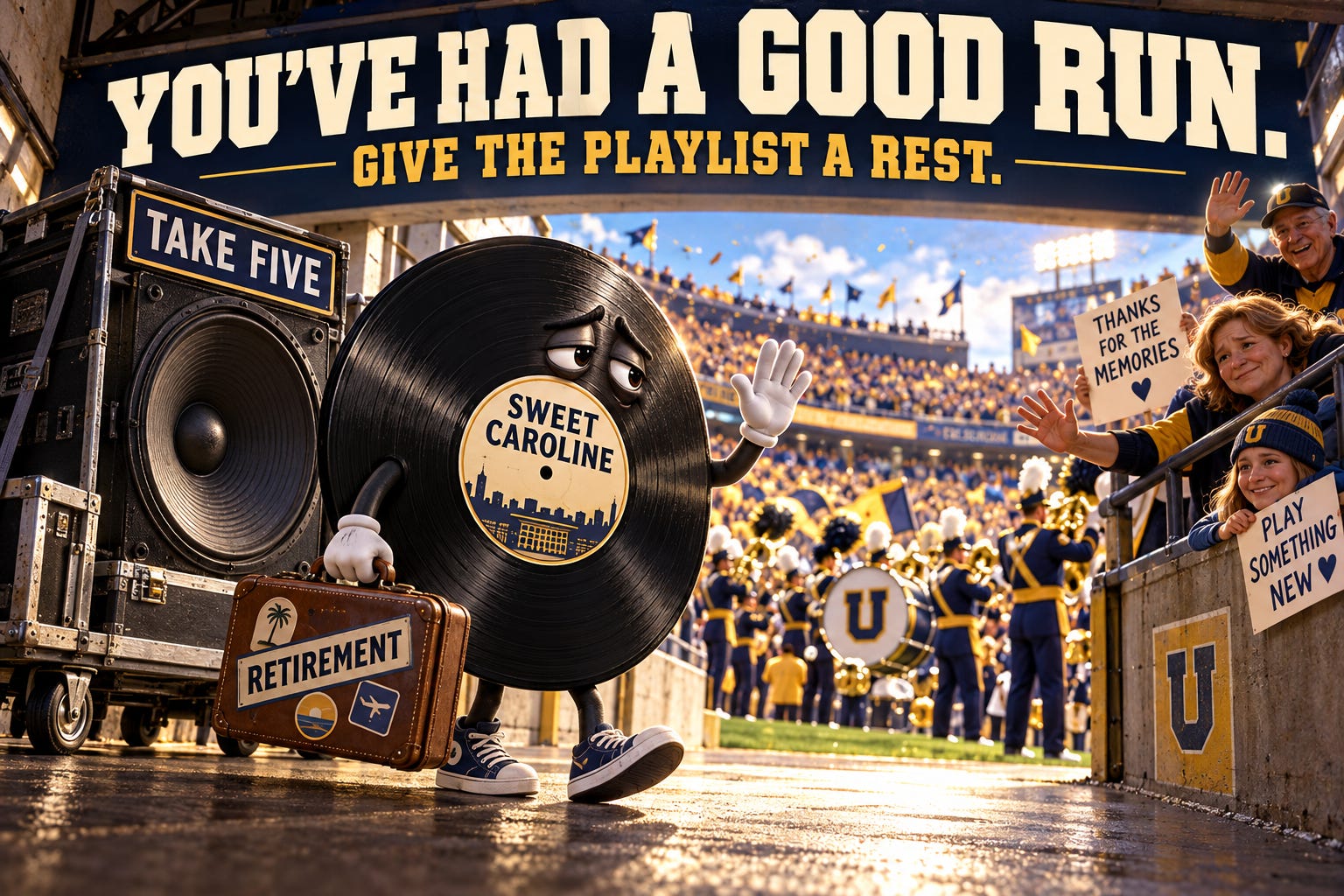
LUTHMANN NOTE: I’m with Greg: give the damn speakers a rest. A stadium full of fans shouldn’t need instructions every thirty seconds. There’s a rivalry on the field and a band worth hearing, if the sound crew would stop interrupting it. When every ballpark and football stadium plays the same songs, you could close your eyes and forget which team you came to see. “Sweet Caroline” deserves a permanent vacation. Copying the Mass-holes peaked with Sam Adams and the Boston Tea Party. Give the Blue Band a chance to finish. The crowd can handle the rest without a karaoke supervisor. This piece is “Exiling Sweet Caroline,” also available on NY News Press.
No matter what the sport, walk into any stadium or arena and the public address system takes you hostage. Announcements, hype tracks, and synthetic energy are all layered into a nonstop sonic barrage that refuses to leave a single second of air unfilled.
Their playlist predates the modern stadium era and has been passed down through oral tradition by early tailgating societies.
Every timeout, injury, or player tying his shoe triggers yet another blast of the same dozen songs, making for less game atmosphere and more of an auditory ransom note.
Stadium crowds are certainly capable of generating drama on their own, but silence is treated as an existential threat, especially during baseball games. If the speakers go quiet for even a few seconds, people might drift off to check their phones or start wondering why a bottle of water costs roughly the same as your Netflix subscription.
Instead, the “music” hammers away, loud, relentless, and aggressively generic, until the experience resembles a five-in-the-morning shouting match with a leaf blower.
At Penn State, the most synchronized source of campus pride is the Blue Band’s traditional melody of fight songs, fanfares, halftime epics, and postgame performances. Yet the Beaver Stadium sound crew still feels compelled to carpet-bomb every third down with Sheck Wes’s “Let’s make some noise,” as if the boisterous 100,000 on hand need a reminder to get loud.
The rest of the playlist fans know by heart: the pump-up riff, the obligatory classic-rock stomp, and the EDM drop that sounds like a dishwasher malfunctioning. Some are so banal they rival the Nittany Lions’ very predictable offensive playbook from last season.
There is one particular stadium singalong that has morphed across the nation into the secular anthem of the American sporting experience and is so overused it has been exported.
“Sweet Caroline,” a 1969 hit by Neil Diamond, was born from serendipity that started as a quirky and spontaneous tribute during a Red Sox game at Fenway Park in 1997. Since then, the rest of baseball, the NFL, college football, UK soccer, and even Australian rugby have jumped on the bandwagon.
When every venue uses the same soundtrack, it stops feeling like tradition and becomes a predictable cliché of musical wallpaper.
It is a musical Esperanto: loved by some and tolerated by the rest. And yet, ask most fans why it is sung, and they have no clue.
The song’s melodic simplicity, once a strength, now feels like a weakness. The chorus, “So good, so good, so good,” is shouted with such frequency that it has become a parody of itself. The song is a karaoke chant devoid of context and sung by folks in nacho-stained jerseys. It has become the musical equivalent of stale popcorn.
The lyrics “touching me, touching you” have become formulaic, forced, and exhausting, and have aged like unrefrigerated coleslaw. Given Penn State’s recent history, it’s a mystery why this particular track hasn’t been quietly escorted off the premises.
Critics are legion.
Matt Reigle of OutKick calls it “a lump of sonic excrement,” lamenting its “boring, lazy melody.” Bob Latham of SportsTravel coined the phrase “Sweet Caroline, No,” arguing that the song’s ubiquity has stifled musical innovation in sports.
Others call it “overplayed, saccharine, and vaguely creepy.”
In a world where sports are about authenticity, local pride, and unique fan experiences, “Sweet Caroline” is a relic and long overdue for retirement.
The time has arrived to turn down the speakers and allow the crowd to find its own voice through the natural rhythm of the game.
The fitting chant at Penn State needs to be: “We are … over it.”