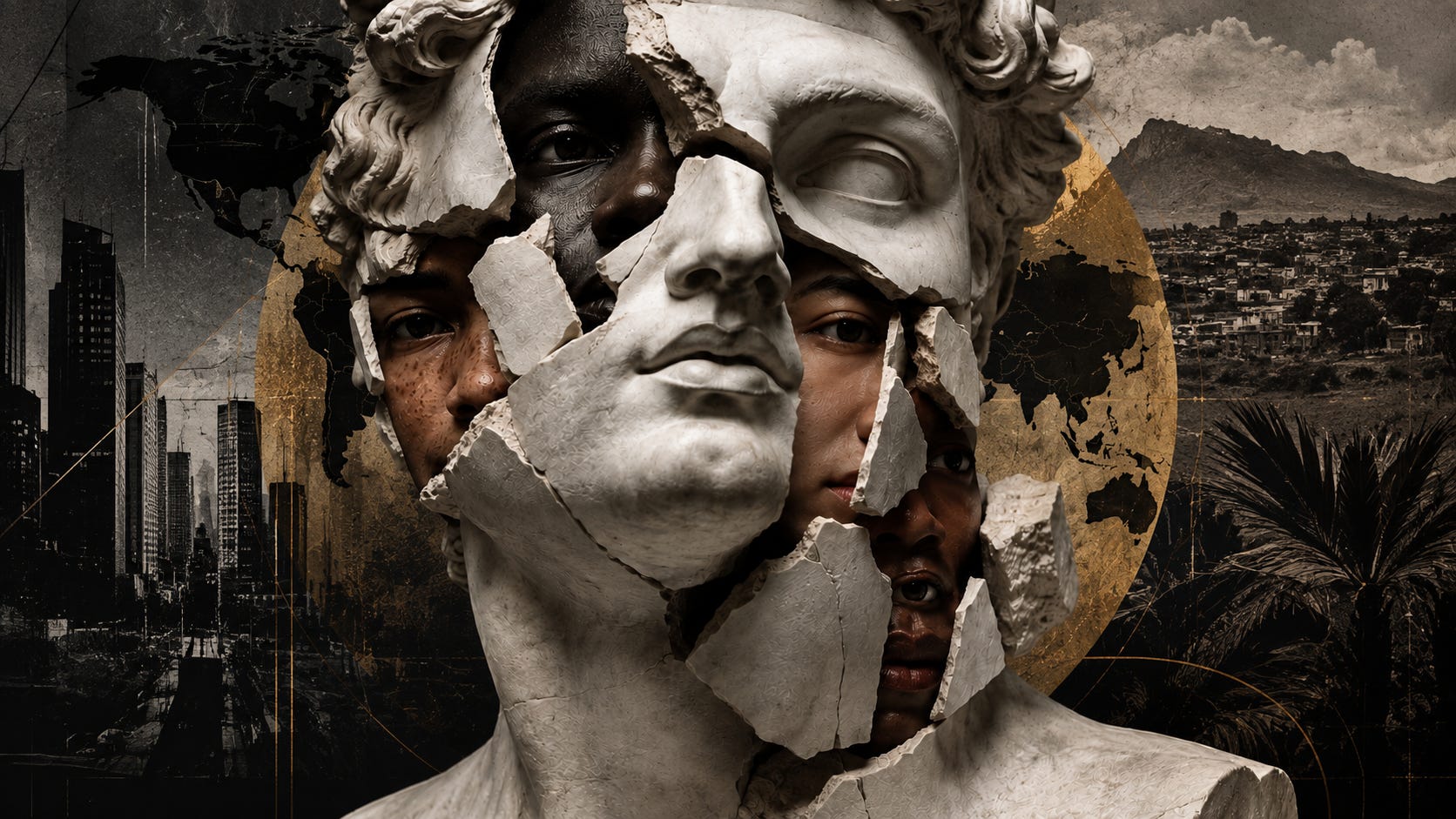
Location, location, location. The old real-estate maxim turns out to have something important to say about ideas as well. Where we stand shapes what we see, and where an idea originates shapes what it is capable of seeing.
I have spent much of the last several years developing the idea of existential health: the human capacity to live meaningfully and participate fully in reality while navigating the fundamental conditions of being human. Meaning, mortality, identity, belonging, freedom, limitation, uncertainty, suffering, responsibility, and transcendence are not specialized concerns. They belong to the ordinary experience of being alive.
Much of the intellectual tradition surrounding these questions, at least in the academic world I inherited, comes from Europe and North America. Kierkegaard, Nietzsche, Heidegger, Sartre, Camus, Tillich, Frankl, May, and Yalom have given us important language for understanding human existence. Psychology, philosophy, psychotherapy, theology, and religious studies have expanded that conversation in significant ways. Their contributions remain important to my own thinking.
But every intellectual tradition has a location, even when it imagines itself to be universal. Ideas formed within particular histories and cultures easily become theories about humanity itself. What begins as a view from somewhere quietly acquires the authority of a view from everywhere. The location disappears, while the assumptions remain.
Living in Costa Rica has made this harder for me to ignore. I ** recently wrote** about becoming a beginner again here, about what happens when you find yourself living outside the world that taught you what was normal. But another question has been growing alongside that experience. I am beginning to see not only how much my own life was shaped by where I came from, but how much the intellectual traditions I inherited were shaped by where
That realization has consequences for the field I am trying to develop. If existential health is truly concerned with what it means to be human, it cannot take assumptions formed within Western societies and simply extend them outward to everyone else. Its foundations must be shaped by more of the world, including people whose understandings of selfhood, meaning, belonging, spirituality, suffering, and flourishing emerged from very different contexts.
The question is larger than whether existential health has something useful to offer the Global South. That formulation already assumes which direction knowledge should travel. I am becoming interested in reversing the direction of inquiry: What does the Global South have to teach us about existential health, and what might have to change once we start listening?
I explore the global implications of this more fully in ** The Human Condition Has No Official Language: Existential Health as a Global Movement**, where I consider what it would mean for the field to become genuinely global rather than simply translated and exported around the world.
Western intellectual traditions have produced enormously valuable accounts of existence. Their recurring failure has been to mistake the particular for the universal, turning culturally specific ways of being into theories about humanity itself. Ideas born within particular economic, philosophical, religious, and cultural histories have been stripped of their location and presented under the more authoritative name of human nature.
The autonomous individual occupies a prominent place in this story. This person possesses rights, preferences, desires, choices, beliefs, boundaries, aspirations, and an identity understood primarily as belonging to the self. Maturity involves differentiation. Freedom means having meaningful choices. Authenticity requires discovering what is true for oneself. Personal development becomes the process of directing one’s own life with increasing independence.
There is much here worth preserving. I have spent years arguing for self-authorship, particularly for people emerging from religious systems in which interpretive authority was located outside themselves. Learning to trust your experience, judgment, conscience, and capacity for discernment matters deeply when you have been taught that truth about your own life must come from somewhere else.
Yet the autonomous self is not simply a description of human nature. It is also a cultural story about what a person is supposed to become. None of us actually exists autonomously. We arrive dependent upon others and remain embedded throughout our lives in networks of relationship, language, culture, history, economics, ecology, and place.
Even the person declaring complete independence does so in a language received from others, using concepts shaped by a culture they did not create. Our most personal identities are assembled from materials we did not manufacture. The question is not whether we are dependent or independent, but how consciously and responsibly we inhabit the web of dependencies from which none of us escapes.
The Global South complicates the Western picture because many of these entanglements remain more visible there. Family, community, economic circumstance, place, religion, colonial history, migration, and collective survival frequently stand closer to the surface of life. They expose the fiction that any of us can be understood as a self-contained individual whose life unfolds primarily within.
There is a version of existential inquiry that becomes easier once certain material conditions have been secured. When there is enough food, shelter, safety, education, healthcare, mobility, and economic stability, concerns about fulfillment and personal meaning often move toward the foreground.
A person might wonder whether a career expresses who they really are, whether a relationship feels authentic, or whether the life they constructed still fits the person they have become. These are legitimate dimensions of human life, and much of my work concerns precisely this territory. The mistake begins when this particular form of questioning becomes our template for what it means to grapple with being alive.
But existential life does not begin after survival has been handled. A mother wondering how she will feed her children is already confronting it. A farmer watching changing weather patterns threaten a livelihood sustained across generations is facing uncertainty, mortality, identity, belonging, and meaning at once.
But existential life does not begin after survival has been handled. A mother wondering how she will feed her children is already confronting it. A farmer watching changing weather patterns threaten a livelihood sustained across generations is facing uncertainty, mortality, identity, belonging, and meaning at once.
A migrant leaving home because staying no longer offers a viable future is not merely making an economic decision. Leaving involves place, memory, family, danger, hope, grief, identity, and the possibility that survival will require becoming a stranger somewhere else. What appears on a policy document as migration is experienced from inside a human life as something far more complicated.
Material conditions do not sit outside existential health. They participate in its formation. Meaning, agency, belonging, and hope are always being negotiated within actual conditions that distribute possibility unevenly.
Modern therapeutic cultures sometimes locate distress too quickly inside the individual. Anxiety becomes something happening in a nervous system. Depression becomes something happening in a brain. Meaninglessness becomes a personal crisis requiring personal reconstruction. These descriptions contain truth, but they become distortions when the surrounding world disappears from the diagnosis.
Sometimes suffering is not evidence that a person has failed to adapt. It is evidence that a human being is accurately experiencing conditions that are difficult to bear. Existential health requires us to understand both the interior life of the person and the world that person is being asked to inhabit.
Western conversations about meaning frequently emphasize construction. We create it, choose our values, author our lives, and decide what matters. This language has particular power for people whose inherited systems of meaning have collapsed, especially those leaving religious worlds that once provided a comprehensive explanation of reality.
I know this territory well. Much of my work has grown from accompanying people after religious certainty no longer holds. When the framework collapses, people often discover that meaning itself seemed to live inside it. They are left not merely without beliefs but without the structure that once organized identity, morality, belonging, suffering, and the future.
The language of meaning-making offers an important response because it restores human participation. Yet it also carries an assumption worth examining: that meaning is primarily generated by individuals through acts of choice and interpretation.
Across many cultures, meaning is encountered less as private construction and more as participation in relationships that precede the individual. Family, land, ancestry, community, ritual, obligation, memory, spirituality, and place provide a world into which a person enters long before deciding what any of it means.
Those contexts are not inherently benign. Families wound, communities exclude, traditions constrain, religions coerce, and collective belonging sometimes demands the sacrifice of individuality. I have spent enough of my life examining institutional religion to have no interest in romanticizing inherited structures simply because they are communal.
Still, highly individualistic societies have lost something when meaning becomes almost entirely a private project. Human beings do not experience their lives as meaningful only because they have successfully constructed a philosophy of life. Meaning also emerges because we care for someone, tend a place, inherit a responsibility, keep a promise, remember the dead, raise children, share food, tell stories, protect what matters, and contribute to lives that are not our own.
This suggests an important development in existential health. The question is not merely whether individuals have enough to sustain a sense of purpose and direction. We also need to ask whether the social worlds we are building make genuine participation possible.
This line of thought has caused me to reconsider some of my own language. Self-authorship remains central to my work because I have seen what happens when human beings surrender interpretive authority over their lives. Religious institutions, political ideologies, charismatic leaders, families, therapeutic systems, cultural expectations, and digital technologies are all capable of telling people who they are and what their lives are supposed to mean.
Reclaiming authority over one’s life is indispensable, but authorship is easily confused with invention. No one authors a life from nothing. We inherit bodies, families, languages, histories, wounds, opportunities, economic circumstances, ecosystems, social categories, traditions, and worlds already underway.
Most of the forces that initially shape us were operating before we possessed enough consciousness to examine them. By the time we begin asking who we are, an enormous amount of the answer has already been supplied. Self-authorship begins inside a story that has been unfolding without our permission.
The deeper task is learning to participate consciously in becoming a person within relationships, histories, places, inheritances, and realities we did not choose. This understanding of self-authorship is less heroic than the Western mythology of the self-made person, but it is more faithful to the conditions under which actual human beings become themselves.
We are neither completely determined by our circumstances nor sovereign over them. Human agency occurs inside conditions, freedom is exercised within limits, and identity develops through an ongoing relationship between inheritance and response. A genuinely global account of existential health has to become spacious enough to hold that tension.
There is another reason the Global South matters to existential health, and it cannot be approached responsibly without acknowledging colonialism. Colonialism was not merely the seizure of territory, labor, and resources. It was also an interpretive project concerned with who possessed the authority to name reality and define what counted as legitimate knowledge.
Colonial powers carried categories for determining what was civilized, rational, educated, developed, moral, religious, primitive, healthy, and fully human. Indigenous systems of knowledge were frequently dismissed or subordinated. Languages were suppressed, spiritual traditions displaced or transformed, and European ideas about property, education, governance, progress, family, personhood, and the natural world were institutionalized as though they represented the inevitable direction of human development.
The political structures of formal colonialism have changed, but interpretive hierarchies have proved more durable. Knowledge still travels unevenly through the world. Some institutions retain disproportionate power to decide which questions deserve investigation, which methods count as rigorous, whose scholarship is cited, which languages carry intellectual authority, and which forms of knowledge remain invisible because they do not arrive through recognized channels.
I have written about this problem before in an essay called ** When Knowledge Is Injustice: Silencing and Ghosting the World’s Wisdom**. My concern there was with the ways dominant systems of knowledge decide not only what counts as knowledge, but whose knowledge becomes visible, credible, and worthy of preservation. Entire traditions of human understanding have been marginalized, extracted from their contexts, translated into Western categories, or ignored because they emerged outside the institutions authorized to certify knowledge.
I find myself returning to that problem now from inside my work on existential health. A field concerned with meaning, belonging, identity, mortality, spirituality, suffering, and human flourishing cannot afford to reproduce the same epistemic hierarchy. If we construct our understanding of existential health primarily from Western philosophy, psychology, theology, and therapeutic thought, then invite the rest of the world into a framework whose fundamental categories have already been decided, inclusion will not have solved the problem.
We will have diversified participation without decentralizing authority.
This is significant because representation alone does not change the architecture of knowledge. A field might include scholars and practitioners from many cultures while continuing to ask fundamentally Western questions, rely on familiar categories, privilege dominant methodologies, and measure human flourishing against assumptions inherited from Western individualism. The people around the table might change while the table itself remains untouched.
This pattern is visible far beyond academia. Psychological theories developed from relatively narrow populations travel internationally as descriptions of human functioning. Development organizations carry assumptions about progress and well-being. Religious movements export theological systems alongside cultural ideas about family, sexuality, authority, and personhood. Wellness industries extract practices from communities, detach them from their histories, and repackage them for affluent consumers. Even spirituality moves through global systems of power.
Existential health must be careful not to become another export. If it arrives in the Global South already knowing what the field is, already possessing its categories, and merely…