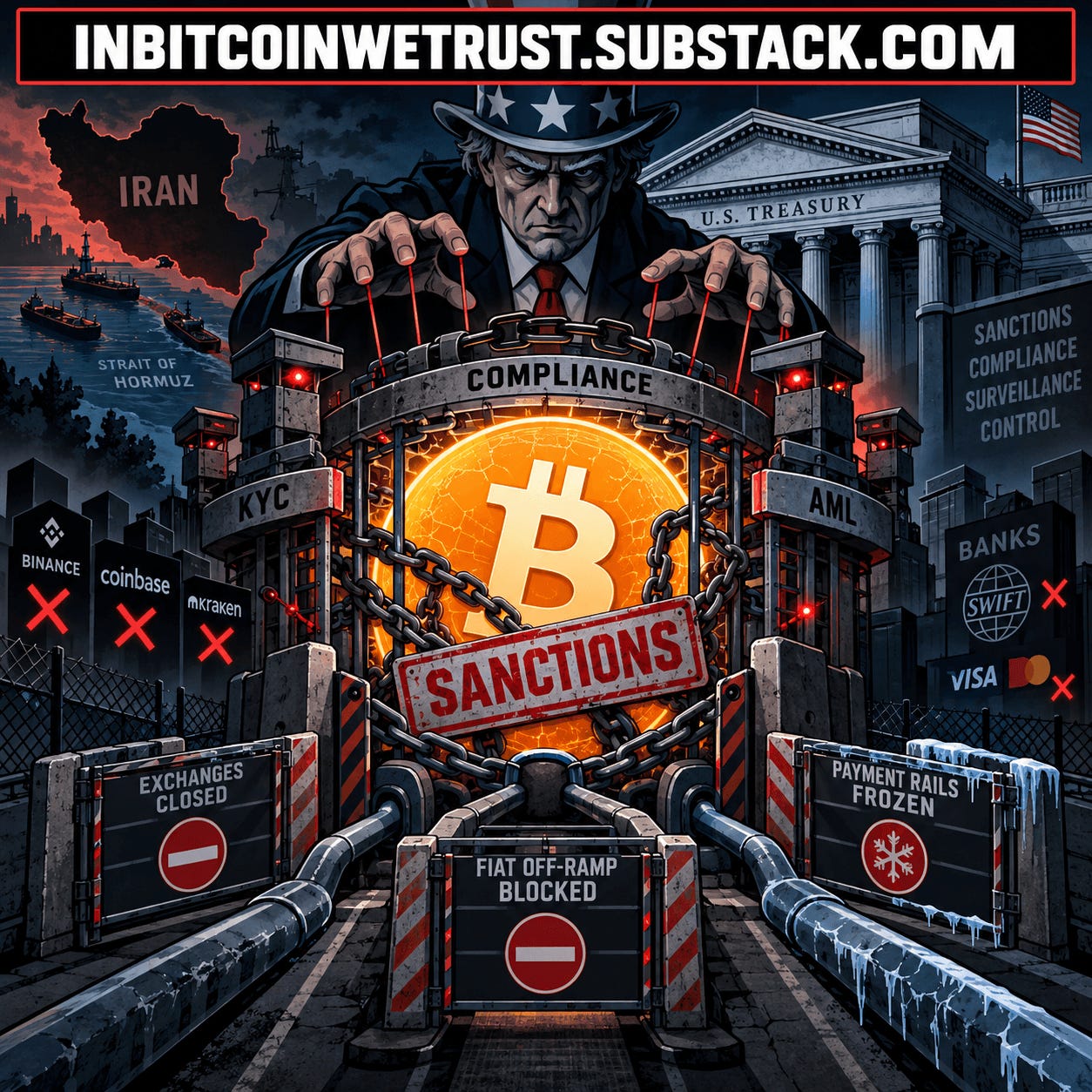
We always wondered what would happen if the federal government finally declared an all-out war on Bitcoin. Two days ago, we got our answer. They didn’t ban it. They didn’t bomb the server farms. They just quietly hijacked the off-ramps—and nobody said a word. The trap is officially set, the tools are built, and this should terrify you.
Let me ask you a question.
If Bitcoin is permissionless money—if it is the ultimate decentralized, un-censorable, un-freezable asset that we have all been told it is for the last fifteen years—then what exactly do you call what happened two days ago?
Washington now possesses every single tool it needs to control exactly who can and cannot spend Bitcoin. They didn’t have these tools a decade ago. They didn’t have them five years ago. In fact, they didn’t even have most of them in March of this year. They built them all in record time, right under our noses, while we were distracted by market charts and political theater.
Two days ago, the United States Treasury Department sanctioned a Tehran-based crypto exchange called BitBank, accusing it of moving hundreds of millions of dollars in Bitcoin to Iran’s Islamic Revolutionary Guard Corps (IRGC).
On the surface, you are probably nodding your head. Good, you might think. Stop the bad guys. And that right there—that exact reaction—is precisely what should worry you to your core.
Nobody will object to what Washington did two days ago. Nobody will protest. Nobody will take to the streets. The target was a hostile foreign military using digital money, so the public will cheer, or more likely, simply ignore it. But this designation was the fourth targeted strike against a single Iranian network since January, and it served as the very first full, terrifying demonstration of absolute, unchecked powers of financial control that didn’t even exist a few months ago.
To fully grasp the magnitude of the invisible prison that has just been built around the digital asset space, we have to do something the mainstream media refuses to do. We have to connect three seemingly isolated threads. Once you see the tapestry they form, you will never look at crypto, the banking system, or your own financial freedom the same way again.
Thread One: A staggering $475 million crypto freeze carried out by a private stablecoin company at the mere request of the government—without a single court order appearing in the public record.
Thread Two: A one-page bureaucratic determination that allows a single unelected Treasury official to declare an entire sovereign country’s digital asset sector completely off-limits, bypassing Congress entirely.
Thread Three: A chilling new precedent of announcing major Bitcoin sanctions without publishing a single shred of wallet evidence, effectively killing the public’s ability to verify the government’s claims on the blockchain.
All three of these threads lead back to one relentless, quiet campaign: the American sanctions war on Iran. But make no mistake. Iran was just the proving ground. The weapons they built were designed for you.
Here is the story of how Washington took control of Bitcoin.
To understand how a trap is sprung, you have to understand the bait. And in this story, the bait started with a boast on state television.
On a quiet Sunday in March, an Iranian lawmaker named Alaeddin Boroujerdi went on Iran’s state broadcaster to brag. He declared that Iran was collecting $2 million in transit fees from commercial vessels crossing the Strait of Hormuz, and he framed this extortion as a glorious reflection of the nation’s geopolitical strength.
He wasn’t proposing a theory. He was describing a well-oiled, highly lucrative system that was already in full operation.
Since mid-March, the IRGC had established a sophisticated vetting corridor near Iran’s coast, sandwiched between the Qeshm and Larak islands. Any commercial ship wanting to pass through these treacherous waters had to submit a highly detailed dossier to Guard-connected intermediaries: its IMO (International Maritime Organization) number, its cargo manifest, the names of every crew member, its corporate ownership details, and its final destination.
Once the paperwork was filed, the real business began. The ships were forced to pay as much as $2 million for the “permission” to cross safely.
Let’s call it what it was: a compliance desk for a maritime shakedown. It was mafia-style extortion dressed up in the bureaucratic paperwork of a sovereign state.
Within days of Boroujerdi’s televised brag, the Iranian Parliament acted with lightning speed, passing a law to make these maritime tolls permanent. By May, internal documents from the Ministry of Economy—leaked and obtained by Fars News—described the modern, digital evolution of this racket. They had built a bitcoin-native version of the toll system.
It was a platform called Hormuz Safe.
If you visited the Hormuz Safe website, you wouldn’t see the word “extortion.” You would see slick marketing copy offering “fast, verifiable digital insurance” against vessel inspection, detention, and confiscation. It was a beautiful, dark irony. Iran was offering expensive insurance against a risk that they themselves controlled. They were the storm, and they were selling the umbrellas.
The Iranian Ministry’s internal revenue target for this operation was staggering: over $10 billion.
For the American sanctions officials sitting in office buildings in Washington, D.C., this was their worst nightmare coming to life. For a decade, they had warned Congress and the President about exactly this scenario. They had written white papers and given testimony about the apocalyptic day when a designated terrorist military apparatus would start collecting massive, nation-state-level payments in the one major asset that Washington doesn’t issue and ostensibly cannot control: Bitcoin.
And now, Iran had handed them that exact doomsday scenario on a silver platter, complete with a public website, a catchy name, and a $10 billion revenue target.
Washington had to respond. And their first move didn’t involve the military, the CIA, or even a traditional bank.
It involved a private stablecoin company.
On April 23, the Iranian government proudly announced that its central bank had successfully collected the very first toll revenue from ships transiting the Strait of Hormuz. The system worked. The money was flowing.
But that very same day, something unprecedented happened.
Tether—the private company behind the massive USDT stablecoin—froze $344 million in USDT held in two specific wallets tied to the Iranian central bank. They didn’t do this on a whim. They did it acting on direct information provided by the Office of Foreign Assets Control (OFAC) and U.S. law enforcement.