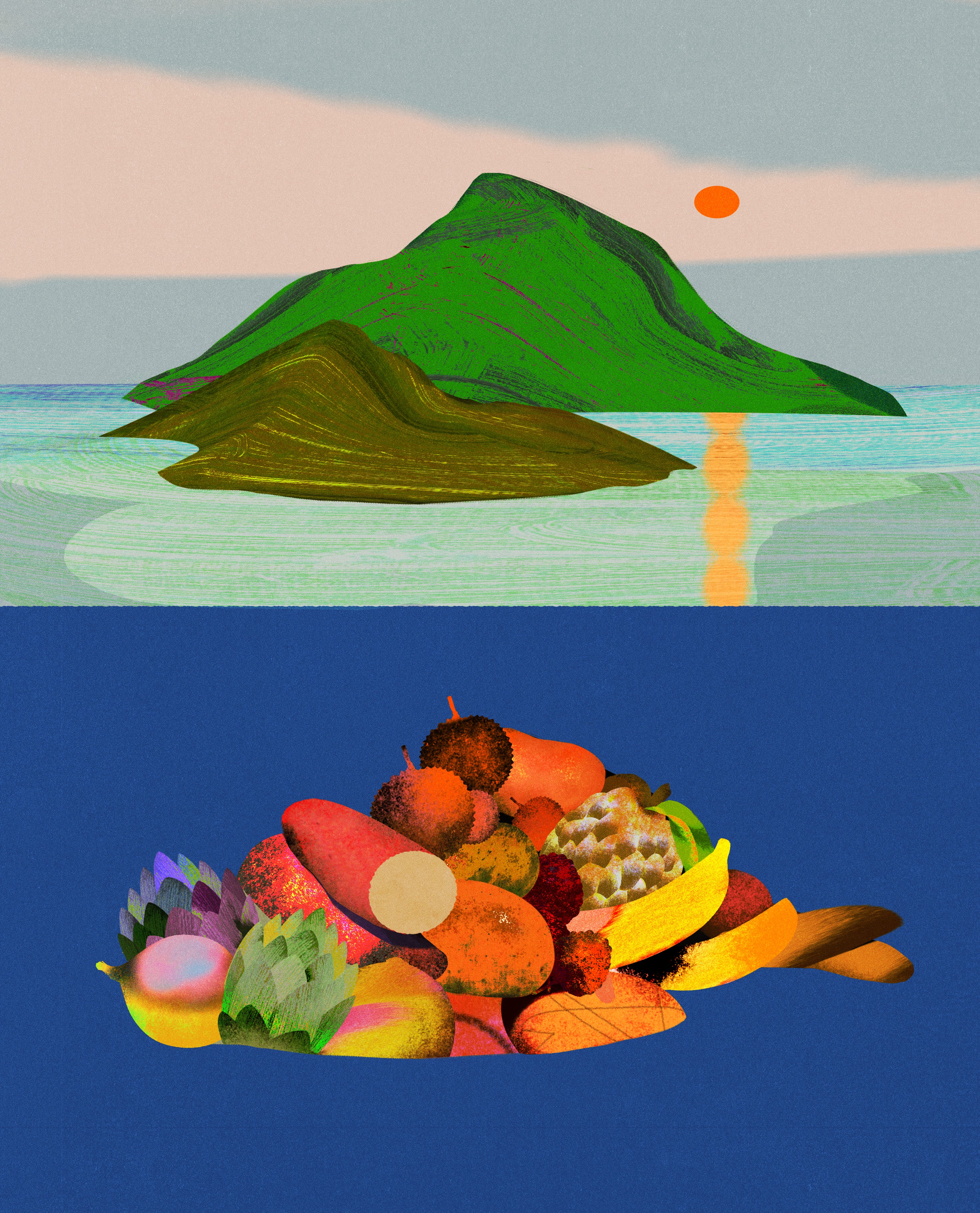
Good morning and welcome to Vittles. Today’s article is an essay by **Ariel Saramandi **is about eating through the climate shifts in Mauritius, and the deep sense of loss that comes when our food and landscapes transform beyond recognition.
This piece was originally published in our third print issue, ** The Influencers.** The issue contains everything from
To read this story and others in print, order your copy now!
Finally, if you haven’t completed our reader survey yet, please do so if you have five minutes to spare (free subscribers should complete this survey, while paid subs should complete this one). If you were one of the first 300 respondents, you should have received an email over the weekend welcoming you to your subscription. If you’re having difficulties accessing the back catalogue, try going to our homepage and clicking the ‘sign in’ button in the top right corner.
The knowledge of our land was acquired in blood and sweat.
Our elders knew the seasons, the humidity of the soil, the time to sow, the time to reap. They knew the land with gruelling predictability, land that they’d arrived on only a few centuries before, as colonisers and as enslaved people, then later as indentured labourers and merchants.
Colonisers, upon their arrival in Mauritius, were ordered to terraform the island. The Dutch – from the late 17th to the early 18th century – butchered Mauritius’ ebony trees for money, and were largely uninterested in planting food that required sustained attention. Guy Rouillard, in his book Les plantes et leur histoire à l’Ile Maurice, quotes a letter from Dutch Governor van der Stel, who wrote that colonists showed ‘the most vivid repugnance’ toward agricultural labour. They knew their presence on the island was only transitory. To them, our land meant only for trade.
Later (in the early eighteenth century, and until abolition) French colonists forced enslaved men and women to clear indigenous and endemic trees and plant cash and subsistence crops on barely arable land – indigo, cotton, coffee, cassava and spices. The enslaved people who were charged with caring for these crops had to stave off rats, brought over by Portuguese sailors in the hulls of their ships. They had to find new, ingenious ways of fending off a multitude of insects and humidity-loving organisms that diseased their cultivations. They were powerless against cyclones, which were routine destroyers of nascent and established crop plantations.
I think of the Yao, Makua, Malagasy peoples forced to work the land here: those whose hands would have known, intimately, the fertile soils of their homelands, who were captured not just for their physical labour but for their sophisticated agricultural knowledge. They would have worked Mauritian earth; they would perhaps have thought it was cursed. Studies over the late twentieth and twenty-first century would confirm that our soil is lacking in fertility, deficient in nitrogen, phosphate and potash.
But no matter the poverty of our soil, no matter the hardiness of our insects, human ingenuity would find solutions. ‘Solisyon’ in Kreol doesn’t just mean solution: it means product, sprayed and scattered, mixed like cocktails and poured all over vegetation – though the word is less common than ‘medsinn’, which denotes pesticides and herbicides specifically. Just as fertilisers could artificially enrich our soil, pesticides would make it inhospitable to animal life, and so our earth was blasted with chemicals.
Most of these chemicals were sprayed on sugarcane, the bastion of our economy until the early 1990s. No crop would dominate the land like cane: imported, studied, hybridised and transformed into a marvel of organic engineering. By the late 1990s cane was fed about 70,000 tonnes of inorganic fertiliser and over 500 tonnes of biocides a year. In 2018 we were the highest-ranking country in the world in pesticide use, at 28kg per hectare; no crop would devastate the Mauritian landscape so singularly by virtue of its monolithic cultivation.
And now, no solisyon or medisinn is enough to cultivate crops where they won’t grow, when they refuse to grow. The fragile arrangements we had for decades – brutalising our soil to produce sugar and food crops – only held as long as the rains came at their appointed seasons, as long as temperatures remained stable, as long as the salinity of the soil didn’t change. Now, climate change has exploded all this. We are planting and growing in the unknown.
Here in Mauritius, climate change is not measured only in terms of indexes, of records showing species and habitat loss. It is also gauged in terms of what has been lost in our knowledge of the earth: the way we tested the earth with our hands, rubbing it against our fingers, the way we were taught about plants’ responses to heat, light, water, the way we knew what to feed them with. Episteme erased.
(I write ‘we’, but of course I am not speaking about myself; I know only granules of what my ancestors knew, all that knowledge lost before the temperatures became incandescent, the heat unbelievable. My mother and my mother-in-law will care for plants but won’t touch soil themselves; they are inheritors of a belief system – one that cuts across class and ethnic lines – that says clean, unsoiled hands are a marker of societal success.)
‘The fragile arrangements we had for decades … only held as long as the rains came at their appointed seasons, as long as temperatures remained stable, as long as the salinity of the soil didn’t change. Now, climate change has exploded all this. We are planting and growing in the unknown’
In the 1960s, agriculture represented about 30% of the island’s GDP. In 2024, that number was a slight, stark 4.1%. Around 8,000 ‘small farmers’ cultivate crops – mostly vegetables – in Mauritius, with each farmer growing their produce on about a hectare of land. To be clear, this is a precariously small amount of land for cultivation. Year by year, the government has noted a decrease in even this many small-scale farmers – farming is seen as low-status compared to an office job – and we now import about 75% of all our food. Though we don’t know how much of those imports go to hotels, stories abound about how the country’s best produce, both locally harvested and imported, lands on a tourist’s dinner plate instead of our own.
I know one small-scale farmer turned vendor in my town – he runs a successful grocery shop with his children. His children are my age; they returned to Mauritius after studying abroad (training as doctors and engineers) to help their ageing father run his business. Today, visiting the grocery shop is a radical experience. Mauritius’ air temperature has risen faster than the global average over the past fifty years, and is now a degree higher than it was half a century ago. This – alongside other changes to our land and our economy – has altered the produce on the grocery’s shelves.
*Garlic. Historical research shows that Indian indentured labourers who came to Mauritius brought at least eighteen different plants to the island for medicinal purposes, including garlic; this is, perhaps, how the plant arrived on the island. I don’t know of a single Mauritian who doesn’t eat garlic every day: it is a staple in dishes cooked across ethnicities (despite inflections such as Indo–, Sino–, Franco–, all our cooking is distinctly Mauritian). Garlic features in dishes from Creole rougay *to more Indian-influenced curries, our Chinese-inspired fried noodles and our supposedly French ‘sauces blanches’. But the heaps of garlic sold at the shop are all imported. What the warming climate has done to local production is part of a global story: heat shortens the cool window the bulbs need to form, making the crop unreliable. Imports are the easier, even inevitable, choice.
Sweet Potato,* which *I believed would just always be there. My mother told me how it was important for good health, said it was ‘our’ food (‘our’ here meaning Creole.) There is also manioc, or cassava, which enslaved Africans ate alongside leafy greens (bredes) to survive. But both manioc and bredes are not grown as much anymore; wheat and rice, all imported, now constitute Mauritian dietary staples. The average Mauritian consumes around 74kg worth of flour per year from entirely imported wheat – much of it from France, whose wheat is contaminated by cadmium, a carcinogenic-heavy metal. We wouldn’t have been so exposed to this cadmium crisis ourselves had we continued to prioritise sweet potato and manioc. Both starchy roots, in addition, sit lower on the glycaemic index than refined wheat. Had they continued to be the bedrock of Mauritian diets, there’s good reason to believe that we wouldn’t have one of the highest diabetes rates on earth.
A wide variety of our local leafy greens,* along with carrots, onions, lettuce, potato *are at risk, given rising sea levels. These have started to dwindle at the grocer’s, for they are saline intolerant and saltwater is permeating agricultural land. Our sea levels have risen between four and six millimetres a year over the past thirty years (between two and three times more than the global average), aggravating saltwater intrusion into groundwater systems, which impacts useable water resources (projected to decrease by 13% by 2050) and agricultural production (which could decline by 30% by 2050). Climate change will continue to reconfigure our bodies, just as it reconfigures grocery shelves. It has and will make us ill in ways that we are only just starting to truly comprehend.
In the grocer’s fridge, I also find imported* *French artichokes – another memory connected to my mother. She would have bought locally grown varieties of the plant; I buy the French ones. She’d buy artichokes almost as a treat, as we were the only two members of our family who loved them. She prepared the flower the way her father liked: boiled, leaves dipped in a vinaigrette of chopped onion, olive oil, salt and pepper, white vinegar. The grocer’s son tells me that artichokes used to grow around Curepipe and Floreal, but haven’t been seen in over a decade – same story for salsify. Curepipe and Floreal, the coldest regions in the country, are no longer properly cold. Lychees – perhaps our ultimate summer fruit – grow in Curepipe now.
‘I think of the Yao, Makua, Malagasy peoples forced to work the land here: those whose hands would have known, intimately, the fertile soils of their homelands, who were captured not just for their physical labour but for their sophisticated agricultural knowledge’
Sometimes, by the counter, the grocer sells small quantities of seasonal fruits – fruits that are either rare or that aren’t produced at scale. I saw roselle buds last year and made tea with the handful I bought. What I haven’t seen in a while are rubus rosaefolius,* or ‘fraise’, the delicate, slightly sweet red berry grown in prickly flowering shrubs *(known as ‘Mauritius raspberry’ internationally). They used to be sold by the box near Curepipe’s Monoprix in the mid-1990s, and my sister and I would pick and eat them during long walks through the forests with my aunt. My mother tells me that the berry used to grow near Sodnac when she was a child. Her old neighbourhood, once mostly woodland, is all houses and apartment blocks now, and even in the shrubs that remain, the berries are nowhere to be found. *Rubus *is described as a hardy, vigorous, adaptable plant, but it crucially needs moderate temperatures to survive. Here, on our island, moderation is nowhere to be found.
Mangoes,* bananas*,* passionfruit*,* custard apples (atte), papaya*:* *fruit that I’ve taken for granted all my life, all of which are intricately sensitive to changes in humidity and temperature. Their abundance will change over the years, for, as we say so often, ‘Tou in sanze aster’ – ‘Everything has changed now’. This phrase is suffused with so much weight that it ends conversations.
Try, for a moment, to imagine what cannot be contemplated, what doesn’t have a number: the scale of ecological devastation wreaked by colonialism.
The declining number of farmers in our time of extreme global heating means that the knowledge of how to grow our own produce is being irrevocably erased. It is not only that we have forgotten how to tend to certain vegetables. Today, we are unable to measure that knowledge against changing climatic conditions, adapt it to our current situation. And what did we even really know* *about our land, before its desecration by colonists since the early 1500s?
‘Climate change will continue to reconfigure our bodies, just as it reconfigures grocery shelves. It has and will make us ill in ways that we are only just starting to truly comprehend’
Through Professor Vincent Florens, I learn of ‘extinction debt’. This refers to the time lag between a habitat destruction event – for Mauritius, colonisation and the devastation of 96% of our forests – and the eventual disappearance of species that can no longer sustain viable populations through the sliver of their life that remains. Florens tells me that a species may continue to live for decades (or even centuries) after its habitat has been critically reduced before its population completely dies. He tells me of our ebony trees, through which one is lulled into some kind of false hope: when walking around the Gorges of Riviere Noire, some of those giant trees are well and thriving, but they are the last of their generation. They cannot reproduce, for they have too few counterparts of the opposite sex; the animals that once carried their seeds are now extinct or greatly threatened. The forest they depend on has been massacred, and surviving species are now struggling to understand their new, hotter, unpredictable environment.
This extinction event extends to what we eat. Three of Mauritius’s endemic coffee species are listed as critically threatened; the endemic palm whose heart we still eat in salads is critically endangered in the wild; a bean we called ‘antac’ was ‘previously used as food,’ according to the Ministry of Agriculture’s 1996 plant genetic resources report, but I’ve never heard of it, never seen it anywhere. The same goes for ‘long tom’ beans, a local red onion variety simply described as ‘local red’, and the ‘Quatre Carrés’ variety of tomato. From the report, I learned that at one point, there were around sixty mango varieties grown in Mauritius. I only know of a handful. I also know that my grocer imports mangoes now.
Extinction is a continuum. Colonialism’s death hand, its malign influence, is such that an untold number of generations will suffer from its reach. I think about the culling of almost all of our forests, then think about our soil, saturated with pesticides over decades, in particular service to a colonial monocrop that wreaked further devastation on our land. I think of global heating, where climate emissions are generated by the countries with neo-colonial ambitions, still pillaging others for resources. Digging, stealing, burning ever more petrol. I think about our country’s geographic isolation, ‘exacerbated in its own microcosm’, as Florens puts it, rendered so intensely vulnerable.
‘The trees cannot reproduce, for they have too few counterparts of the opposite sex; the animals that once carried their seeds are now extinct or greatly threatened. The forest they depend on has been massacred, and surviving species are now struggling to understand their new, hotter, unpredictable environment’
Those who know me tell me…