Hello, All:
Before talking about Fable 5.2 and the Gemini 4 Carbon model, I have an exciting announcement!
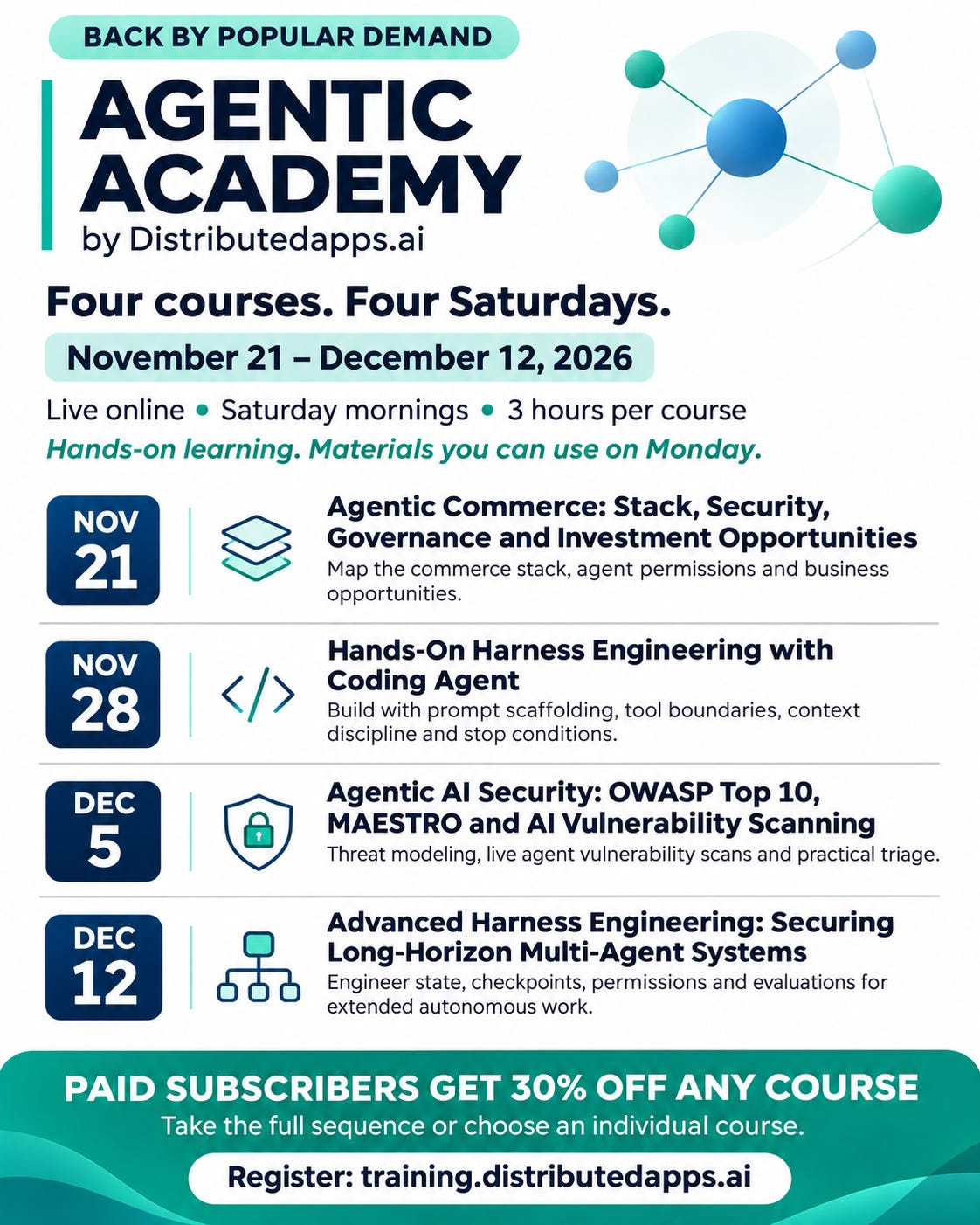
Back by popular demand and tested with our clients, we now offer the following courses online. Paid subscribers get a discount.
Four courses. Four Saturdays. They cover the most important aspects of Agentic AI. Choose one or all. The courses have no dependencies.
Nov 21 → Dec 12, Agentic Academy by Distributedapps.ai goes live on Saturday mornings. Each course is three hours, hands-on, taught live, and ends with materials you can use on Monday. One course per Saturday, so you can take the whole sequence or drop into the one that intrigues you the most. Paid subscribers get 30% off any course.
Nov 21 — Agentic Commerce: Stack, Security, Governance and Investment Opportunities
Where the agentic money actually is, and where it is lost. We map the commerce stack end to end, then break it: what an agent is allowed to buy, approve, refund or recommend, and what you must log before a regulator asks. For founders and product leads deciding what to build first.
Nov 28 — Hands-On Harness Engineering with Coding Agent
The build session. Prompt scaffolding, tool boundaries, context discipline, and stop conditions, hands-on keys the whole three hours. You leave with a working harness pattern, not slides about one.
Dec 5 — Agentic AI Security: OWASP Top 10, MAESTRO and AI Vulnerability Scanning
The threat model your security team will ask for. We take the OWASP Top 10 Agentic Skills and agentic applications, work through MAESTRO, then run vulnerability scans against live agent endpoints and triage what comes back.
Dec 12 — Advanced Harness Engineering: Securing Long-Horizon Multi-Agent Systems
The failure mode nobody demos: agents that behave for twenty minutes and drift by hour four. We build the harness — state, checkpoints, permissions, evals at every hop — for systems that run unattended across days. A secure and Governable agent is the key for the next generation of Agentic AI deployment. Click below to register for our class and get a Certificate from DistributedApps.ai after the completion of each course.
Now, let us start with today’s post:
Two top models arrived days apart, and they differ on scores, price, and the instructions each one takes. Anthropic's Fable page presents Fable 5.2 as the strongest model in its line for technical work, and Google's Carbon post presents Carbon as the strongest model in its line. The independent composite puts one ahead on raw capability and the other ahead on cost per completed task. The prompt guides differ in kind: Anthropic published a dedicated guide for Fable with a measured effect for each rule, while Google published no Carbon-specific guide, and Carbon prompting uses a general guide plus a migration checklist.
The score pattern is a split. Fable takes the agentic coding tests and the science tests on Anthropic's table, and Carbon takes business workflow automation and the long-context test on Google's table. The independent composite places Fable ahead, and the cost per completed task places Carbon ahead. Each company's table favors its own model, and the shared tests give the cleaner read: the same test, run on both models, shows where the lead sits and how wide the lead is.
The guide asymmetry matters more than the score split for daily work. Anthropic's guide reads as a list of observed failures, and each failure carries a measured number from Anthropic's own tests. The guide names what breaks when an old prompt meets the new model, and it names the fix and the cost of the fix in tokens. Google's material for Carbon reads differently: a general prompt-design guide written for an earlier model, thinking docs that describe the dial, and a migration checklist that changes settings rather than prompt text. One guide teaches prompt text. The other teaches settings.
The price pattern differs from the score pattern. Carbon's per-token price is lower than Fable's at launch, and the introductory rate ends before the higher rate starts. The per-token price misleads on its own: the cost of a completed task depends on how many tokens the model spends thinking, and the thinking dial determines that spend. Fable at its highest effort spends far more per task than Carbon at its high level on the same composite, and Carbon at its middle level posts the lower cost on the automation test.
Both models move thinking out of the prompt and into a setting. Fable sets thinking with an effort dial, and Carbon sets it with a thinking level. The dial changes tokens and time far more than it changes reply length, and both companies put the dial in config rather than in prompt text. Both companies also name a cheaper model as the start point for everyday work, and both treat the top model as the escalation for hard, long, verification-heavy jobs.
Figure 1 is the independent composite, with Fable ahead at both settings shown and Carbon behind at both settings shown.
Figure 1: The independent composite puts Fable 5.2 ahead at Max and High, and Carbon behind at High and Medium.
In paid section, we will cover the following details:
Fable 5.2 scores — the stake is the agentic coding lead on Anthropic's table.
Carbon scores — the stake is the automation lead and the long-context margin on Google's table.
Head to head — the stake is the leader and the difference on each shared test.
Price, context, and cost per task — the stake is the cost of a completed task against the per-token price.
Fable 5.2 prompts — the stake is ten ruleswith measured effects from Anthropic's guide.Carbon prompts— the stake is the general guide, the thinking docs, and the migration checklist.Where the prompts agree and differ — the stake is the shared outcome-first pattern and the split on thinking dials.
Which model fits which task— the stake is the score map by task type.Three prompt templates you do not want to miss— the stake is copyable text for a coding job, a document job, and the routing rule.And we will start with the course discount code for paid subscribers ($100 savings)