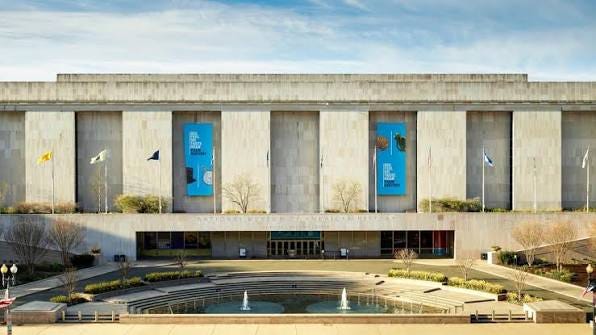
The problem with the Bartons, the men who are attempting to destroy our national museums, is not that they’re “fake historians,” as Noel Sims and Rebecca Crosby said in their post “The fake historian advising Trump’s anti-Smithsonian crusade”; it’s much worse.
The * Popular Information* post offers a concise history of the Bartons, which I won’t rehash here. But, as a 20+-year museum veteran, trained historian, and now public historian, I’d like to explicate the issues from the frame of the field as well as offer some ways we can all work to save our heritage.
Trained historians are a fairly recent concept, as it goes. In the West, many of our histories came from the wealthy hobbyists or clerics. Their point of view was often skewed. Even as universities appeared during the Renaissance, historians often overlapped with other fields like medicine or religion. Now, are you thinking, wait, the Renaissance is like 500 years ago, what do you mean recent? This is where historical training comes into play. Even scholars of recent history are trained to see the macro and micro scope of events. Similarly, events are framed within context and within systems. History is also not just what happened, but also the causes and results. Being okay with complex thought is the great gift from a history degree.
Another great gift from studying history is that you almost immediately come face to face with your human failings. You will never know all of history. I don’t mean the unknowable, like what the Lascaux Caves mean, say, but you literally will never be able to read enough to know everything. As an art historian who largely worked with an encyclopedia collection, I have a good facility with a lot of history. If there wasn’t visual culture with an event, I know nothing. Naval history, not much. Ecological history, nope. Even within art history, my knowledge base is largely bound by the collections I’ve worked with. Inca, not much. But their predecessors (in what is now Peru), the Wari, I’d love to tell you about their textiles and stone buildings. Understanding intellectual boundaries is another great gift of a history degree.
But, and this is a huge but, the degree isn’t what made me capable of embracing complexity and understanding boundaries. I went into art history and museum work for the great love of sharing art with the public. In my time in museums, many colleagues who did that work came from other training backgrounds. Guards, with degrees as varied as MDs and BFAs, would check information to ensure they could give visitors the right answers. Exhibition designers often crammed information in the run-up to laying out a show. Housekeeping also often checked in because they regularly got questions, particularly from families waiting for restrooms.
Museums are an ecosystem of learning. The wage scale for most who toil there is low, but the mission still compels the staff to stay in roles that are regularly 100 hours a week. Why? History will be forgotten or worse rewritten if we don’t do that important work.
But here’s where the real issue comes to bear about the religious vigilantes who have Trump’s ear. Many museum professionals and public historians are not trained in history, but they can still see the value of complexity and humility. The issue with the Bartons is that they’re actually doing what they claim the Smithsonian is. They’re hoping to rewrite our past, which they’ve framed as bringing back “truth and sanity to American History,” to quote Trump, who issued an executive order. The Bartons are attempting to cement the fallacious belief that the early Presidents wanted a Christian nation. (That many presidents were deists is well documented.) They’re hoping to turn the Smithsonian into yet another soapbox for their Christian nationalist platform.
But why? Because museums do not tell you what to think. They help you learn how to think for yourself. Walk into any gallery. You’ll see a grouping of objects. The panel will introduce the theme, i.e., why those items are there. They could all be from the same era, like Jurassic dinosaurs or 1960s posters, or they could be based on a theme, like birds from around the world or prints of bears. The panel will offer some concepts that can ground your visit. Each label might offer 100 words to tell you about that item or maybe just give an ID. (I have a longer free post on museum installations if you’d like to read more.) In those rooms, though, is there one right answer? Is there one way to think about those items? In a well-constructed gallery, no. A visitor could walk in every day and see something new.
Take the issue of slavery, which is at the crux of their plans for changing the Smithsonian. It’s also central to our nation currently and has always been. My family joined this nation in the late 20th century, and yet, I still need to sit with the legacy of the enslavement of stolen African people. It impacts my life daily, from the way my freeway is built to the way my schools are funded; everything goes back to slavery. My lack of affordable healthcare and the fact that I have poor public transportation all go back to slavery. Wait? All that.
If I were to do an installation about Slavery (and I’ve worked on many installations that touch on slavery), I’d start by considering what aspect I can tackle. For example, I once installed works about redlining and the connection to the Great Migration. My goal was for people to see these artworks about places in the Rust Belt and connect today to the mid-20th century as well as the 19th century. Did my labels villainize anyone? No. Because the villains are not walking into art museums on school tours? That might be. But there’s a bigger reason. Guilt is not conducive to learning. Empathy, however, is. That’s one of the things the Bartons and the religious right fear—people who care make change for the better.
The other thing fascists, and the religious right are fascist-aligned, is thought. Museums are about open-ended ideas. Freedom to think beyond multiple-choice answers is enormously important in our society. Of course, free thought is the particular freedom the flag-code flaunting, ‘Jesus loves war’ MAGA folks fear. They’ve signed on to offer their brain, as it were, to Trump’s cult of personality.
If you’ve not given up your faculties for a man who fondles children, you’re the right person to ensure the Smithsonian keeps doing its job. Museums never had the job of being “a symbol of inspiration and American greatness.” As I’ve written, museums started as colonialist spoils, then as diversions for the masses, and finally as the largest education service in the US. As the American Alliance of Museums touts, more people go to museums than to sporting events.
Most of the people reading this, and truthfully, most people who’ve attended public schools in the US have walked into a museum gallery. While most people haven’t studied history, if they’ve ever enjoyed anything they’ve seen in a museum, they can push back against this completely fictitious reading of the function of museums as well as the actual history of the nation. My training as a historian is not what makes me capable of understanding why knowledge cannot be tamped down to make small men feel bigger. It’s my inherent belief that the future cannot be destroyed for the will of a few.
In a sense, this belief comes from the very foundations of our nation. I recently wrote about how hopeful exploring the myths of our nation can be. We cannot move forward when mired in the lies of the past. The truth will out, and our fate will be to sink or swim.
To return to the Bartons, their failing isn’t their lack of training. It’s their inherently rotten, self-serving, cowardly need to reframe history in their faulty image. Sadly, many a trained historian has fallen down the same path for self-aggrandizement. It’s not the training that made them despicable; it’s their nature.
On the other hand, if your nature isn’t completely morally bankrupt, you can help ensure this doesn’t come to pass. For better or worse, we are in a nation founded on the truth that all people are equal. It’s a promise that’s yet to come to bear. It’s also one that museum professionals hold dear every day as they assiduously catalog, preserve, and share heritage. Museum pros are pushing us closer to seeing the past in new ways, to being better thinkers, and ultimately to making us a better nation. By connecting to your elected officials and screaming from the rooftops about the importance of freedom in museums, you ensure a better future for our nation.