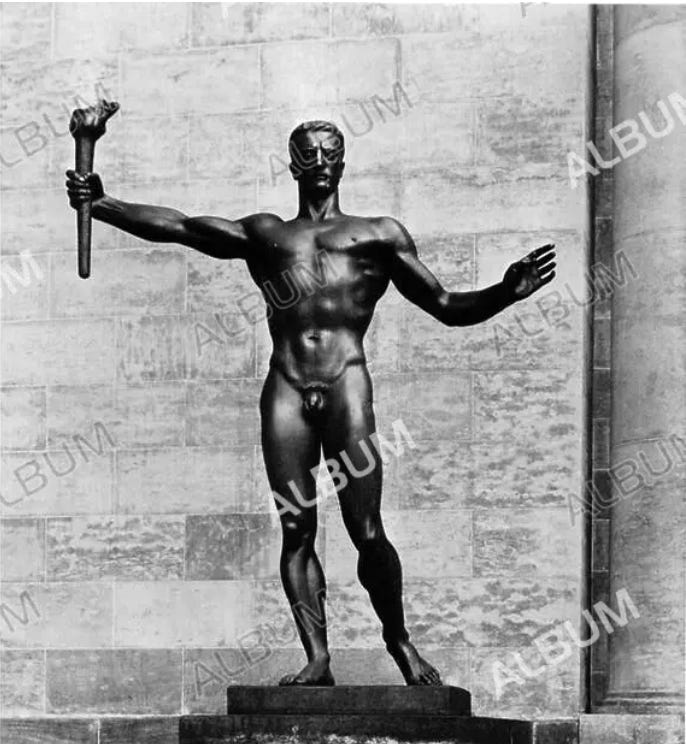
Fascists rarely make good art. I am in no way the source of that brilliance. This is well established in art history, but it was the topic most strongly challenged in a recent article on categorization. From the responses, two threads emerge: what is good art and what is fascist art.
By far, the most common response was, “Look, here’s the good stuff fascists do.” In this, they’re pointing to the way the art conforms to reality. This sculpture clearly depicts four men with hats. Good art goes beyond showing.
Compare Arno Breker’s *The Party *with Michelangelo’s David. Both are clearly men in the buff. Both artists render the forms correctly. Breker’s figure, though, is easy to read. He is looking ahead and holding a torch. With the name, you can get the point without much effort: the Nazi Party will lead the way. Michelangelo shows the boy who would be king, David, standing at ease, a rock in his hand. What is he thinking? How does he feel about dispatching his duty? How close is Goliath? Good art makes you think. Realism alone is not fascist. But it’s the easiest way to give people a simple message.
Fascists would like to keep you from thinking. They want you to hear their message without questioning. Communication ideology is their primary goal with the art. Complex art invites nuanced thought and multiple narratives. Fascists maintain power through simple messages. In fascist systems, good and bad are black and white, so no one questions the complexity of problems of the state. Realist art, but one with little emotional weight, therefore, is perfect. It can be easily understood but invites no other thought. Most importantly, the visual simplicity does not expand the viewer’s critical thinking skills. Simple art gives dumb messages to simple people and keeps them dumb.
Fascist art is also usually top-down thinking. The artist works for the Nazis to produce what the Nazi says. The artist is literally a hired hand of the party. How do the artist’s feelings play into this? I did a post a couple of weeks ago about Nazi artists, in which the artists were on the spectrum from having to fight to loving to fight for what they believe. When we look at any war, there are the true believers and the people who had to do it. In the aftermath of any kind of armed conflict, we find ourselves seeing a lot of young people having to make choices in life, and preparing them for a lifetime wrestling with them, while the people who chose that war probably think very little about it. When we’re talking about fascist art, it is not art by people who ally themselves with Fascist ideas. It’s art made to propagate specifically fascist ideals.
MAGA art is a great example of Fascist art. Trump loves images that depict him as patriotic and faithful. He’ll take AI as easily as he’ll take something bad by an artist, as long as the picture tells specifically what he wants. The art is solely a visual aid in his self-serving message. He needs images that keep the viewer’s thinking process simple.
Ethics also comes into play. An artist who is willing to comply with the demands of a government that murders on mass is also willing to curtail any sort of creativity. Is mass death isn’t a line that you mind crossing? Then certainly innovation and nuance are something they’ll happily jettison. As I discussed, for example, architect Albert Speer often abandoned many of his early ideas in response to Hitler’s input. He also happily used prisoner-laborers. Someone who truly believes in evil will always happily compromise on their art because they’ve already compromised on their soul.
Efficiency is also why fascist art will always be inferior. Hitler wanted to churn out imagery and architecture that supported his position. In Fascism, speed is more important than creativity because you need to maintain control of the people. Art is not instantaneous. However, keeping a populace enveigled requires a constant stream of messaging. Similarly, Trump is putting out a steady diet of AI to keep MAGA focused on their hateful message. The worse things are, the more Truth social posts and AI images.
People who hold fascist beliefs can make good art. As I wrote about, Emil Nolde was famously one of the artists Hitler found to be degenerate. After the war, his family kept his anti-sememtic Nazi’s views quiet.
Many people, like , brought up Dali as an example of a fascist who made good art. But he’s a more complicated case. As with Nolde, his art was largely not in service of Fascist messaging. He was certainly a Nazi sympathizer. But he wasn’t the virulent anti-semite that Nolde was. He worked on many projects about Jewish causes, including Israel. He never created artwork that spewed the Nazi party line.
Instead, Dali can be seen as an opportunist. He happily turned to anyone who helped him get ahead. He started as an academically trained painter who was largely seen as less capable than his peers; at least part of his style stems from his inability to render correctly. His true skill was in self-promotion. Other surrealists also developed compelling works, but they didn’t kowtow to the press or donors quite like Dali. Salvador Dali was known to suck all the air out of the room.
In surrealism, there is enough that you can identify that you can understand the message. The juxtapositions between what you understand and what you see delight you. The deviation between the real and the surreal image being presented causes delight. Dali’s popularity is similar to how Fascists use realists for their monuments. Easily understood ideas are quickly appreciated. In fascism, realism serves as a conduit for a simple message. In surrealism, realism is the conduit to a complicated one.
Dali's surrealist works were not fascist. They were not in the service of a simple message. Later in life, after returning to Spain and being celebrated by the dictator Franco, he painted a portrait of Franco’s daughter. Even though a Fascist paid for this portrait, it was not commissioned to support the party's message. Its existence actually highlights how often Fascists and Dictators espouse one thing for the people and another for themselves: glorious, interesting art for Franco’s family and serious party messages for everyone else. Dali’s image, though, also highlights the speed Fascists love. Franco wasn’t known for his patience. The composition has some of the hallmarks of classic Dali, with the inscrutable landscape in the horse. But the surface is hardly up to the quality of his early works.
Dali, actually, is the greatest example of how both Fascism and Capitalism are systems that kill creativity and art. Dali was always hemorrhaging money. During his time in the United States, he worked with Hallmark to create a series of holiday cards. While they have visual appeal, they don’t have the visual interest of one of his early Surrealist works. Similarly, his late works under Franco were rushed. In Capitalism and Fascism, time is sacrificed because creativity isn’t valued. In the former, quantity is more important than quality. In the latter, simplicity is essential.
Dalí's best works come from the period when he is in discourse with surrealist thinkers, artists, and writers. In the community, he can create complex, enduring visuals.
So when I say fascist don’t make great art, I don’t mean that the artists themselves were not capable of going beyond simple messages. Nolde shows they were capable of innovation. Breker also made some interesting works after the war.
Instead, what I mean is that in the paradigm of fascism, messaging is far more important than the medium or how it is presented. Quality and curiosity are sacrificed to efficiently serve up messages people don’t question. Good art is not solely pretty or capably realistic. Good art invites thought. The surface invites consideration. Production is done with care. The form is interesting. Art is meant to engage us on a sensory level. Fascists sacrifice sensory pleasure to their own power. For the fascist, the art is a means to an end. Artists, instead, create objects that live beyond in our minds and defy singular meaning.