Fascists rarely make good art, as I’ve said a couple of times recently. Celina 101 countered my claim, and I’d like to repeat my point. Fascists rarely make good art. Fascists control every element of the art, and as such, it’s not particularly good art. It needs to be good propaganda, not good art.
But this doesn’t mean logically the converse is true, not that NOT fascists often make good art. Similarly, it doesn’t mean that art made for non-fascist purposes lacks an ideological underpinning that impacts their work. My take, interestingly enough, is not even particularly anti-fascist.
In her response, she's not actually responding to my argument. She's responding to a more sweeping one she'd rather argue against — something like "political art is bad," "clarity is bad," or "patronage is bad." I never said any of that. So before I defend what I actually wrote, let me restate it plainly, because it seems to have gotten lost in the enthusiasm to defend fascist art.
My claim is structural, not moral. Fascism, as a production system, subordinates art to propaganda. The artist is handed the message, the deadline, and the permissible forms, and is expected to deliver. Creativity is curtailed not because fascists are evil but because the system requires efficient, legible, repeatable output. That's why I also wrote, in the same essay, that capitalism produces bad art for the same reason: when message, volume, or speed take precedence over creative discourse, the work suffers. Notice that my argument doesn't depend on the morality of the patron's ideology or on whether the art is accessible.
With that stated, let’s go through Celina’s response. She starts with: “It has become apparent to me that, for some, the belief that fascism was immoral leads almost automatically to the conclusion that artists associated with it must have produced inferior art.” Now, standing up for Fascism is awesome for her. But she’s adding elements that were not in my argument. I didn’t say that the immorality of fascism was what made it bad.
I specifically said in fascism, art must be made efficient and specifically to convey a message. Arno Breker, for example, was given very specific rules on his work. It wasn’t like what he’d been doing in Paris prior to the war, but he wanted to work for the party and complied. Similarly, as the curator of How Art Shaped Fascist Italy brought up, Italian artists working for Mussolini happily switched to futurism because that’s what the leader wanted. It’s not the immorality of the system; it’s the lack of creativity and the need to produce with speed. Italian Futurism is a particularly useful example of my point. The works before Fascism were largely much more interesting. (But that’s for another essay).
I used Michelangelo’s David as a counterpoint, as Michelangelo was given artistic creativity: “David is not powerful because it floats free of civic or ideological purpose.” I said nothing in that essay about the meaning of Michelangelo’s work. The issue I discussed was solely the degree of freedom the artists have in creating their artwork. The Wool Merchant’s guild, which commissioned Michelangelo, didn’t ask him to switch styles. They hired him for his style. As she mentions, the figure then becomes a symbol of the Florentine Republic. This messaging flexibility actually supports my point. Fascist art is shoehorned into simple messages. Other systems allow creativity that makes them work beyond that moment.
Celina suggests I’m implying other systems produce good art because they’re moral: “None of this diminishes the greatness of those traditions**.** It simply establishes the point that proximity to power has never, by itself, been a disqualification from artistic seriousness.” Correct. I never said it was. Power pays the bills; art has always cost money; patronage is the norm. The question isn't whether power is present. The question is how much room the artist has inside that system. Which brings us to the example Celina raised, and I'll happily take: the Catholic Church.
The conception that Renaissance patronage is in any way like Fascist patronage is a misunderstanding of both eras. As she mentions, in looking at the Met’s resources, “Patrons specified subjects. Canonical scenes were repeatedly commissioned. Yet, as the Met notes, artists operated within patronage systems that imposed restrictions while still leaving considerable room for creativity.” It’s the considerable room for creativity that’s at issue here. In systems that need a clean message quickly (like Fascism and Capitalism), creativity is curtailed.
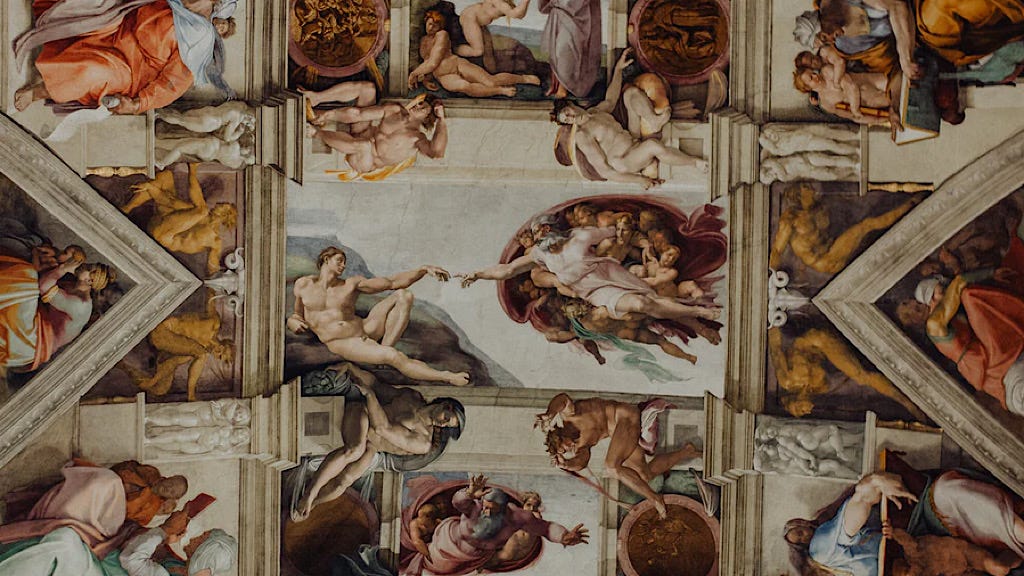
The Catholic Church is a system of power that paid for a lot of art. But, unlike Fascism, they did not curtail stylistic creativity. Take the Sistine Chapel. Multiple artists were employed to create their works in the chapel. They were not asked to change their style to meet the Church’s needs. While there were iconographic stipulations, like Mary wearing a blue robe, you can see clear visual differences between the styles of Perugino and Michelangelo. Famously, Michelangelo went toe-to-toe with the Pope to make the ceiling look the way he wanted.
Fra Angelo is actually an ideal counter to the drawbacks in Fascist art. The Catholic church required Jesus to be on a Cross and Mary to be wearing blue and pink (heavenly and earthly). Fra Angelico's morality certainly came into play with his art, as he was a clergyman. He’d certainly have had personal feelings about faith that impacted his compositions. But it’s not his morality that makes this work interesting. It’s how his treatment of the crucifixion is handled. The figures circle around the cross, with Mary fainting at its base. In looking at the composition, your eye will be drawn to Jesus and Mary. But if you were someone in the Dominican monastery where this might have hung, you’d be praying with this repeatedly. After a few times, you might meditate on Adam’s skull and bones under the Cross. (Jesus was crucified on Golgotha, which is sometimes said to be the resting place of Adam.) Or, you might finally wonder why there is one guy in the back who is looking at his friend instead of Jesus or Mary. These interesting details exist due to Fra Angelico’s creativity (and desire to give mendicants glorious tools for prayer). His patrons valued his creativity and style. The nuance in Fra Angelico’s work would not be allowed if his patron were a Fascist, because it would take away from the point (and take extra time to produce).
Celina goes on to say that I’m moralizing and using weak reasoning to discuss art made not as propaganda but as creativity by people like Dalí. In this, I wonder if her love of Dali is clouding her reasoning. “That is a forceful moral intuition, but it is a weak theory of art. The moral verdict on fascism was already settled by the post-WWII consensus; the aesthetic verdict is not its automatic corollary. I believe her error lies in assuming that because a regime is assumed evil, the forms it patronizes must be artistically null. History offers no such reassurance.” Again, she’s ascribing morality to me that I did not. I didn’t say anything interpretive about the morality that the art portrayed.
Dali’s politics were more complicated than the Encyclopedia Britannica, as she cited, might imply. (I worked on an exhibition about Dalí where his wishy-washy politics are mentioned. Great source.) That issue aside, she again missed my point: art made in the service of a simple political idea is different than art made by artists with bad politics. He did not produce works that were used to replicate fascist concepts in the public consciousness. Dali was not commissioned to make a portrait that sells Fascist ideals. His works, therefore, are not fascist. As such, her continued inclusion of him in support of Fascist art is odd. Does she love that Dali was a fascist (though there are questions on that), love his art, or love that he is a fascist artist?
Celina also uses Dali’s early works as proof of his skill. I’d suggest that she reread what I wrote about Dalí, because that was my argument. Dalí's strongest work comes from his surrealist period when he was in community with others rather than working for a patron.
What I find telling is that Celina never addresses the capitalist half of that comparison. The Hallmark cards are inconvenient to her argument, because they show my argument isn't about fascism specifically, but about what happens when art is instrumentalized under pressure. If I were really just moralizing about fascism, I'd have nothing to say about Hallmark. I said a lot about Hallmark. She skipped it.
But here’s where I know Celina is not being intellectually honest about my argument: “None of this obliges us to admire every work produced under fascist patronage. Some official art under such regimes is indeed deadened by censorship, cliché, and coercive conformity. Yet it is simply false that art becomes inherently inferior because it is clear, ideological, accessible, or directed by patrons.” She actually just summarized my point. In Fascist art, which is specifically art to share fascist messaging, it is censored and coercive, which makes it less interesting. It’s not the ideology. I never said that art is inherently inferior for having ideological underpinnings or being accessible. She chose to add that so that she could construct this false repudiation and stand up for fascist art. I’m not sure if she chose to counter my argument because she love fascists, Dali, or if she didn’t understand my argument.
But her overall claim that all art is tied to power, so therefore fascist art can be good, is truly problematic. Power plays into art, and I bring this up daily in my writings and videos. But by simplifying the message to this generality, we lose the important naunce of my point. Fascists are authoritarians who control the message, simplify the visuals, and define the medium, and in doing so, they often clip the wings of artists. While power always plays a role in art, other systems allow artists to retain their creativity.
What’s most interesting to me about her counterargument is that she also addressed my broader issue with the simplicity of messaging. She decided to counter my argument by arguing against a point I didn’t make. So, to be clear about what this exchange actually is: I made a narrow structural argument about how fascism produces art. Celina responded to a broader argument about whether political art, clear art, or patronized art is automatically bad — a claim I didn’t make and don’t hold. She defeated that claim handily. Unfortunately, it wasn’t mine. Why she decided to go all the way around the wrong way to stand up for fascism is strange.