There are some weeks when my fashion feed feels particularly busy, and this was definitely one of them. With a much-awaited comeback, a controversy that raised some uncomfortable questions, and a celebration where Bollywood brought its festive fashion A-game, there was plenty to pause, scroll back, and look at twice.
Let’s get into it.
Sabyasachi’s return to New York Fashion Week after nearly 18 years was one of those fashion moments that made me stop scrolling.
He chose Christy Turlington to open Bengal Byzantine Broadway on September 15. She walked out in denim, paired with pieces from the new Sabyasachi x The Metropolitan Museum of Art jewellery collection, an unexpected but perfect introduction to the show.
Sabyasachi brought together classic Americana, blue jeans, plaid shirts, denim vests and cowboy hats, with hand-beaded coats, embroidery and the craftsmanship his label is known for.
And then there was the jewellery. Inspired by historical objects and influences spanning Byzantine, Etruscan, Roman, Greek, and Islamic art, the oversized gold-and-gemstone pieces often became the most dramatic part of the runway.
Christy Turlington was also a particularly fitting choice. She had previously closed Sabyasachi’s 25th-anniversary retrospective in Mumbai, while Deepika Padukone opened that show.
For me, the larger idea was even more interesting: Indian craftsmanship doesn’t have to arrive in a sari or lehenga to announce itself. It can coexist with denim, cowboy hats, and Americana and still retain its identity.
Then came the Ralph Lauren debate.
Ralph Lauren is facing fresh criticism over a deep-pink evening gown from its Spring 2027 collection. The heavily embellished embroidery has been widely compared by Indian designers and fashion observers to zardozi, a traditional Indian embroidery technique that uses metallic threads, beads, and other embellishments.
The controversy centres on the fact that Ralph Lauren’s social media post described the gown as having “hand-applied embellishments”, without identifying zardozi or its Indian craft heritage.
What makes the story particularly interesting is that this isn’t the first time Ralph Lauren has faced questions around Indian craft.
Earlier this year, the brand’s jhumka-style earrings were described as “vintage accessories”, prompting an online debate around credit. A ₹44,800 Bandhani-inspired skirt also drew scrutiny for its use of the traditional craft.
And then there was the Prada-Kolhapuri chappal controversy, which raised similar questions about the use of a recognisable Indian craft without initially identifying its provenance.
Now another example has entered the conversation. Industrialist Harsh Goenka posted on September 14 about a Fendi bag he described as a ‘Navratri’ bag, questioning its ₹8.3 lakh price in comparison to what he said was a similar ₹500 bag sold on the streets of Gujarat, and criticised the lack of credit for Indian artisans.
So I find myself asking a slightly different question now: when does inspiration become invisible?
Fashion has always borrowed, mixed and travelled across cultures. That’s part of its history. But when a centuries-old craft becomes simply “embellishment” on a luxury garment, something important can get lost, its name, history and the artisans behind it.
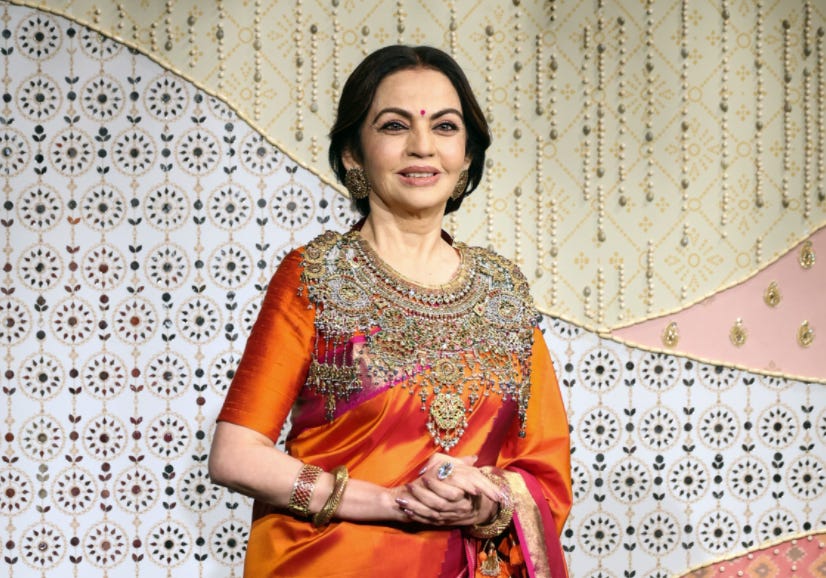
Back in Mumbai, the Ambanis brought their own take on Indian festive dressing to their annual Ganesh Chaturthi celebrations at Antilia. It saw a cluster of stars turn up in their ethnic best. Nita Ambani, meanwhile, drew plenty of attention with her massive diamond necklace, which reportedly took three years and 14 karigars to make.
The evening was also filled with love, bringing together some of Bollywood’s favourite couples for the celebrations. Among the many looks, a few particularly caught my eye. Alia Bhatt made a statement in a metallic ice-blue Masaba Gupta saree, while Kareena Kapoor opted for a mustard Anamika Khanna anarkali. Katrina Kaif brought a touch of sparkle with an olive-green look and mirror-work dupatta, while Kiara Advani kept it elegant in a blush-pink Chanderi saree, paired with an emerald-and-diamond choker.
I loved seeing how celebrities are reinterpreting traditional sarees and suits with modern styling. And honestly, that is the part of festive fashion I love most, finding the balance between “I want to look traditional” and “I still want this to feel like me.”
Putting these stories together made me realise how much the fashion conversation has shifted.
For me, the common thread is craft.
Fashion is no longer just about ‘Who wore it?’ or ‘Where can I buy it?’
People are more aware than ever and increasingly interested in asking: Who made it?’ Where did this technique come from? And what happens when an old craft finds a completely new context?
That, to me, is where fashion gets really interesting.